
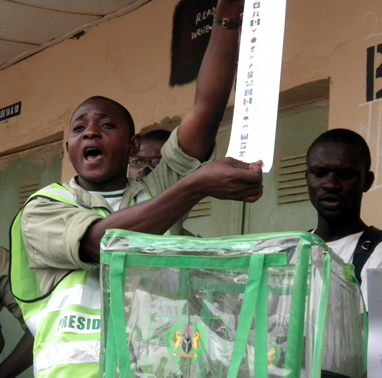
As United States citizens, who have had the opportunity to express their opinions through the (peaceful) democratic electoral process; we often fail to recognize that this opportunity is not available to a vast majority of the global populace.
There are several non-governmental and international organizations who work in countries across the globe in order to guarantee that this opportunity be made available to their citizens. One group, the United States Institute for Peace (USIP), recently served to be an effective facilitator in helping the country of Nigeria to prepare for their April 2011 elections, and safeguard their citizens’ opportunity to exercise their voice in a democratic matter. The reflection of the processes utilized by USIP (found here) proves to be an effective case study in analyzing the means to which countries can utilize to in order to protect their electoral processes, in a country which has historically experienced much turmoil during election season (i.e. the elections of 2007).
The complexity and comprehensive nature of this particular example would be best suited for a more experienced crowd (college level). It can be used as a part of a conflict resolution and international relations curricula, as a tool to understand processes required to promote nonviolence in traditionally violent regions of the world. In this setting, it also serves as a tool of analysis, which can be manipulated by students, in order to understand what (if anything) made USIP’s plan successful. Furthermore, students should be encouraged to critically think about the word “successful” through open dialogue, in order to understand the broader picture of what exactly makes something a “success” in the realm of peace education.
An activity which can compliment this activity is a variation of the View from Windowactivity, also found on USIP’s site. Doing this activity prior to the introduction of the case study provides a smooth segue into understanding why violence often erupts in several countries due to elections; through the realization that everyone has a different perspective, especially in violent situations.
Goal:
A large issue with several educational materials is its applicability to real-life situations (or lack thereof). One can have several tools in their toolbox, but if they don’t know what tool to use with a pan head screw (for example), then their entire toolbox is useless. Utilizing this case study will aid in the development of both critical and analytical skills necessary for real life application, a necessary element to “liberating education” as Paulo Freire mentions in his book, Pedagogy of the Oppressed (1968). Thus, the goal with using a recent case-study in an educational environment will help to provide more concrete skills, for its applicable to situations that can often be very tense and violent in nature.
So, as the Nigerians preached leading up to the April 2011 elections, “B some 1”, and educate for more peaceful (and fair) elections.
 Peace Learner