Abstract Nigeria is Africa’s Midwest region where made up of a complex race of more than 300 tribes. Historically, Nigeria is full of conflicts, including life threatening, others minor and pedestrian. There has been constant conflict among regional tribes due to differences in the level of development , ethnicity and religion. Conflict management requires the application of resolution techniques to regulate these conflicts; and peace-building seeks to develop constructive relationships across ethnic and national boundaries to resolve these deadly conflicts. The government in Nigeria must address the root causes of these conflicts.
Background
The ethnic-religious conflict in Nigeria is divided into southern, middle, and northern regional conflicts depending on the center of the occurrence, and the conflict also varies with regions. In the case of conflicts in the central part of the country, the conflict has become even worse as it overlaps economic issues with the chronic and daily pattern of ethnic-religious conflicts in Nigeria.Conflicts between ethnic-religious communities usually appear in an intensified form. ( Inequality as the northern region lags far behind the southern region, and land disputes among nomadic Muslims and agrarian Christians are the main reasons behind the deepening of the Sino-religious conflict.)In the north, anger over poverty and discrimination combined with the political ideology of Islam, giving birth to Boko Haram, an Islamic political militant group. The Nigerian government claims to have effectively eradicated Boko Haram in December 2015, but fighting has continued in the northeastern region.In the southern part of the country, the central government, led by the northern Muslim-born president, and local armed rebels are confronting each other.
Path to peace Peace building can come in form of direct effort which mainly focuses intentionally on the factors driving or mitigating conflict, in an attempt to reduce structural or direct violence. The Kroc Institute indicates peace-building as “the development of constructive personal, group, and political relationships across ethnic, religious, class, national, and racial boundaries … to resolve injustice in nonviolent ways and to transform the structural conditions that generate deadly conflict”. The U.S. Government and U.S. Embassy in Nigeria work very closely with a number of organizations in Nigeria to protect people and to have respect for human rights. They work with the Plateau Peace Building Agency, by giving grants for the agency’s ongoing efforts to work for peace and dialogue in this embattled state.
Migration is one of the most popular movement that has been widespread around the world. There are many different reasons for the migration such as to find work, education, avoid politics and culture. Particularly in Africa, there are massive population movements; displaced people and labor migrants across national boundaries from the African continent to the Europe caused by poverty, violent conflict and environmental stress. However, many European countries are not willing to allow the African migrant and immigrant workers to join their countries who are mostly the poor people attempting to improve their lives. They think that African migration causes negative influence to the international and capitalist development in Europe. On the other hand, some European historian think that African migration can be beneficial to the Europe that labor exporting movement can improve the economic changes. Under the UN Development Programme (UNDP) report, interviewing 1970 migrants from 39 African countries in 13 European nations, many African migrants did not move to Europe for the job; instead they wanted to earn better lives from the developed countries because they did not have enough food, water, shelter, medicine and education.
Background:
The large scale African migration started
around 200,000 years ago due to the technological innovations that caused the
increase of population and their expansion to the urban areas. For example, 15,000
years ago in Egypt and Sudan, with their development of cultivation using the
way of mechanized farming, damaged environment by reducing arable soil and
causing desertification to spread. Climate changes also have been cause for
migration that drought has forced inhabitants to leave many locations
throughout the continent because of their poor agriculture and water scarcity. After
the end of WW2, some European countries were economically booming because that
local workers could not fill the vacancies and labor reservoirs were limited.
Therefore North-Western European governments headed to Africa to find solutions
from the migrants. During the 15th century, the Portuguese first
arrived on the West African coast for the slave trade and were soon followed by
the Dutch, British and French. The slave trade rapidly developed European
economies and commodities while destroying opportunities for economic and
political development in Africa. Famous historian Walter Rodney viewed slave
trade was beneficial to the European economy, saying that “Europe has developed
by under developing Africa.” Furthermore, there has been a concept of migration
in the past, but it is different from the current concept. While the number of
migrants now increases due to the civil war, food and water shortages, in the
past, Europeans forcibly took and colonized many slaves as they occupied
Africa. Thus, if it was a forced migration in the past, it is now a trend to
move first to find a better lives. Currently, many North African immigrants are
crossing the Mediterranean Sea into Europe. And this issue is considered to be
a very central issue among countries in the European Union, including Italy, France,
Germany, Hungary and Malta, with different opinions on migration. While Italian
officials think that North African Movement as economic migrants, many other EU
states considered it as war refugees.
Economic
Migrants vs. War refugees
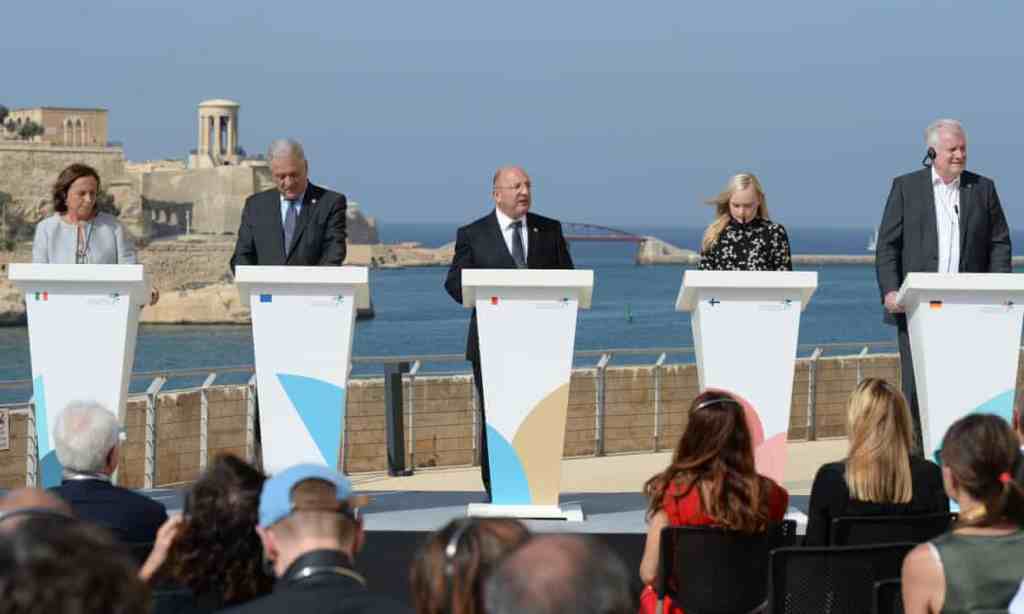
In July 2019, newly elected and re-elected members of European Union Parliament has reviewed EU’s foreign policy to find a compromise throughout the meeting, which includes the issue of irregular migration of North Africans to European borders. This meeting has been took place at the fortified coastal city of Birgu in Malta after Italy’s new coalition government agreed to open one of its ports to a second NGO boat carrying 182 migrants from North Africa. This has been the most complicated and sensitive issue faced by EU policymakers beside the Brexit. While some think that African migration was absolutely beneficial in the past from the labor opportunity and expanding market, in recent days, many EU members think that migration is limiting job opportunities to their national people, fleeing violence, economic decline, persecution and their sizes are expanding tremendously. On 2015, they said, “Europe is longer experiencing the migration crisis.” It is common that most African migrants coming to Europe are desperate people who suffer from poverty and warfare and they are most likely the refugees. They must be repatriated.
Thus, this migration issue has caused
serious controversy between the countries in the European Union. Germany and
France strongly opposed Italy’s acceptance of North African refugees and
migration. Italy has issued temporary residency permits to migrants, stressing
the importance of European and African solidarity. However, other European
Union countries said that if they continue to accept migrants from Africa, more
people will continue to come and damage the European people in economy and
employment.
Speaking
at the annual Atreju’ meeting in the Italian capital Orban said: “if you are
willing to repatriate immigrants, we will try to help with repatriation. Shared
distribution, not. Shared repatriation would be very good.” Oppositions
rejected the idea migration can lead to cultural enrichment, arguing
integration fails and warned migration brings “public safety problems.”
Due to the undecided policy from European
Union on migration, Europe is struggling with rising levels of migrants from
Africa. There are different views existing in the Europe upon the African
migration that some agree with migration that it helps labor shortage and
commodities in Europe, which helps their economic survival. On the other hand
some disagree with continuous migration and illegal immigration that if it
starts to accept, it will continue to accept and it will have a lot of negative
impact on the rights and employment opportunities of the European people. This
argument among European Union member state is still progressing toward a more
standardized EU immigration policy.


 Peace Learner