TeachUNICEF

POSTED ON BEHALF OF KELLY RYAN

One of the challenges for any teacher, practitioner, and parent is trying to find the best way to teach children about those difficult, scary, and challenging topics that are a part of our world. TeachUNICEF is rooted in the Convention on the Rights of the Child (CRC), and provides unique topic and age appropriate activities and lesson plans to help teach children about human rights, armed conflict, human trafficking, and other important topics. Moreover, TeachUNICEF resources are aimed at students in a variety of contexts and locations.

TeachUNICEF is a portfolio of free global education resources. Resources cover grades PK-12, are interdisciplinary (social studies, science, math, English/language arts, foreign/world languages), and align with standards. The lesson plans, stories, and multimedia cover topics ranging from the Millennium Development Goals to Water and Sanitation.

Our mission is to support and create well-informed global citizens who understand interconnectedness, respect and value diversity, have the ability to challenge injustice and inequities and take action in personally meaningful ways. We hope that in providing engaging and academically rich materials that offer multiple voices, we can encourage the exploration of critical global issues while presenting opportunities to take action.”-TeachUNICEF

The lesson plans provided by TeachUNICEF are divided by topic/grade level and by lesson plan, readings, videos, and audio. A Child Rights lesson plan for PK-2nd grade students includes an entire coloring book that encourages students to learn what rights are and why they are given to children. A 9-12th grade lesson plan on gender equality provides students with stories of children from around the world and asks them to chart the trend of girls in primary education programs in the last decade.

The TeachUNICEF map shows viewers how the program is used around the globe. Pins are drawn on a world map to indicate how and where TeachUNICEF implimented. If you click on a pin the website will play a video or direct you to a lesson plan unique to the particular geographic area. This makes the project not only helpful to teach in different contexts around the globe, but it also helps teachers teach their students about issues, challenges, and solutions in schools far from their own classrooms. Similarly, the “Field Note” section allows teacher, parents, and youth to share their experiences and how they are implementing TeachUNICEF.

One of my favorite sections is the “Take Action” page. This section allows the viewer to participate in an active way to accomplish a global goal. Supported by the U.S. Fund for UNICEF, many opportunities are given for students, teachers, or anyone else to participate in advocacy, volunteering, raising funds for projects, and more. This, coupled with the free lesson plans, provides an active learning resource for TeachUNICEF participants.

This program hits on many of the pillars of peace education. However, I think it most directly relates to exploring approaches to peace and skill building. The TeachUNICEF lesson plans address many issues affecting people, especially children, all around the world. As previously mentioned, the lesson plans talk about human trafficking, armed conflict, gender inequality, etc. Many of the lesson plans use narratives of children in conflict or in poverty to show what life is like in their environment. Skill building is also an important part of TeachUNICEF through the “Take Action” opportunities. My favorite is the Trick-or-Treat for UNICEF program which not only raises funds for UNICEF but also raises awareness for its programs.

TeachUNICEF is a wonderful and free resource for all teachers, parents, practitioners, and students. It is grounded in the CRC and uses activity based, reading, visual, and audio techniques to educate students on tough issues. Most importantly, it gives students ways in which they can advocate for peace through action!

Links:

TeachUNICEF: http://teachunicef.org/
CRC: http://www2.ohchr.org/english/law/crc.htm

Technology in the Classroom as a Peaceful Learning Practice

POSTED ON BEHALF OF MARIA SCHNEIDER

I myself am not someone who is fascinated by technology, nor someone who chooses to use it day-in and day-out. I am maybe one of the few people who still do not have a smart phone, an iPad or a kindle and there is something about not owning such devices that gives me peace. Ironic I know because I decided to look into using technology in the classroom as a way to increase peace in the learning environment and cater to learners with all different learning styles. I think that I don’t appreciate technology as much as others because I often do not know how to use programs, devices, websites etc. and that I become frustrated and stop using them altogether.  My frustration however, might not be so strong if I was well versed in how to use programs effectively and incorporate them into different contexts; thus I decided to explore ways to incorporate technology into the classroom to build peace and a positive outlook on learning form the eyes of students.

The eLearn Magazine: Education and Teaching in Perspective http://elearnmag.acm.org/featured.cfm?aid=2047484 features several different blog postings about tools, methods, and resources for educators and facilitators in both informal and formal classroom settings. I found many of the articles to be interesting and provide information that I was preciously unaware of. The Top 100 Tools for Learning http://c4lpt.co.uk/top-100-tools-2012/ also provides a long list of resources that can be used to teach and enhance all different lessons for various age groups.

Though these tools can be used in any setting I think they would be the most beneficial in a formal classroom setting with middle, high school and/or college students, as there is more structure within the allotted time of the class/course. In addition, branching out with various tools and technology helps bring variety to enhance all learning styles and build intelligence in community building, emotional learning and life skills building.

I would use the Top 100 Tools for Learning in group projects, presentations, and as I lead class sessions. Being introduced to meditation and yoga in the classroom I think that Skype is one tool that could be utilized to hold a yoga class/meditation session, iMovie, Garage band and iTunes are programs that could be used to create movies and podcasts and share them with other students. I hope that by incorporating these tools more widely into the classroom that students are able to realize that learning does not occur simply from listening to the teacher, and raising your hand to respond but that it happens collaboratively in different ways that can be interactive and fun as well as educational and academic.

*[One precaution that needs to be taken is realizing that not all student may have access to internet resources outside of the classroom. Because of that it is important that you find alternative routes to using technology in the classroom, media center, renting equipment (high school/college), using community resources at public libraries and community centers. Incorporating these devices and technological programs can be done more often in the actual classroom to eliminate the opportunities for students who do not have access to computers to feel left out from those who do have access.]

This Piece of Bread is an Ambassador from the Entire Cosmos

POSTED ON BEHALF OF KELLY RYAN

One of my go-to forms of meditation and relaxation is cooking and/or baking. I love making cookies, cupcakes, casseroles, and just about anything else that is edible. While some people might not think that chopping, scooping, or measuring are great ways to decompress, it works for me. After the module on meditation and yoga I began to think about other ways that food could be helpful in building serenity and peace. After some investigation I came across Deer Park Monastery’s mindful eating techniques. This process for eating—by yourself or with a community—is a great way to ensure that mealtimes are opportunities for meditation.

Deer Park Monastery is a sanctuary in California that brings together engaged Buddhists and lay followers to learn and grow under their teacher Thich Nhat Hanh. At Deer Park, participants and followers are not just encouraged to participate in the mediation hall or during formal sitting meditation. They encourage mediation in all activities in one’s daily life.

The eating meditation begins with serving. “Serving ourselves, we realize that many elements, such as the rain, sunshine, earth, air and love, have all come together to form this wonderful meal.” Eating is done in silence so that every individual is able to connect with the universe and reflect on their nourishment. Participants focus on several principles while practicing this mindful eating:

  • This food is a gift of the earth, the sky, numerous living beings and much hard work.
  • May we eat with mindfulness and gratitude so as to be worthy to receive it.
  • May we recognize and transform our unwholesome mental formations, especially our greed, and learn to eat with moderation.
  • May we keep our compassion alive by eating in such a way that we reduce the suffering of living beings, preserve our planet and reverse the process of global warming.
  • We accept this food so that we may nurture our brotherhood and sisterhood, strengthen our sangha and nourish our ideal of serving all beings.

The full process can be found online at: http://deerparkmonastery.org/mindfulness-practice/eating-meditation

This website is a great resource for many reasons. For personal use it provides great ways to enrich our individual meditative experiences and incorporate them into our daily routines. It provides some useful resource about the types of meditation practiced at Deer Park as well. It is also a great resource for teachers, educators, and practitioners trying to incorporate mediation into their classrooms or with their participants. Beyond the eating meditation, the website gives helpful meditation techniques for breathing, sitting, embracing anger, walking, and even hugging.

I chose to focus on eating meditation because it has a direct environmental component; it seems to bridge our meditation and environmental modules. Too often I—and I assume others—rush to eat our food so we can move on with our day. Taking time to understand how it impacts our bodies, nourishes us, and fuels us is crucial. Moreover, eating meditation allows us the time and space to reflect on what the earth has given us, what we have taken from the earth, and how we can become better stewards of the earth through our direct consumption.

This meditative practice can be used in any classroom I think. While I’m not a teacher, I remember how much my classes loved when our teachers brought food to share! A great way of practicing this meditation would be to encourage a snack day or just bring snacks to class for your students. Go through the meditation and ask your students to reflect on how the food went from the soil to their hands. Encourage them to contemplate the people needed to harvest the food, the process of cleaning/preparing the food, material used to wrap/package the food, the vehicles and fuel used to transport the food, and how the food got from the store to their hands. While every student may have different visions of the food process, of their nourishment, and of the impact food consumption has on the environment, this is a great visual and tactile way of teaching both mediation and an appreciation for the earth.

This hits on many of the pillars of peace education but I think it specifically speaks to skill building and nurturing emotional intelligences. This activity builds on meditative skills that are important to personal, academic, and professional development. It provides students with a way to practice meditation in their daily routine. Additionally, it supports emotional intelligences by promoting time and space for individual reflection on something as personal as eating and consumption.

This mediation might not be for everyone. Some people might find it hard to be silent during eating, especially if eating is a time of community building. However, it is one way of utilizing a standard routine (eating) and transforming it into a meditation practice. I encourage everyone to try the meditative eating and to build meditation around other daily activities in their lives.

Men Make a Difference in Prince Georges County

POSTED ON BEHALF OF MARG BRENNAN

Every year in October, Prince George’s County schools participate in National Men Make a Difference Day throughout different schools. Below are two news briefs, photos, and a slideshow about the event that were released by the county:

http://www1.pgcps.org/communications/press.aspx?id=165385

http://www1.pgcps.org/communications/press.aspx?id=164724 (various events throughout the day)

https://picasaweb.google.com/PGCPSphotos/2012MenMakeADifferenceDay?authuser=0&feat=directlink

At my middle school, the event runs for the entire day. Fathers, uncles, siblings, cousins, and many other community members are invited to come in for breakfast, participate in workshops throughout the day, and attend or participate in any student classes. We had over 100 participants this year (which in the three years I’ve been at the school has been the greatest turnout yet) and my students thoroughly enjoyed bringing guests into the classroom and interacting with the other participants. Some spoke about their careers or families and answered any questions that students had.  Participants could join the children for lunch and they had a closing lunch provided for them, as well as a round-table discussion with students. Some of the participants were already established mentors within our community and informed students of resources available to them.

I think that this event can be incorporated into any subject or class. As a math teacher, I really enjoyed having the participants in and out of my classroom all day, but I would have said that regardless of the subject I teach, as their contributions really didn’t have much to do with math specifically. With more planning, I think that these participants could be incorporated into subject-specific lesson plans, but it was definitely not necessary to do that.

Many of my students do not consistently have a positive male role model and most responded very well to the visitors in the classroom. For these students in particular it was helpful that some of the participants were established community mentors and it opens some doors for students outside of school. Because many of our guests spoke to students about careers and future decisions, the type of event we planned I think works best with middle and high school students, who have the capacity to have those conversations; the same type of event could definitely be used with younger children as well, who are just as much in need of the mentoring. The formal educational setting worked well, although I could definitely envision this in a less formal community venue as well.

In my opinion, the potential for the knowledge, skills and attitudes that students could develop from participating in this event and engaging with the guests is significant. I speak to many parents and guardians that start conversations with something like, “Well I’m trying my best, but I’m working two or three jobs and it’s just me.” I have several students who don’t have the opportunity often to have meaningful conversations with adults beyond their teachers and this provides the opportunity for them to really learn from others in their community. Students learn about opportunities to become involved in events outside of school – many are not involved in sports, after-school activities, or any outside activities and end up with a lot of unsupervised downtime; they are exposed to different opportunities with events like these.

From my vantage point, this event supported multiple pillars of peace education, but I saw the most from Community Building (as discussed above) and Skill Building. Some of these role models really went above and beyond and discussed relevant issues with students.  I watched some of my more resistant students open up, even if it was only in the form of letting them help them with classwork. I am often asked when “so and so’s dad” or “that police officer” will be coming back to the room. They touched on things like conflict and related it to when they were in middle school or trying to fit in and figure out who you are. For many of my students, this message, and especially where it was coming from – men from their community that they were able to relate to – had an impact. My students are at an age where they start to make decisions that will have a lasting impact on the rest of their lives and they often do not have the capacity to make the best decisions in those situations. This program, which I wish happened more often, plants some seeds for more informed, thoughtful decisions.

All Natural Beauty Products

POSTED ON BEHALF OF BETH JIMERSON

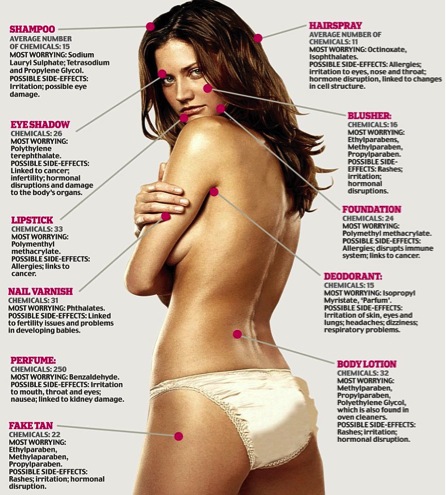
Take a look at the alarming picture above. It points out the large number of chemicals that most of us come into contact with on a daily basis. How many chemicals do you recognize or come into contact with every day?

Not only do the chemicals found in everyday household and beauty products harm our bodies, but they also harm the environment. After being awakened to the alarming number of chemicals found in everyday products that we actually put onto our bodies on a daily basis, I decided to do some research into what exactly those harmful chemicals were, in order to avoid them. I then decided to go one step further to find natural ways to produce my own products as alternatives both to get away from the commercialism involved in beauty products and also to save some money, and the environment! Although this started out on more of a personal journey to health and well-being, I started to see the bigger picture of creating less waste and allowing fewer chemicals into our environment. The link below shows one of the websites that I found most useful and interesting, though there are many if you search around:

http://tlc.howstuffworks.com/style/50-all-natural-beauty-products-you-can-make-yourself.htm

The chart (perhaps minus the half-naked model) could be used to exemplify some of the harmful chemicals that we come in contact with on a daily basis and start dialogue about what other products might contain these chemicals (such as cleaning products?). As the beginning of a lesson, students could check out the labels of products they use daily or ones that are in their cupboards for any of the above chemicals. They will probably be surprised at the amount of chemicals they come into contact with on a daily basis! They could then look at natural alternatives and decide what natural products have which properties. For example, one of the products often found in natural beauty aid is lavender. A quick search even on Wikipedia highlights the benefits of lavender as:

believed to soothe insect bites, burns, and headaches. Bunches of lavender repel insects. In pillows, lavender seeds and flowers aid sleep and relaxation.[9] An infusion of flowerheads added to a cup of boiling water is used to sooth and relax at bedtime[citation needed]. Lavender oil (or extract of Lavender) is used to treat acne when diluted 1:10 with water, rosewater, or witch hazel; it also treats skin burns and inflammatory conditions.[citation needed] A recent clinical study investigated anxiolytic effects and influence on sleep quality. Lavender oil with a high percentage of linalool and linalyl acetate, in the form of capsules, was generally well tolerated. It showed meaningful efficacy in alleviating anxiety and related sleep disturbances.[18]Lavender can be used to treat different types of cancers, such as, breast cancer, ovarian cancer, prostate cancer, pancreatic cancer, and liver cancer. Although it has not been completely proven that lavender is effective towards these cancers, many studies have shown that lavender has led to disease stabilization or tumor regression.[19]Lavender may be very effective with wounds; however, Lavender Honey (created from bees feeding on lavender plants), instead of lavender essential oil has the best effects of uninfected wounds. (http://en.wikipedia.org/wiki/Lavender)

Students can explore using the recipes in the website, finding their own websites, or even experimenting with developing their own natural products through careful research on the different properties of natural products. It is important to point out that there can be negative effects of certain products as well, and allergies related to them. Even something as seemingly innocuous as lavender has shown to have the following negative effects:

Lavender oil can be a powerful allergen, and it is also recommended that it should not be ingested during pregnancy and breastfeeding.[21]

In vitro, lavender oil is cytotoxic. It increases photosensitivity as well. Lavender oil is cytotoxic to human skin cells in vitro (endothelial cells and fibroblasts) at a concentration of 0.25%. Linalool, a component of lavender oil, may be its active component.[22] Aqueous extracts reduced mitotic index, but induced chromosomal aberrations and mitotic aberrations in comparison with control, significantly. Aqueous extracts induced breaks, stickiness, pole deviations and micronuclei. These effects were related to extract concentrations.[23]

However, according to a 2005 study “although it was recently reported that lavender oil, and its major constituent linalyl acetate, are toxic to human skin cells in vitro, contact dermatitis to lavender oil appears to occur at only a very low frequency. The relevance of this in vitro toxicity to dermatological application of lavender oils remains unclear.”[24]

In terms of phototoxicity, a 2007 investigative report from European researchers stated that, “Lavender oil and sandalwood oil did not induce photohaemolysis in our test system. However, a few reports on photosensitivity reactions due to these substances have been published, e.g. one patient with persistent light reaction and a positive photo-patch test to sandalwood oil.”[25]

In 2007, a study was published in the New England Journal of Medicine which indicated that studies in human cell lines indicated that both lavender oil and tea tree oil had estrogenic and antiandrogenic activities. They concluded that repeated topical exposure to lavender and tea tree oils probably caused prepubertal gynaecomastia in some boys.[26] The Aromatherapy Trade Council of the UK has issued a rebuttal, [27] and it is also disputed by the Australian Tea Tree Association, a group that promotes the interests of Australian tea tree industry.[28](http://en.wikipedia.org/wiki/Lavender)

Also keep in mind that more extensive research can be done on the properties of such oils.

This exercise or one similar to it touches on the pillars of exploring approaches to peace by looking at peace as an environmental standpoint, and skill building by building, practicing and adopting life skills that bring about peace through attention to our environment. As is stated in our module on peace through environmental education, many agree that “life on Earth has entered its most precarious phase in history.” Environmental education considers how to balance respect for nature and its sustained health with human needs. While we might argue that we need certain products to feel good and feel good about ourselves, there are options to do so without harming our bodies or the environment. I challenge everyone to try just one of these recipes and cut out some amount of harmful chemicals from our daily routines not just for the environment, but for ourselves!