Mentoring Peace Through Art

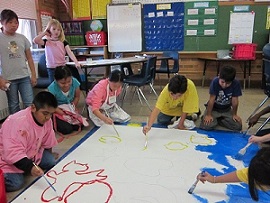
While searching for innovative ways to teach and promote peace building, I came across an organization that not only achieves these goals, but that also allows young people to explore their creativity. Mentoring Peace Through Art is a Minneapolis based non-profit organization founded by Jimmy Longoria and Connie Fuller. The organization develops art projects aimed at elementary to high school kids throughout the diverse and troubled areas of Minneapolis. They provide the children with opportunities to explore their artistic and creative abilities while promoting peace.

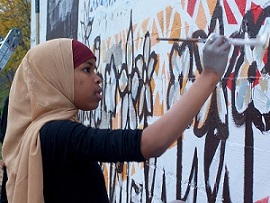
MuralWorks in the Streets” and “MuralWorks in the Schools” are the two programs made available by the organization. “MuralWorks in the Streets” takes teens to the streets to make over walls ruined by gang graffiti by replacing them with beautiful, colorful art. According to the organization’s website, they have successfully remade 11 walls across the city as of 2012.

MuralWorks in the Schools brings art projects into elementary schools to teach children peace through activities that promote teamwork. Each project assigns individual students with tasks that contribute to a final product.

These programs not only teach young people about team work and the power of art, they also help keep them away from unlawful activities and guide them in positive directions. The efforts made by the organization can help to identify, engage, and promote future leaders while bringing peace to the community.

When, where and in what setting can these programs be used?

I believe that the ideals of Mentoring Peace Through Art and its programs can be applied to any educational setting. Since the main goals of the organization are to promote peace and build cooperation, any member of a community can take part in creating murals and art projects. The great thing about these programs is that they use a tool that is accessible to everyone, art. Allowing people to work together and express their individual creativity while creating artistic pieces that are representative of the community is the perfect way to teach peace. Since these programs have been successful with children and teens in troubled areas, there is a likelihood that it can be successful for people of all ages in various parts of the world.

How these programs can be implemented?

To implement these programs and really make sure they’re beneficial, educators should have strong connections to their communities and their community leaders. They should be well-connected in order to identify areas that need attention and intervention. Additionally, good relations with community leaders can help in gaining the support of the community as a whole. Educators should also be knowledgeable about art in order to develop projects that successfully promote positivity and peace. Strong leadership and communication skills are also important. Several of the seven pillars of peace education can be applied to these programs. Community-building, skill-building, engaging multiple intelligences, and nurturing emotional intelligence can be used with these programs. For example, by engaging people’s creativity, the art programs are able to focus in on engaging multiple intelligences as well as nurturing emotional intelligence.

Through the art programs, both children and adults can gain artistic, social, and team-building skills. In addition, they can learn to appreciate their communities and understand the importance of strengthening them.

Who will benefit?

Although the programs offered by Mentoring Peace Through Art can be beneficial for all, there are two groups they can be especially beneficial for. I think that they can be used by people of troubled areas all over the world. For example, community leaders and educators from cities with violence can take advantage of this program and prevent young people from following those violent paths. Since children are impressionable, educators can implement art programs to show them that they are capable of achieving anything. The programs can open their eyes to the possibilities they have before them. Another group that may benefit are adults who have struggled with the law. I think that these programs can be turned into rehabilitative resources for them. To prevent violence in troubled areas, it it also necessary to give attention to the sources of the violence. The programs can serve not only as outlets for these people but also as resources that allow them to build friendships and connections.


Website: http://www.mentoringpeace.org/

Expression of Peace through Art

The workshop we all were gratefully a part of last weekend taught me a lot about how to approach peace building. A couple of pillars/ideas that have been stuck in my head are community building and exploration of approaches. Creative peace building has been popularized through art therapy. Art is an expression of feelings and emotions. What art therapy does is give people or a community a way to express their feelings, especially after or during a time of crisis and conflict.


Barefoot Artists is an organization that promotes peace through art. www.barefootartists.org


The organization gives struggling communities access and resources to create art, and every community would have its own distinctive expression. This empowers the people through their own indigenous art and culture. The form of art is usually visual art (drawings, paintings, building, etc.). It allows people to find peace within themselves by expressing their emotions through a visual form. By doing it, people in the community are forced to work together and form a stronger relationship with each other. The organization has transformed a conflicted and struggling community to a stronger, more expressive, and more peaceful one.

One of the things that they have done is transform a mass grave of slain people in Rwanda into an artistic memorial, which the people in the community have highly appreciated. Lily Yeh organized and trained the village people before together they built and crafted this memorial. http://barefootartists.org/projects/the-rwanda-healing-project/genocide-memorial-park/


Educational Setting


I think this resource can be used in various places. Though this organization mostly focuses on international extreme conflict communities, it can be incorporated in a basic classroom or a community in a developed country that may have been hit by a tragedy. A lot of times, kids cannot express their sad feelings through words, and art is a great device to do so. A community such as Newtown, which has been struck by a tremendous tragedy, could be an ideal place to implement this resource.

I would recommend art therapy to elementary school, middle school, high school, and a larger community.


Implementation


For an educator to implement this resource, he or she must acquire art resources (knowledge, people, and tools). Some art experience or skills are required for this to work. As an educational leader promoting art as an expression, he or she needs to be able express his or her own feelings visually. A leadership skill is highly essential to the success of this method. Moving a large group of people that have been struggling from a conflict or a tragedy is not an easy task. This requires a great communication skill. One needs to be able to speak through people’s hearts and somewhat understand their pain.

Multiple intelligence is the applicative pedagogy in this resource, because it requires one to be a proficient and talented educator to be able to execute this.


For people who have been struggling as a community or a group from a never-ending conflict, traumatizing tragedy, and fear of the future, this is a resource that could open your eyes. One simple thing can really make a difference. We never want our communities to be haunted by horrific history; we do not want our kids to grow up only remembering a tragedy and be afraid every day. Art allows us to stand up and express that we want peace in our lives.

Image


Move This World: Peace Education Through Movement

While attending the Peace Education Exploratorium this weekend, I had the opportunity to learn about many different pedagogies of peace at work in the world today. The role of sports and peace education specifically piqued my interest as one of the guest facilitators, Amanda Munroe, spoke about her involvement with  Move This World, formerly Dance 4 Peace. 

Here is a short video about Move This World’s work. Move This World Video! 

Move This World is a non-profit organization dedicated to using creative movement to transform conflict, violence and bullying in communities around the globe.  Move This World created an innovative curriculum focusing on fostering empathy, mediation skills, diversity appreciation, anger management and conflict transformation. With a need for peace intervention at all levels, Move This World operates with grade level specific curriculum. The curriculum theme for each age group can be viewed by clicking here! 

Founder, Sara Potler, began the program with youth in Bogota, Colombia. Promoting peace through dance, Potler began the formation of the idea that movement can be used to create peace. Today Move This World works internationally in Colombia, Germany and the Philippines and stateside in Baltimore, Newark, New York City and Washington, D.C. Move This World employs several different peace pedagogies. By working and learning students with whom we are learning with, community building is a play. By moving and working together, relationships between peers can strengthen and encourage a community of peace. The second pillar of peace pedagogy, engaging in multiple intelligence’s is played upon. Through movement via sports, dance or whatever gets students flowing you can engage in the body, music, naturalist and interpersonal multiple intelligence’s. By accessing these intelligence’s, students are able to experience alternative forms of education. These tools enable students to benefit by stretching their skills into multiple forms of intelligence’s. 

Ways to use this resource – Elementary & Middle School 

Incorporating movement in the classroom is the first step in introducing peace pedagogy into the classroom. By looking at the curriculum themes for each grade level, teachers can gear their lesson plans to whichever activities best fit their classroom.

Ways to use this resource – High School

While kindergarden through eight grade focuses on key themes to teach students, the high school curriculum focuses on facilitating students own leadership and peace building skills. The first semester hones in on understanding emotions, conflict and cultural diversity. With an entire semester of immersion into conflict resolution information, the second semester is geared towards fostering students own leadership capacity as they grow to be peace-makers in their own community. 

During high school I was involved in the PALS, Peer Assistance and Leadership, which fostered parallel goals as Move This World focuses on during primary education. This program was brought to my high school by the administration in hopes of reducing the increasing amount of violence. While other non-violent programs were simultaneously put in place, as the development of the PALS program increased the violence occurring within the school decreased.  To learn more about training opportunities through PALS, click here. 

Ways to use this resource – Become a Partner! 

If your school or organization desires to facilitate peaceful change through movement, please sign up to receive more information from Move This World by clicking here. Move This World works in Colombia, Germany and the Philippines and stateside in Baltimore, Newark, New York City and Washington, D.C. If your school or organization is outside these regions, Move This World provides many beneficial tools to use in your classroom, as well as great curriculum models to follow. 

The Playing for Change Foundation: An Innovative Approach to Peace Education

The Playing for Change Foundation fosters positive social interactions among at-risk youth through music education. Students have the opportunity to learn and play music with their peers in a safe environment, establishing community and peace building for youth suffering from poverty, infectious diseases, conflicts, genocide, etc. The foundation currently has 8 schools dedicated to fulfilling this mission in Mali, Ghana, Nepal, Rwanda, and South Africa. More information about this initiative can be found on their website: http://playingforchange.org/mission.

     This project can be expanded to elementary, middle and high school students in America. Many schools have had to cut their music programs due to a lack of funding for instruments, but I believe these programs can be just as important as the other essential subjects mandated in K-12 education. Playing an instrument can generally help improve students’ performance in math, in addition to introducing them to various genres and international music. It also offers a creative outlet for students to engage in, helping demote violent behavior and activities in and outside of the classroom. As a student, I recall required music education sessions in elementary school. By middle school, music lessons were no longer required, although concert band was an option. All participants were responsible for renting or purchasing their own instrument. Having free access to instruments, as demonstrated through the Playing for Change Foundation may create higher participation for students whose families are financially unable to provide them with an instrument. By increasing the number of music programs in schools, students, particularly at-risk youth have a safe space to engage in teamwork and personal growth. Learning an instrument and being creative does not only have to be an activity for small children; all age groups should be encouraged to participate in the fine arts and have the ability to do so.

     The concept of PFC does not have to be exclusive to schools. Camp counselors, Sunday school instructors, and other leaders can integrate music into their programs. It will be important for any instructor to have access to a variety of instruments, such as guitars, pianos, drum sets, xylophone, tambourines, etc. Guest instructors with a background in music should be invited to teach the students how to play the instruments. A small 20-30 minute session can be set aside for this activity during any given time of instruction. Students should be encouraged to create a song together in order to promote teamwork and to perform their song in front of their peers to boost self-confidence. Students who become passionate about learning, creating, and playing music will be likely to engage in music outside of the classroom, helping them refrain from violence when they are feeling bored or when facing a personal struggle.  

     The multiple intelligence pedagogy is relevant in peace building through music education. Some students are visual learners and may prefer to learn a song by reading the notes or studying written instructions. Others may learn by doing, i.e., watching someone else demonstrate how to play a song on their own instrument and then trying it themselves. Other students may be auditory learners, being able to pick up an instrument by ear or following spoken directions well. Regardless of how each student learns how to play their instrument, they all learn peace building, even if they are unaware of this, by working together as a team and being patient with each other’s different learning styles and pace of comprehension of new material. Students will not only leave their lessons with new music skills, they will have the skills to be more effective communicators by helping their classmates if they do not understand something. Having fun together while creating community may also be a gateway toward positive attitudes about collaboration, taking turns on instruments, and being patient as each participant learns through their own unique style.   

     Two stakeholders who would benefit from this resource are music teachers at my local high school and camp counselors for elementary and middle school-aged students. Music teachers can benefit from this resource by implementing these activities in their schools. They can collaborate with community centers or instructors at other schools to create after-school activities if there is not sufficient funding to hold a program in every institution. A camp counselor can utilize this resource by holding music sessions in addition to other daily activities. Camps usually foster the ideals of sportsmanship, teamwork, and leadership in the participating youth, so learning and creating music would be a great way to emphasize these concepts. Competitions between small groups of campers of the most creative song, as voted on by the entire group, can help promote sportsmanship. If students need assistance reading notes or finding the correct key on their instruments, other students can exemplify teamwork and leadership by helping them.


Roots Of Empathy – The Education of the Heart

Ken Robinson in a very charismatic talk at the Dalai Lama center for Peace+Education in 2011 claims education should be not just the education of the mind, but the education of the heart and I wholeheartedly agree. Particularly in relation to Peace Education and nurturing a civil society of responsible and caring citizens, the education of the heart and how to “feel” is just as important. We focus a lot of our educational energy on lecturing on the outside world and I believe Peace Education is the necessary inverse – it invites students to turn their gaze and perspective inward. They key to this inverse is the connection between humans and the power of empathy. In conflict we shut empathy off but empathy holds the power to solve conflict! There are numerous scientific studies that show the student’s early environment plays a large role in who they become as they grow, so this has become common knowledge. Empathy and nurturing emotional intelligence is one of the seven pillars of Peace Education and can be cultivated and groomed at different levels in the classroom. This was absent and not seen as important in my early childhood education, but it was in the household and this can vary from student to student. It is the role and duty of Peace Educators to foster a sense of empathy or increased emotional intelligence in our students and be part of the solution.

Sir Ken Robinson – Educating the Heart and Mind

https://www.youtube.com/watch?v=I1A4OGiVK30 (more specifically the last 10 mintues or so)

“Roots of Empathy” is a unique and award winning yearlong charitable program that is actively part of the solution in a desensitized and emotionally out of touch society. It takes place in a Elementary through Middle schools and has programs available globally. It has been researched and has been proven to create significant change in participating schools. The program pillars are specific and include Emotional Literacy, Neuroscience, Temperament, Male Nurturance, Inclusion, Infant Safety, Perspective Taking, Prevention of Teen Pregnancy, Attachment/Attunement, Participatory Democracy, Infant Development, and Violence Prevention. Instead of targeting violence, bullying, and aggressive behavior directly the program takes a holistic approach and engages all the students in the classroom.“Roots of Empathy” focuses on the relationship between parent and child and gives students the opportunity to observe an infant and its development. This program is at its core a reflective practice, because the students are actively identifying problems with their child and solving them, which effects the way they solve their own problems and manage their own relationships. The program is very personal and children very quickly learn through this program their own temperament traits and the situations that may spike or increase the chances for conflict.

Roots Of Empathy

– A more in depth video

There is a healthy amount of useful information and great resources on the site as well as contact information if you or a school around you is interested in running the program. Many of the activities like asking the students to depict creatively episodes when they felt afraid or helpless and using the community to help create an atmosphere of social responsibility are activities that can be incorporated in any classroom at any level.

Home

Humans uniquely possess the ability to empathize with others, including non-humans. We must embrace this distinct trait and connect students with themselves and their feelings, so they can go on and empathize with friends, family, and people on the opposite side of the globe. If we are to create a future culture of peace, we must start with the future, the children and the power of empathy can go a long way.

Fostering Peace Building Strategies in Youth

The National Crime Prevention Council offers a variety of lesson plans for students based on grade level. I found one that is tailored to teach children in kindergarten and first grade the basic concept of conflict and the benefits of settling them justly and quickly. The full activity can be found here: http://www.ncpc.org/topics/conflict-resolution/activities-and-lesson-plans/conflict-management-grades-k-1. Students are asked to express how they would feel when a conflict is not solved fairly and to brainstorm ways that they can do so in response to a variety of scenarios. The instructor then introduces resolution methods and examples that accommodate the age group, such as chance, taking turns, apologizing, and sharing. The children are asked to brainstorm their own examples of conflict, which they practice solving with the aforementioned methods.

I believe this lesson plan can be used to teach children peace building strategies at any elementary school level. The examples of the resolution methods can be altered according to the age group so they can better relate to the scenario. Some children may remain vulnerable to bullying and violent approaches to conflict after first grade; therefore, reinforcing these essential methods can make a significant difference in a child’s life.

How this resource can be used to teach children conflict resolution

This lesson plan teaches fundamental character and behavior, such as fairness, kindness, and sharing as conflict resolution strategies and can be conducted in a normal classroom setting. Educators may thus find this exercise especially relevant when they are focusing on the Six Pillars of Character in their regular lesson plans. No special materials are needed for this activity and at least 30 minutes should be dedicated to it.

This peace building activity pertains to the skill building and nurturing emotional intelligence pedagogies for conflict analysis and resolution, which are the ultimate goals of this exercise. Skill building is established when students utilize nonviolent approaches to conflict, such as listening, recognizing and accommodating each individual’s needs, and negotiating a resolution based on the identified needs. Strengthening these skills at a young age will help students be effective in conflict prevention and resolution as adults, allowing them to identify a problem as it escalates and applying their skills to develop methods to subdue it.

By asking students to identify how they feel during a conflict that produces an unfair outcome, they become more emotionally intelligent. Children who can express their feelings and understand why they feel upset or content during a conflict may find it easier to be aware of why others are feeling the way they are and how they can better accommodate each aspiration, including their own, during problem solving. Students with a firm emotional intelligence may also be able to better control negative feelings that provoke violence. This serves as a gateway for them to integrate their problem solving skills into the situation.

Through this activity, students will ultimately learn to approach a situation with a positive attitude and with the intention of resolving the conflict non-violently. In addition, children who are introduced to peace learning strategies may be less inclined to engage in bullying and more likely to use peaceful tactics if a conflict should arise. Two stakeholders whom may be able to effectively apply this activity into their lesson plans are kindergarten and first grade teachers at a local elementary school and my former kindergarten teacher who now serves as a guidance counselor. I will reach out to each to raise awareness about the conflict resolution tactics that their students can benefit from in this lesson.

Theories of Change in Education

Theories of Change in Education

Change Theories in Education

Posted by

By Merrilee Henk, WTWL Writer

Merrilee3Merrilee Henk is a teacher and life long learner. She has a background in psychology and emotional and behavioral disabilities. Merrilee currently teaches elementary special education and is working on her doctorate in education. She has written numerous articles on parenting, discipline, behavior modification, and other child related topics. Merrilee gives presentations for the Wisconsin Public Library Summer Reading Program for Children and recently began writing for eHow. Follow these links to view non-teaching related articles by this author: How to Attack the “After Christmas Naughty” and How to Change Your Life. . .Pick Your Vice.

Public education has been evolving with society since its conception, and reform efforts continue to drive that evolution. Reform efforts that do not address reform from a systemic perspective have overwhelmed public education institutions (Gabriele, 2000). Ravitch (2004) described the existing failure of many reform efforts as, “… forgotten innovations [that] continue to live in schools where they were introduced with great fanfare . . . schools are like archeological sites; digging would reveal layer after layer of fossilized school reforms and obsolete programs” (as cited in Jones, 2007, p. 189).

Different theories approach systemic educational change from varying philosophies, strategies, models, and methods (Gabriele, 2000), searching for the theory that will create conditions necessary for systemic change. Gabriele declared these conditions to include an “ideal-based, holistic, continuing, participatory, user-friendly, easy to adjust/improve, and emancipatory” for effective change to occur. Three theories of change utilized by school districts are institutional theory, free market theory, and round table theory.

Institutional Change Theory

John Meyer and colleagues developed the institutional change theory in the 1970’s (Huerta & Zuckerman, 2009). Institutional change theory is a framework based on the relationship between schools and their cultural environments. Society’s cultural norms shape organizational structure by encouraging schools to conform to the accepted rules and rituals of an institution. Scott (2003) described institutional theory as “[emphasizing] the influence that an organization’s cultural environment has on organizational structure and behavior, and it seeks to understand the ways in which cultural rules from the environment shape or constrain organizational action” (as cited in Huerta and Zuckerman, p. 415).

Established institutions, operating with rules and rituals that have come to represent legitimate schooling, become role models for other institutions seeking legitimacy. But not all institutions want to maintain the status quo and are constrained by societal and institutional norms. Huerta and Zuckerman (2009) cited the example of charter schools seeking to break away from the “long-standing institutionalized patterns of teaching and learning…” (p. 416). The institutionalization of the public school system has provided direction and limitations concurrently.

Free market theory

The free market theory proposes that educational change occurs as schools compete for excellence (Marion, 2002). The assumption that all schools begin with an equal opportunity to achieve excellence is attractive to proponents of school choice because it justifies the removal of their children from a failing school to one of greater success. According to the free market theory, the blame for failure lies with the school district.

Adnett and Davies (2000) and Lubienski (2006) proclaimed that federal regulations make it impossible for educational institutions to be genuine free markets, resulting in the failure of the free market theory in educational change (as cited in Eyal, 2008). Eyal deduced that a free market system, if possible to create in the public school system, would fail to produce significant change because the characteristics of the free market system would not create an environment conducive to change.

Roundtable Theory

The roundtable theory (RT) is a shared leadership theory for school change. Gabriele (2002) explained RT as distributing leadership and learning equally across participants. Involving stakeholders in the decision-making process through shared leadership can lead to higher levels of commitment. Gabriele described the ideal RT practice as being run according to a Leader’s Guide developed by consensus and periodically reviewed. The RT sessions would include a reading and review of literature on a topic during a 60 minute session, a time for participants to respond individually and uninterrupted by other members, and all participants would have an equal voice.

A change theory positively focused on strengths, rather than problems would be an ideal choice for school change. Gabriele described the RT model as based on achieving an ideal state, including all stakeholders, and being conducted within the regular school day. RT is an on-going process allowing schools to progress toward excellence. Gabriele noted that RT is a research-based model proven to lead organizations toward the “self-transformation of participants and goal attainment.
Discussion

Change will affect staff regardless of the change theory chosen or the changes proposed. Bueker (2005) stated, “One of the most difficult aspects of implementing a whole school reform is striking a balance between proper program implementation and individual teacher flexibility” (p. 411). Bueker noted that empowering teachers, treating teachers with professional respect, and providing structured and continuing support for staff, could minimize the negative effects of school change.

National trends, such as the accountability movement and federal mandates like the No Child Left Behind Act, can prescribe change. H. K. Meyer and Rowan (2006) described the affect that trends can have on education when they stated, “we might apply new institutional constructs that can account for both an evolving theory and its application to changing policy contexts, including the “tightening control of government over the core technology of schooling” linked to standards and accountability reforms” (as cited in Huerta and Zuckerman, (2009), p. 417). The choice for school reform can be beyond the control of the school district, the administration, and the teachers it will affect.

Conclusions

School change is constant. Eyal (2008) suggested, “despite the prevalent image of public institutions as highly conservative and stagnant, it might be interesting to investigate their potential as sources of innovations that are no less radical than the alternatives proposed by free-market ideologues” (p. 487). School reform creates stress on all stakeholders and requires careful consideration of theoretical framework. Vernez, et al. (2004) reported that there is little evidence to support the validity and effectiveness of many school reform initiative policies, which makes research of the different strategies essential.

An analysis of change theory models prior to setting a course is critical. The RT model described by Gabriele is research-based and proven to be an effective school change theory. The effectiveness of the RT model in practice, during the call for reform to meet the skills of the 21st Century, warrants further research on the applicability of RT in meeting the educational needs of the future. School structure will continue to evolve, and the reform theories proven effective by research will continue to be refined.

References

Bueker, C. (2005). Teachers’ reports of the effects of a whole-school literacy reform model on teacher turnover. Elementary School Journal, 105(4), 395-416. http://search.ebscohost.com.ezproxy.apollolibrary.com

Eyal, O. (2009). Degeneracy, resilience and free markets in educational innovation. Systems Research & Behavioral Science, 26(4), 487-491. http://search.ebscohost.com.ezproxy.apollolibrary.com, doi:10.1002/sres.940

Huerta, L. & Zuckerman, A. (2009). An institutional theory analysis of charter schools: Addressing institutional challenges to scale. PJE. Peabody Journal of Education, 84(3), 414-431. http://search.ebscohost.com.ezproxy.apollolibrary.com, doi:10.1080/01619560902973621

Gabriele, S. F. (2002). The “roundtable” for school learning and planning groups: Planting a seed for systemic renewal. Kybernetes: Special Double Issue: Systems and Cybernetics: New…, 31(9/10), 1361-1368. Retrieved October 10, 2009, from Research Library. (Document ID: 277870851).

Marion, R. (2002). Leadership in education: Organizational theory for the practitioner. Long Grove, IL: Waveland Press, Inc.

Jones, B. A. (2007). “Table top theory” as a policy framework for gauging the confluence of teaching and private sector interests. Teacher Education Quarterly, 34(2), 185-204.

Related posts:

  1. Empowering Change in Education Teachers in every district face the frustrations of working under…
  2. Radical change and wikis: teaching new literacies. Luce-Kapler, R.  (2007, November).  Radical change and wikis:  teaching new…
  3. The Edge of Education Carnival. Issue 3 Welcome to the third issue of the Edge of Education…
  4. Activating the desire to learn. An Annotation by Laurie Walsh Internal control psychology’s choice theory…
  5. “Choice theory” and student success. Glasser, W. Glasser, W.  (1997).  “Choice theory” and student success.  Phi Delta…

Peace Journalism

While searching for a topic to write about for this post, I stumbled upon the concept and field of peace journalism. With my interest piqued, I delved more into the subject of peace journalism and came across this video of young woman named Vanessa Bassi at the TEDxLAU (Lebanese American University) conference who gave a compelling talk on the use of peace journalism in Lebanon. Over the course of the talk Bassil discusses the nature of journalism in Lebanon (and the rest of the world) and questions why peaceful events receive less attention in the media than violent events.

Because of the complexity and nature of the subject, this video would be more suited for high school and college students. This video is more of starting point that would get students and teachers asking questions about the portrayal of conflict and peace in the media and how much air time and exposure each one receives. However, the video does not need to be show in its entirety and showing a small clip can be the starting point for a more general discussion in a middle school (12-14 years old) setting. This video could be used as a starting point and a supplementary material for beginning a discussion on the media and how it can affect our perception of others and the world around us.

Ways to Use this Resource

This video and the discussion that would follow would probably be best suited to an informal discussion or debate that would occur in a classroom setting. Because this video is on youtube and therefore available outside of the classroom, it can be watched before class and class time can be spent discussing questions like:

  • What information was presented in the video?
  • Is it applicable to our lives and how so?
  • Can conflict be a good thing?
  • What exactly is peace journalism? What do you think it involves?

This sort of a discussion would be part of a transformative learning process that would help students to question the world around them and the current status quo of conflict and peace in the media. It would be a good introduction to discussing what it means to live in a culture of violence versus a culture of peace and whether the media fosters one or the other.

With this video and subsequent discussion, students and teachers would touch upon the three of the seven pillars of peace education:

  • Reframing history: Students and teachers would discuss why peaceful movements have not received as much coverage in the media and whether this has impacted whether or not people view peaceful movements as being effective. It would also help them question their own perceptions of others and what impact has the media had on their own world views.
  • Exploring approaches to peace: Students would begin to realize that working towards peace does not necessarily mean having to work in a formal, government institution and that peace education can be applicable in any sort of work environment.
  • Skill building: The discussion in the classroom would hopefully help students improve and work with their critical thinking skills by looking at the information presented in the media and how it can affect our perceptions of the world. It would also encourage the use of intrapersonal skills and prompt students to look inwards and examine how their own views about conflict and peace have been affected by the media.

Students and teachers who use this resource can benefit from the ideas it presents and the subsequent discussion because it encourages everyone to examine the role of media in our lives and its effect on our opinions. Perhaps this resource can also be used by prospective journalism students who, understanding the effect of media on our daily lives, are looking to use their skills and potential careers in a way that has a positive effect on their communities- much like Vanessa Bassil did.

Let’s Talk About It!

SchoolTalk was introduced to me when the Executive Director of SchoolTalk, Leila Peterson, came to speak to my Conflict Organizations and Actors class at George Mason University in the Fall of 2012. SchoolTalk works to provide a safe place for families to resolve concerns regarding special education identification, assessment and service delivery. After hearing about SchoolTalk’s benefit to DC public schools, I researched them online to find more information about what they do. While SchoolTalk is a valuable resource to the families, teachers and students in DC public schools, they also provide training services which would benefit educators and families impacted by children with special needs. 

SchoolTalk is designed primarily for educators and parents with special needs children, however their trainings in conflict resolution techniques is applicable in many fields. The goal of SchoolTalk is to create better forms of communication between parents and administrators regarding the delivery of special education services for students. The conflict resolution techniques SchoolTalk provides can provide informal activities tailored to students with special needs or more formal trainings to the parents/guardians of children with special needs. 

Ways to use this resource:

Educators and parents can use the material they learn online or schedule a training with SchoolTalk. To fully implement this resource, participants must be willing and open to hear about alternative ways to resolve conflicts regarding special education. Encouraging a partnership with SchoolTalk reinforces one of the pillars in peace pedagogy, exploring approaches to peace. 

Parents and students who engage in SchoolTalk training and lessons would be able to foster patience with the public education system as well as straightening conflict resolution skills. By utilizing this resource, the communication between faculty and students can become more peaceful, contributing to a more peaceful classroom environment. 

Grades of Green

POSTED ON BEHALF OF SARAH JACKSON

http://www.gradesofgreen.org/initiatives

I found Grades of Green in a Google search for how to incorporate recycling into the classroom. I did this search after one of our class modules that challenged me to consider my impact on the earth, and choose one feasible strategy for mitigating that impact. Recycling in the classroom seems a clear place to start, and thus – this resource was discovered.

This resource is designed for use in a traditional classroom, however, the ideas, initiatives and resources can easily be adapted to fit any type of organization or business. The goal of the website is to propose alternative methods of communicating and educating – those that do not use so many of our planet’s finite resources. For example, one idea they posit is to post chalkboards throughout the building to present ephemeral messages, rather than using paper (ie: bulletin boards) to do this, which ultimately creates a lot of waste as the messages change each month. While this idea is geared toward a school, it clearly can be used for any type of business or organization.

At my school, I would use this resource primarily to model for my students (and colleagues!) how to be good stewards of our earth. I would start small – focusing only on what I personally can control: a recycling bin next to the trash can, creating small chalkboards to use instead of poster paper, taking charge of a display case to communicate ways to be environmentally conscientious, and conserving the use of electricity in my classroom. I believe that these types of actions would foster conversations with my students about why I’m making these choices, which would then lead to a greater awareness amongst my students and colleagues. The attitude I would most hope to develop in those around me in the school (including myself) is that of gratitude and care. I take for granted all that I have that directly impacts the environment. I want to appreciate what I use and consider how I use it. I hope that by making these small but determined changes I would create pause in the young people whom I have been tasked to influence.

Implementing this resource supports the pillars of community building and skill building. We all share one environment. Therefore, whether we like it or not, we are one community on earth. Becoming responsible members of that environment forces us to work together to care for it and share strategies and information of the best choices that will protect it. This illustrates the pillar of community building. Secondly, in order to accomplish change and promote awareness, the pillar of skill building is incorporated into the use of this resource. To be good stewards of the earth, we must develop an array of life-style changes and choices that promote conservation. In addition, we must have the knowledge to empower others to want to make changes in their lives as well. Innovation and practicality are both required to do this effectively, especially when it’s much more convenient to use it up and toss it out. To make better choices, we must access aspects of the skill building pillar as we reflect, analyze, innovate, and communicate.