DCPEACE: Cultivating Peace in D.C. Schools

DCPEACE is a program supported by the US Association for the UN University for Peace. The goal of DCPEACE is to teach conflict resolution and peace building in elementary classrooms through teachable moments and other classroom techniques. Their focus is on younger students to help them develop non-violent skills to combat violence at the earliest ages possible. The hope is that these non-violent skills will be developed before the tendencies towards violence. They host educator trainings, parent workshops, and hold Peace Clubs after school hours to further supplement their in-class programs.

Most effective, though, have been their Skills for Understanding Workshops and the Curriculum Enhancement they have been able to have teachers implement. In the workshops, they use theater, art, physical activities, and bring in outside facilitators to teach students effective skills to choose non-violent conflict resolution.

As one of the teachers in the video said, the goal of the program is to “give students the tools to solve their own problems.” Through these workshops and peace clubs, they have transformed student attitudes at Malcolm X Elementary School. Their confidence levels and self-esteem of students have increased, and they are focused on their own and others success. There has been a transition to a more community-based environment where students look out for one another.

Their website houses a program evaluation after the 2008-2009 school year at Malcolm X Elementary School. After the initial year of programming, 100% of teachers and administrators reported an increase in the students’ abilities to manage conflict. The program itself is reported to have decreased violence at the school by an average of 53%. This evaluation has great information in it, and I encourage you all to check it out. It can be found here on the main DCPEACE website.

There are not a lot of recent articles or blogs about what DCPEACE has been doing in the past year or so, as it was only a pilot program housed at Malcolm X. However, their results are promising and their data is accessible so the programs could be replicated or supported in a new setting. Their most recent updates are from the middle of 2010. I’m not sure why this program has not caught on in more high-risk DC schools. It has proven results and focuses on violence prevention and conflict resolution, which help classrooms and entire schools run more smoothly. Their evaluation does not state where funding comes from, but a lack of funding could be why the program is not expanding.
Let’s talk about peace and possibly get rewarded for it: National Peace Essay Contest for High School Students

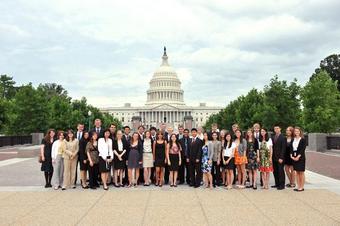
The National Peace Essay Contest for high school students sponsored by the The Academy for International Conflict Management and Peacebuilding, the education and training sector of the United States Institute of Peace, is a way to incentivize high school educators and students to include peace talks as part of curriculum especially for history, government and social studies content areas. According to the institute the goal of the contest is to “promote serious discussion among high school students, teachers, and national leaders about international peace and conflict resolution today and in the future.”

The incentives for educators include the fact that the activity complements existing curricula and other scholastic activities and meets National Contents Standards, which is the direction that most school districts, including the District of Columbia is heading in. Students’ incentives include skill building in the areas of research, writing, and reasoning skills. Additionally, first place state winners receive scholarships and are invited to Washington for a five-day awards program. The Institute pays for expenses related to the program, including travel, lodging, meals and entertainment. This unique five-day program promotes an understanding of the nature and process of international peacemaking by focusing on a region and/or theme related to the current essay contest.

Educators can incorporate this contest as part of a reframing history activity by having students analyze past national or world conflicts and reevaluate outcomes applying the concepts of peace studies such as exploring approaches to peace and how those past violent conflicts could have been transformed non-violently. Students will be exposed to a different way to view conflict in the world and begin to generate ideas about how to resolve those conflicts while maintaining peace, justice, human rights and security in the world, as well as begin to examine what their personal roles are as global citizens in the effort for peace.

Check out contest information at: http://www.usip.org/npec

New resource from Educators for Social Responsibility

Book by Book, by Carol Spiegel, is a valuable resource for librarians, teachers, guidance counselors, and parents to find books to complement the standard language arts curriculum for teaching important peacemaking and social and emotional learning concepts. Written by a veteran peace educator, Book by Book leads adults to children’s literature that will help students explore themes related to conflict and its resolution, social justice, and appreciation for diversity.

Learn more…

Remembering Elise Boulding

Elise Boulding, 89, a sociologist who was instrumental in establishing peace studies and conflict resolution as an academic discipline, died June 24 of complications from Alzheimer’s disease at a nursing home in Needham, Mass.

Read full article

Elise Boulding will continue to be an inspiration to all the peace educators, researchers, and builders in the world.  Her commitment and advancement of the field has put the study of peace on the map in monumental ways and the ripples of those efforts continue to expand.

If you are not familiar with Boulding’s work, be sure to check out one of her more famous books, Cultures of Peace: The Hidden Side of History.

Conflict Resolution: What Is It and How Can I Be a Part of It?

Goal: To learn how to identify and manage conflicts in a productive manner.

Objectives: Students will be able to:

  • Describe various sources of conflicts
  • List the variety of ways people choose to respond to conflict
  • Reflect on the ways in which they have chosen to respond to conflict
  • Use active listening and “I statements” to solve conflicts

Continue reading