Peace and Community Service For Children

By: Rebecca Kane


Content: This resource is a lesson plan from the Louis D. Brown Peace Institute in their designated “Peace Curricula” section, which has designated lesson plans for Elementary, Middle, and High School Students. The section I have chosen to discuss is from their “Pathways to Peace: Lesson Plans for Elementary School.” This organization is dedicated to being a center of healing, teaching, and learning for families and communities that have been impacted by murder, trauma, grief, and loss. 

Access to their website at: https://ldbpeaceinstitute.org/the-peace-curricula/ 

Access to this specific set of lesson plans (Today we will be discussing Lesson 5): https://ldbpeaceinstitute.org/wp-content/uploads/2020/03/Pathways-to-Peace-Lesson-Plans_Elementary-School.pdf 

Context: This lesson is specifically designed for elementary school-aged students. Those who then benefit from this resource would be elementary school educators, community youth facilitators, or anyone who falls into a category like such. This lesson is designed for formal or informal educational settings. This could be particularly helpful for communities dealing with children who were exposed to violence, whether directly or indirectly, through the media, in order to give them a safe space to process their feelings and emotions. 

Implementation: This lesson plan can be incorporated at any point during the school year that the educator deems necessary, but could be especially useful if the school or community center holds Peace Weeks or even Mother’s Day events, as part of this lesson pertains to these matters.


The Lesson Plan Set-up: 

  • Students will ideally be set up in a circle to facilitate open sharing.

Materials: 

  • Large blank paper/poster paper
  • Makers, crayons, and/or colored pencils
  • Printed copies of the story of Louis D. Brown (the Elementary version) (Provided Below)
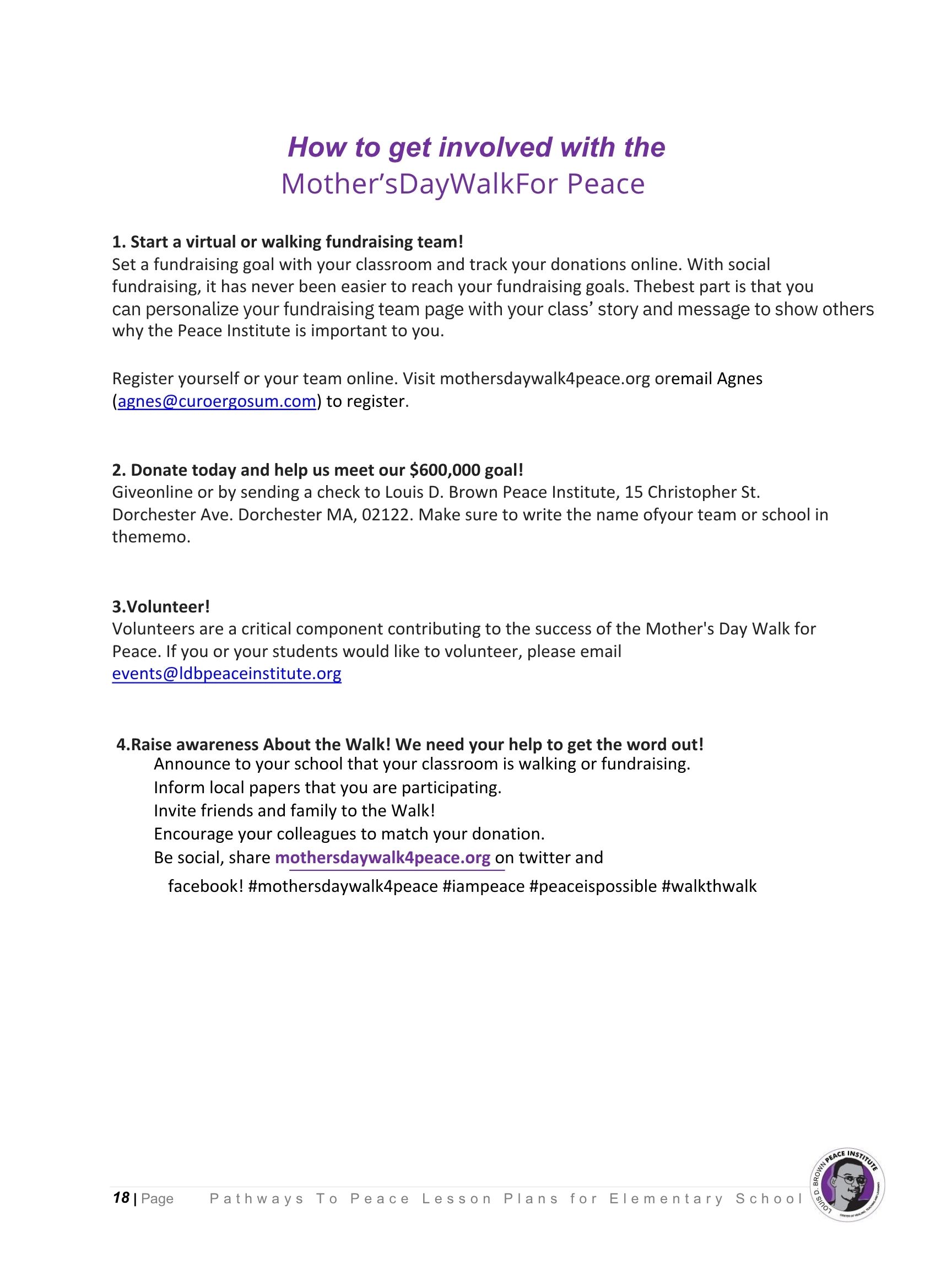
  • Printed copies of “How to get involved with the Mother’s Day Walk for Peace.” (Provided Below)
  • Tape or other resource to hang materials

Time: 45-60 minutes

The Lesson Plan: 

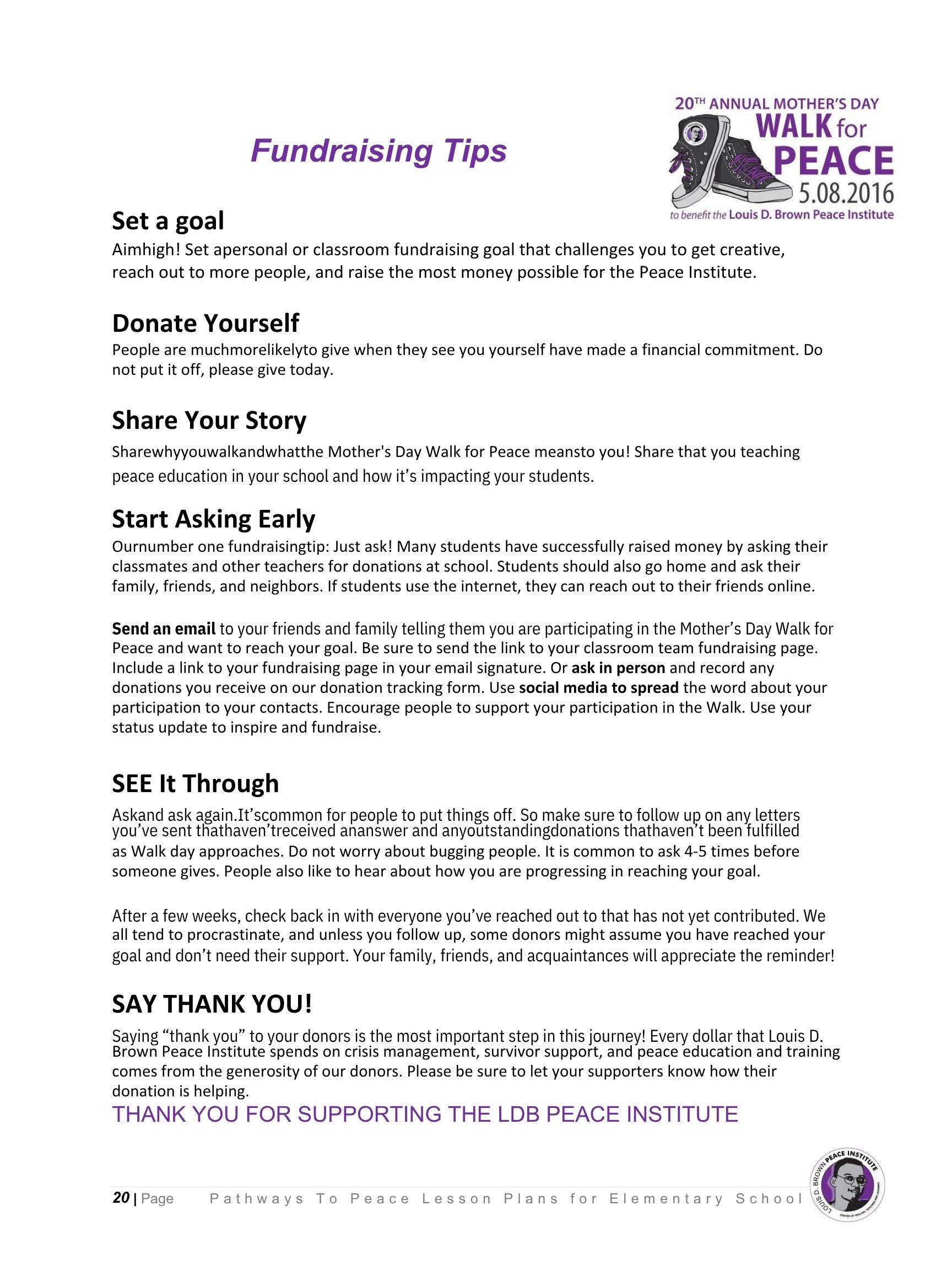
(5-10 mins) Introduction: The educator/facilitator will introduce themselves and welcome the students, and if they so choose, they can even allow for short introductions for students to share their names. Following this, the students will be read the Principles of Peace to set the tone for the lessons. The educator/facilitator must also remind the students that the lesson in class today is a set time for them to practice the Principles of Peace that they had read. 
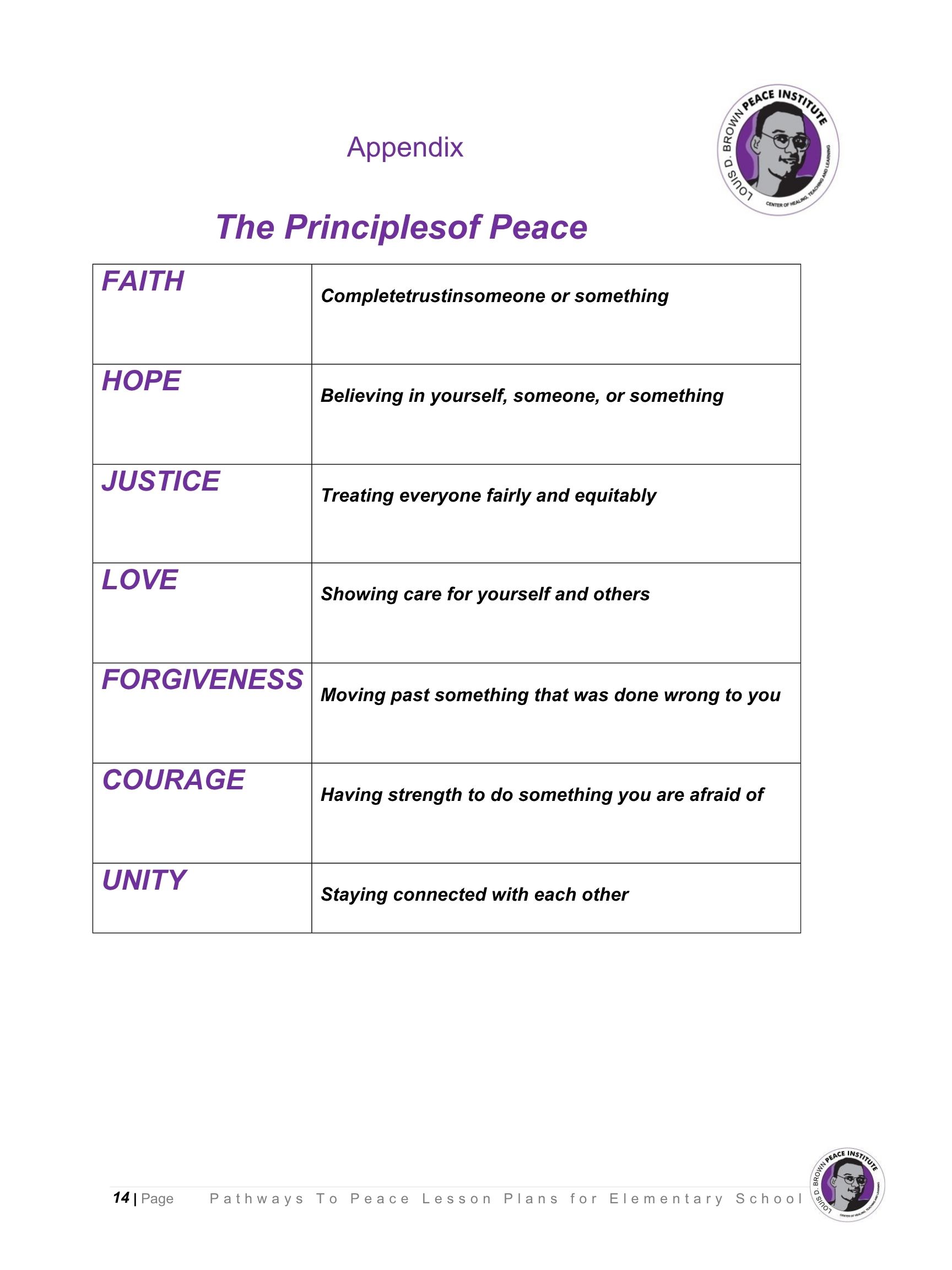
(20 mins) Mother’s Day Walk for Peace and the Story of Louis D. Brown: The educator/facilitator will begin by reading the students the story of Louis D. Brown and how his parents had started the Peace Institute. After reading this story aloud, the students will then be asked some questions to get them thinking. Here are the questions:

  1. What kind of person was Louis? How did he help others?
  2. How does what happened to Louis make you feel? How do you think his family felt when he passed?
  3. What did Louis’ family do to keep his memory alive? How does the Peace Institute help the community?

(Disclaimer: The educator/facilitator has the ability to alter/cut questions that do not fit in the time frame, and also questions they do not feel comfortable asking, per the students’ response to the story itself.)
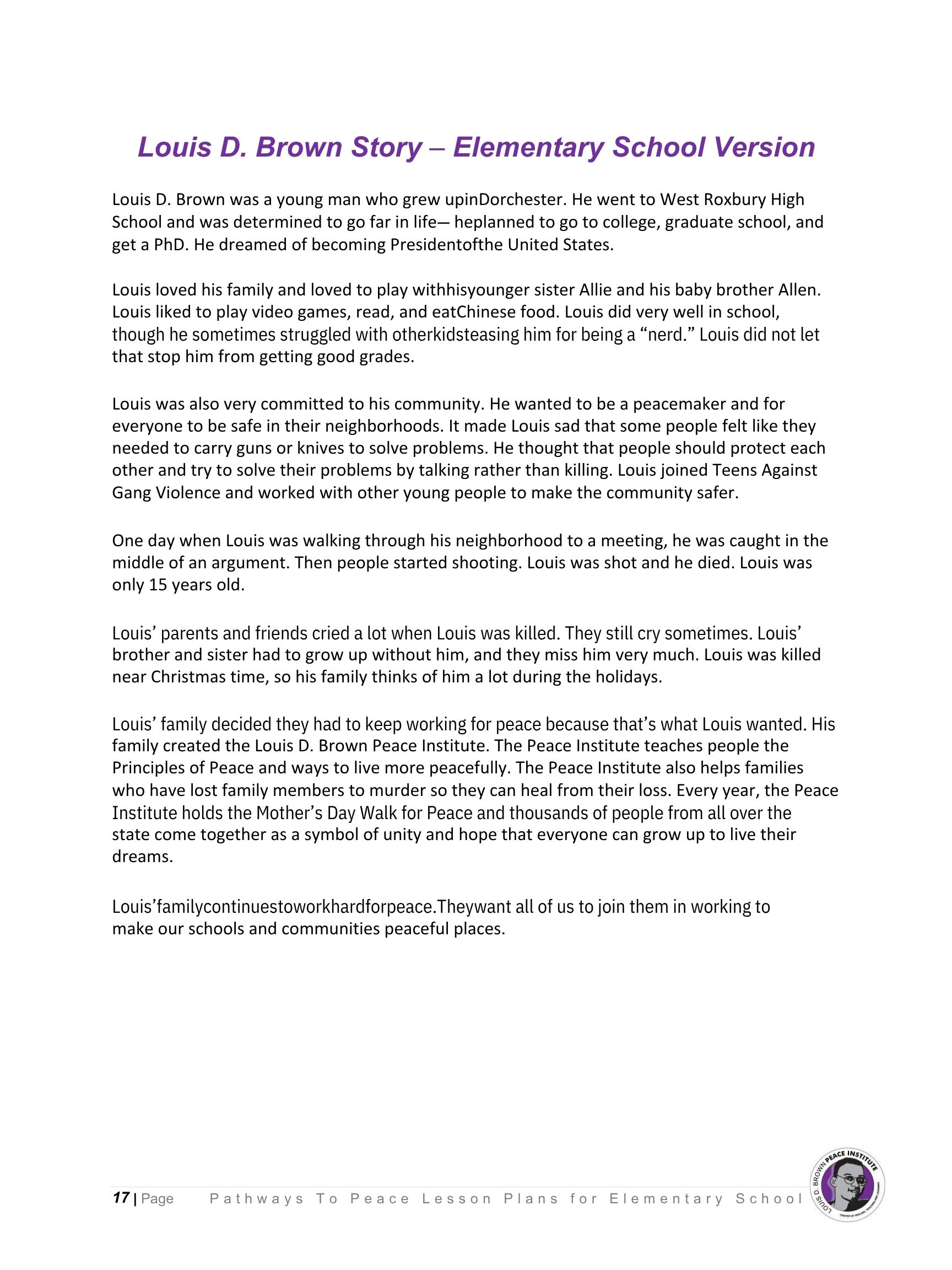
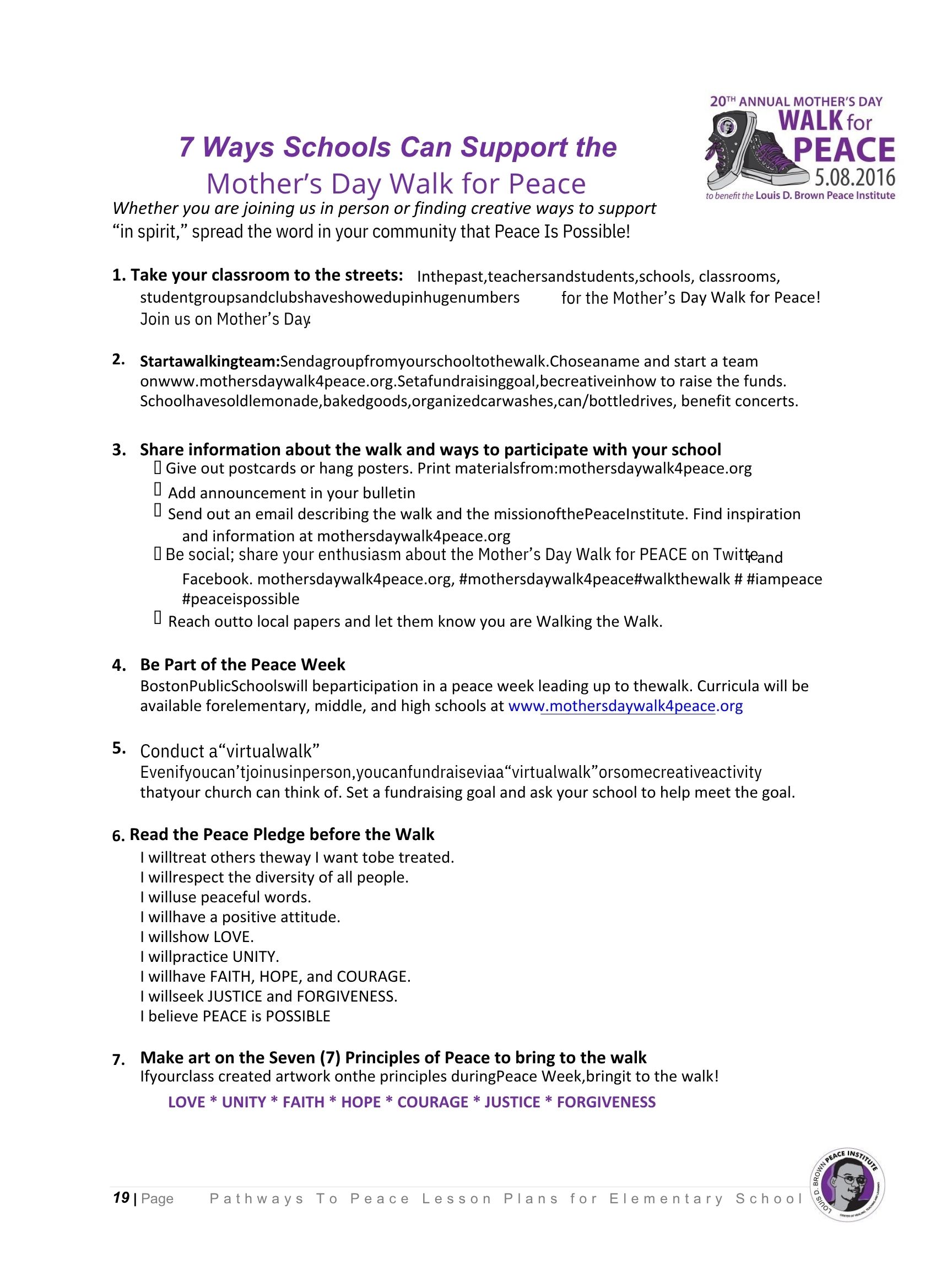
Following this discussion of Louis’ story, the educator/facilitator will then explain that an important part of the Peace Institute’s work is the yearly Mother’s Day walk for Peace. The walk is a way to bring the people together from all over the city and state to create a community where they can share love, feel unity, and have hope, which are all parts of the Principles of Peace. The students will then be encouraged to let the people within their own communities (friends and family) know about this Mother’s Day Walk for Peace, and will be given sheets of paper with information about it to bring home. Once they have discussed the contents of the sheet and have been given time to ask questions, the educator/facilitator will ask the students these questions about the Mother’s Day Walk for Peace:

  1. Why is walking together and being together important for peace?
  2. What other ways can you think of to work for peace in the community? 

(15 Mins) Vision of a Peaceful Community: 

The purpose of this section is to humanize the community and to stop the blame and shame of violence, especially on the young people who have the potential to become peacemakers of said community. In order to stop the violence and start building peace, the institute wants to share that we must recognize the strengths, assets, and resilience that are present within every community. 

Instructors will ideally put students into groups of 3-4. If not possible, the size of the groups can be adjusted to better fit the group’s needs. Once they have been separated into their groups, they will be given a large piece of blank paper or posterboard. The educator/facilitator will then ask each group to work together to draw what they imagine a peaceful, happy community to look like. In order to help the students start, the educator/facilitator will give these as examples for the students to begin their drawings:

  1. People working together
  2. People sharing
  3. People having jobs, houses, and happy families

Educators/facilitators are also encouraged to make sure students within each group are sharing their ideas and working collaboratively to represent the Unity section of the Principles of Peace. 

(5 mins) Peace Mural:

After the groups of students have finished the drawings, the educator/facilitator will have each of the groups hand their posters and form them as one, making their very own peace mural that shows off everyone’s work together. 

In a circle, the students will then all share one thing that they see happening in these images of a peaceful community that they would then like to see happening around them in their own communities to promote peace. 

Here are the papers needed if you decide to include the Mother’s Day Walk for Peace portion:

Goal: The goal of this resource is to help students create a shared vision of a peaceful community and, by doing so, create a personal commitment to peacemaking in their own communities. This resource combines the arts with storytelling, a similar idea to that of the ones said in “Storytelling For Social Justice: Connecting Narrative and the Arts in Antiracist Teaching,” written by Lee Anne Bell. This resource acts as a counter-storytelling community (Bell, 2020). By allowing students to engage with Louis’ story, students move beyond concealed stories of trauma and begin to develop critical empathy and understanding, social imagination of a more inclusive community, and narrative agency to rewrite their future with new goals and ways to do so, all detailed in Bell’s book, and have the possibility to be shown by the students who complete these activities. 

Relevance: Far too often, the public school system within the US creates lesson plans and guidelines that each school must abide by, neglecting to take into account the differences between states, cities, communities, etc, and how their learning might need to be shaped differently for the students as well. For educators working in communities affected by systemic inequalities or conflicts, students are often only surrounded by “stock stories” (Bell, 2020), which only focus on the violence that happens in their neighborhoods. By reshaping this and using the story of Louis D. Brown’s legacy, they are being provided with a counter-story in order to promote more critical and thoughtful dialogue about real-life issues that these students, although young, could be seeing in their own communities. 

The activity allows for students to reshape and be the architects of their own communities. It allows them to also see the transition from being observers of their community into being active and aware of their surroundings, to the point where they can create their own “peaceful community,” making them finally feel like a member of it. Often we also try to shield children from the realities with which they live, and although I do understand that, in some areas, it is virtually impossible, especially now with so many children having access to social media and the internet. With that idea in mind, I wanted to share a resource that I thought captured more of what we need to be teaching from a young age, and that is peace, and how, no matter how old, we all have the ability to act on it. 

Audience: The audience for this resource is any elementary school teacher working with their students to develop peace education in their classroom. I have shared these measures with my own family member who works in the public school system, teaching Kindergartners in the state of Maryland. 

This resource is also for local community center leaders or coordinators specifically working with youth. This can also include the leaders of after-school care programs, as they also have direct access to the youth of the school. My family member teaching kindergarten has shared these ideas with the people who work directly with her students in the after-school care program. 

References: 

Bell, Lee Anne. Storytelling for Social Justice : Connecting Narrative and the Arts in Antiracist Teaching. Second edition. New York, New York ; Routledge, 2021. Print. 

The Peace Curricula – Louis D. Brown Peace Institute. (n.d.). https://ldbpeaceinstitute.org/the-peace-curricula/

Pathways to Peace. (n.d.). Pathways to Peace lesson plans for elementary school. https://ldbpeaceinstitute.org/wp-content/uploads/2020/03/Pathways-to-Peace-Lesson-Plans_Elementary-School.pdf 

Bridges To Understanding

I recently learned about Bridges To Understanding through another popular organization, Teachers Without Borders (TWB).  This year TWB has decided to adopt Bridges To Understanding’s youth programs and educational curriculums since the non-profit organization, founded in 2001, will be dissolving (http://www.teacherswithoutborders.org/programs/teacher-programs/peace-education/bridges-understanding).  The Bridges To Understanding’s vision was to “empower and unite youth worldwide, enhance cross-cultural understanding and build global citizenship using digital technology and the art of storytelling” (http://www.facebook.com/bridgesworld?sk=info).

I thought it was interesting to see how Bridges’ two core curriculum-based programs, the Bridges Ambassador Program and the Bridges Global Citizens Program, connected students across the globe in a way most educators (especially those in a public education system) would never accomplish in the traditional classroom setting.  The Bridges group laid the groundwork for a “network of established partner schools and community organizations in Seattle, Peru, Guatemala, South Africa, India and Cambodia where [their curriculums] have been adapted to insure cultural relevancy” (http://www.facebook.com/bridgesworld?sk=info).  The first curriculum, the Ambassador Program, teaches children how to create digital stories about their daily lives, local culture/traditions and community.  With the help of Bridges staff, teachers lead discussion forums on conflict and resolution as well as environmental sustainability issues through both a local and a global lens.  The second curriculum, the Global Citizens Program, works on a more international approach by bringing together partner schools around the world into a classroom-to-classroom discussion forum to talk about important global issues.  This allows students to view others’ videos while sharing their own stories, photography and ideas (http://www.bridges2understanding.org/programs/programs.html).

Contextually, this peer-to-peer learning can be implemented at any age level.  In our global environment, the use of digital technology is something many young children are learning far more quickly than in the past generation.  I think both science and humanities teachers should be encouraging technology-based curriculums such as this one into their classrooms since it not only broadens the children’s skill set for the future workplace (arguable one goal of education), but also gives them the opportunity to explore a vast amount of new information available online.  Technology is typically applied in science classes, but by introducing online discussion forums into humanities classes, students are able to personally clarify the local context of the broad cultural content they learn.  By giving youth a protected informal setting, educators can eliminate some of the psychological barriers preventing students from asking questions in the formal classroom setting while increasing the perceived self-importance of other individual youth who take pride in speaking about their culture; perhaps, for many, this is the first time a foreigner has taken an interest in their lives.

The Bridges organization has added a resource called the Bridges Passport Program for educators to help implement their curriculums with ease.  This program provides educators with access to “ten youth-produced digital stories, with accompanying story guides, for classes to explore rich multicultural content” in the context of any existing curriculum (http://www.bridges2understanding.org/programs/programs.html).  After the merger with Teachers Without Borders, educators can also access both of the Bridges’ curriculums through the TWB website.  The only logistical setback would be that individual classrooms would need access to either a computer, camera or a TV to view and create the digital stories.  I would suggest taking the last class of each week to focus on a global issue presented within the content youth learned in class that week.  Educators can alternate between using a story guide to watch and discuss an international student’s video one week and having their students create videos to post online the next week.  If there are time restraints on watching videos or creating videos which is probably more likely, educators should encourage students to meet outside of school to discuss possible global issues in their local community and think of ways they can incorporate these themes into both a video and the lessons they are learning in class.  The application to already existing class material is key.

This resource is geared heavily towards conflict resolution and human rights education; hence, it would fit well into humanities classes.  Pedagogically-speaking, educators would use this to build trust across cultures and community building.  This resource allows students to explore alternative perspectives on global history and learn how they can reframe it to incorporate means of peace.  Bridges To Understanding specifically works to “develop students’ cross-cultural understanding, as they discover differences and similarities in the challenges faced by their peers in other countries” (http://www.facebook.com/bridgesworld?sk=info).  This requires students to not only become leaders to actively discuss issues in their community, but also active listeners to other students’ problems.  On a practical level, they must also become familiar with technology.  I believe the Northern Virginia public school system would make an excellent candidate as well as George Mason University for implementation of these programs since we have public access to many forms of technology.

Resources:

http://www.bridges2understanding.org/ – The Bridges To Understanding website

http://www.facebook.com/bridgesworld?sk=info – The Bridges To Understanding Facebook page

http://www.teacherswithoutborders.org/programs/teacher-programs/peace-education/bridges-understanding – The Teachers Without Borders website

Sing for Success

“When you do what you love, things can happen for you.” When you visit the blog for the PS22 Chorus, this quote is displayed on the headline and it could not ring more true than with this amazing group of students. The PS22 Chorus was started by Greg Breinberg in Graniteville, Staten Island, New York. “Mr. B,” as his students refer to him, arrived at Pubic School 22 in 1999 after being laid off from his previous job as a music teacher. When he arrived at PS22, he was the second grade teacher however, he persuaded the principle of PS22 to let him to teach music again as well as start a chorus for the students in 2000.

Starting any type of school arts program in the year 2000 was a very risky move. In the 21st century, our schools are experiencing budget cuts from every angle and, more likely than not, arts programs are the first ones to get the axe. Too many of our politicians and policy makers fail to see the amazing difference art can make in a student’s life. Before Mr. B was given the opportunity to teach music again, he would play music in all of his classes in order to keep the students engaged in the class and to encourage their participation.

The PS22 Chorus has provided all of its members, past and present, with an amazing opportunity that they may not have had anywhere else. Many of the students that are a part of this chorus come from broken homes where their parents neglect them and they do not have a bright future to look towards. PS22 Chorus gives these students an opportunity to not only escape from the troubles they are having at home, but a chance to actually reflect on their experiences and emotions so they can grow from them. Music provides these children with an emotional outlet that they would not have been able to get anywhere else.

Something very unique about the PS22 Chorus versus other elementary school music programs is that each student is given the chance to perform a solo. The group performs a variety of songs every year highlighting each student’s strength as a singer while the rest of the group performs background vocals and provides harmonies. By allowing different students the chance to shine, the students are able to see each other as equals instead of one being better than the other. Once all the students realize that they all have an amazing gift to give, difference based on race, ethnicity, gender, height, weight and many other things can finally be overlooked and the students can unite to embrace their love of music and build strong relationships with one another that can last into the future.

Too many times the arts are forgotten. Statistics have proven that when students receive a more well rounded educational experience that includes the arts, physical activity and other alternative methods of learning, they excel in their studies. Incorporating arts into the classroom can be done very simply. Like Mr. B, you can play music as your students enter the classroom each day so the students are engaged with what you and the class from the beginning of the period. Also, providing them the time during the class to reflect on the song and what emotions it brought to light for them can help them process hardships or happiness they may be experiencing in their lives outside of the classroom.

Another way to successfully incorporate music into the classroom in order to promote critical thought and peace would be using music to enhance the teaching of subjects such as history, literature, science or math. You can enrich your history and literature lesson plans by connecting the topics you are discussing with the music of the culture from which it came. With math and science, you can help your students connect to the material more so, absorb it and fully understand it through the use of song. If you are able to stimulate your student’s mind through the use of song, they are more likely to engage with you and the rest of the class and therefore have a full educational experience.

In a time where the arts were being cast aside and looked down upon, Mr. B knew how important they were to his students’ happiness and success. Thinking about a world where are youth are denied the right to express their creativity in our school systems is absolutely heart breaking. If we want our youth to grow up to be full adults, ones who not only have the critical thinking and analysis abilities necessary to be successful members of the work force, but emotional beings who are able to express themselves and connect with peers on a deeper level in order to form strong community bonds, we must continue to promote an educational experience that incorporates the arts.