What’s Good in My Hood?

POSTED ON BEHALF OF MARIA SCHNEIDER

Saturday September 29th of this year, several AU students and a GW student volunteered to work with 70 DC kids on the Chesapeake Bay in Maryland for the day. The day was divided into different workshops: canoeing/kayaking, forestry, marine life, and art with nature. This day-long retreat was the kick-of event for the What’s Good in My Hood? Initiative that will take place at several community centers across the city, those being: Lafayette, Keilworth-Parkside, Harrison, Macomb, Trinidad, Benning Stoddert, Bald Eagle, Ferebee-Hope Recreation Centers, Palisades Community Center and Chevy Chase Playground. Click here for more information!

I was first introduced to the What’s Good in My Hood? program at the beginning of September when I was put in contact with Sean Miller, an American University adjunct faculty who teaches a course titles DC Healthy Schools in the School of Teaching and Health. Sean along with several staff at the Department of Parks and Recreation staff in DC have started this program in the District of Columbia through various recreation centers across the city to increase environmental awareness, love of the outdoors, and to empower elementary and middle school youth to be active within their own communities.

This DC program is similar to the New York Restoration Project’s What’s Good in My Hood? program that DC native Akiima Price talks about in this short introductory video.

The What’s Good… program is one that can be implemented with students of various ages ranging from young elementary school through high school. Though the current program is aimed at kids ages 9-13, it could be altered easily to accommodate older or younger youth with slightly different projects, and/or more complex themes and discussions. The New York Restoration Project’s What’s Good in My Hood? Workbook can be found here and downloaded for free to bring the innovative program to any urban community through a Peace Education initiative, school program, or community organized one as well!

Through the program students would gain valuable knowledge about the unique aspects of their own communities, natural and not-so-natural resources, living versus non-living parts of where they live, where they get their food and water, and most importantly how to stay involved, voice concerns, and take action for change within their own neighborhoods through community advocacy and writing to local, state, and national legislators.

The What’s Good in My Hood? program most fully supports the Community Building and the Exploring Approaches to Peace pillars of Peace Education. Community Building is key, because not only are program participants getting to know one another throughout the process, but they are exploring their own community spaces, and working together to create more accountable and responsible community members. Students explore approaches to peace in the way that they take action collectively through advocacy and various student-led initiatives towards the end of the program process in step five that Akiima Price describes in the video—Don’t Shout, Speak Out.
Reframing History through Incorporating the Disability Rights Movement

POSTED ON BEHALF OF KI’TAY DAVIDSON

Content and Context

This video entitled “The Power of 504” is a video of the 504 sit ins at the height of the disability rights movement. The video depicts hundreds of disabled individuals barricading themselves in federal office buildings in San Francisco to protest the lack of the implementation of the 1973 Federal Rehabilitation Act. The act was the first civil-rights statute for persons with disabilities in the United States. This video is widely available on youtube and similar web video sites.

This resource would be best utilized for 5th-12th grade students in a history, or english class. Specifically, this source could be incorporated in the common civil rights history unit that most students will discuss each year.

Not only is this resource applicable to the discussion of civil rights within history, but it is also expands the communities in which we discuss human rights and movements for equality. The disability community is a population that is still heavily marginalized and left out of a social justice conversation and context. As a result, focusing on the disability rights movement will both expand the understanding of marginalized communities, awareness of varying civil rights movements and will promote a social model of disability for future generations.

Objectives and Goals

The goal of this activity is two tiered: (1) to reframe history and (2) to discuss divergent approaches to peace. The framing of this activity would be to watch the video and then to discuss modern day civil rights movements by breaking into small groups and discussing the various ways in which our society has and does limit equity and how those communities are addressing those issues. In this discussion, students should discuss two major themes. First, the parallels of the disability rights movement to other recent movements (ie: LGBTQ, education, Native Americans, Latinos etc). Second, students should discuss how peaceful movements have been effective in bringing about reform. This question should begin to synthesize a students prior information on civil rights movements for Women, African Americans, Irish Americans etc and compare that information in a modern context. At the end of the discussion, students can report to the rest of the class on their group’s discussion and the teacher should write similar themes on the board. By the end each student will have gained a broader understanding of civil rights movements, as well as an awareness of peaceful protest as a means of promoting equality. In an academic sense, students will have engaged in critical thinking, and analyzing by comparing and contrasting the various movements.

No Impact Man

POSTED ON BEHALF OF KATIE KASSOF

No Impact Man: The Documentary, a film by Laura Gabbert and Justin Schein, follows the experiment of author Colin Beavan and his family as they attempt to live with no environmental impact in New York City for one year.  It is a fairly well known documentary (and book) made in 2009 and is available streaming on Netflix and in the AU Library.

This film would be best suited to a high school and younger adult audience because of the open mindedness that often disappears in older age groups.  Also, since some of the themes are more mature (no, not in sexual ways…) I feel that the film might be lost on younger audiences.  Because of the way I envision using this piece, to launch into a larger project that would span 2-4 weeks, it would fit best in a more formal environment or at least an environment which offers repetitive meetings for a minimum of one month.  Because of the diverse themes the film presents, it could fit into many different subjects, but environmental science and psychology are the two that initially come to mind.

The idea for an activity around this film is pretty obvious but has many opportunities for discussion and introspection.  First the class will watch the film.  It is about 90 minutes so it may be split up over two class periods.  This will lead nicely into a discussion of the students’ impressions of Colin and his wife, as well what they thought were the most reasonable things to give up and the things they would not be willing to give up (I’m sure electricity will be top on the list of things no one would be willing to live without).  After this discussion the students will each be charged with a week-long project: choose something in their life to live without for one week straight.  Document this journey either with a written journal or video journal (depending on resources and/or student learning preference).  After their week of abstinence, the students must explore how this impacted their life, the environment and the world and present their findings in a creative class presentation.  The larger issues of personal peace and sustainability can be discussed after the students have a chance to ruminate on their experiences.

At first glance No Impact Man seems strictly like an environmental impact documentary, which does fit in with the peace concept of sustainability.  It could also qualify for a Pacifist theme.  While watching the film, though, another theme emerges: personal peace.  Sure you can take away all of the environmental positives from the film: waste less, use less energy, be less materialistic, eat locally, etc., and these are absolutely important.  But I think the more poignant take away was the improvement of the family and the personal peace they each achieved.  Better yet, this was a surprise to Colin and his wife as well.  They too went in with the environment in mind and came out with a much bigger picture experience.  Their health improved from eating locally and cutting out take away.  They state that they become better parents to their 3-year-old daughter by playing more family games and cutting out television.  They spend more time out of doors exploring the city and being social, especially when they give up electricity.  They are less invested in material possessions and more focused on the well being of their family.  Add to this the obvious environmental discoveries and you have a recipe for a great peace teaching film.

Check out the website http://www.noimpactdoc.com/index_m.php and watch the trailer .  Enjoy!

Guide to Composting for Schools

POSTED ON BEHALF OF AUDREY VAN GILDER

I found this pretty wonderful “guide to composting” for schools, created by a Connecticut middle school after its successful efforts to reduce waste, and written in a way to make the process replicable.

http://www.ct.gov/dep/lib/dep/compost/compost_pdf/schmanual.pdf

Young kids would likely be most excited by the idea of participating in composting, but ideally this resource can be applied to any formal or informal educational setting, especially those with science or conservation objectives. Rural schools might have an initial advantage in starting composting projects because the know-how, infrastructure, and space are plentiful, but composting in an urban setting can be just as useful (especially with the popularization of urban gardens and farms).

Composting fits into a school’s culture and curriculum in many different ways, and students can be active participants in a process that not only results in a less harmful end product (thereby benefiting the community and surrounding environment), but that also engages them in a scientific, hands-on, never-ending project. After an administration makes the logistical arrangements, the rest is up to teachers to involve their students in an activity with tangible results and with the potential to foster increased awareness of, concern for and engagement with the environment. Beginning on page 43, the Connecticut manual lays out specific lesson plans that educators can use as guides for incorporating the school’s composting efforts into classrooms. Each asks students to not only participate in the compost process, but also to reflect on the experience and how it changed their conception of waste.

Teaching and participating in a compost program most fully supports the community and skill building pillars of peace education. The knowledge and skills students can gain even through a short composting stint are substantial and can influence the choices they make outside school. But the potential for community building that this resource has extends far beyond the individual students, contributing to a community of engaged, environmentally thoughtful, and conscientious learners.

Pen/Faulkner Writers in Schools project

POSTED ON BEHALF OF SARAH JACKSON

The resource I’d like to recommend is the Pen/Faulkner Writers in Schools project. This is an organization that provides books written by local authors to classrooms, as well as places local authors in schools for a book talk with the students. It is an organization that has been used by the English Department at Ballou Senior High School for years:

This year, I am taking advantage of this opportunity for the first time.

I think the best educational setting for this program is one that houses potential burgeoning authors. This can mean people of any age or background. The program requires the participants to read and dissect a work of literature in advance, in order to be prepared for the author’s visit that culminates the experience. Therefore, there would need to be some sort of framework for formal teaching and collaborating.

This year, I am using this resource to have my students study the genre of Memoir. I have selected two texts, one for my 9th graders and one for the 10th grade, that I hope will reach my students by resonating with their own experiences; as well as expose them to the world beyond what they know here in D.C. My hope is that students will learn that literature is liberation. I want them to realize that literature is everywhere and that it can be for anyone. I think too many of them maintain the bias that reading and writing are irrelevant for their lives. I want them to see that personal and social issues can be unearthed and exposed through powerful literature. I want them to meet the person behind the page and see there is no mystery there, there is no magical gift. There is an individual with an idea and determination to pen it. It could indeed be them one day.

I believe this resource supports several Peace Education pillars, particularly Reframing History, and Skill Building. Through the Pen/Faulkner Writers in Schools project, my students will be reading the personal stories of people who have lived through traumatic experiences and periods of history. Yet, there will be more to these stories than destruction and despair. There is a protagonist who survived and grew, someone who chooses to give back by visiting young people in schools. This is a different ending to the story of violence and chaos so often told by history. Furthermore, by working closely with a text and then the author of that text, students witness first-hand that the skills they learn in the classroom will not stay there if they know how to apply them. The fact that the authors are local powerfully illustrates to the students that there is a life other than the one they know, and this life of success is certainly within reach.

826 Valencia Street

POSTED ON BEHALF OF EMILY FLEITZ

826 Valencia street is an organization started by Dave Eggers that provides free after school tutoring to students in Berkely, CA. I first heard about it at his talk at the 2011 National Book Festival, and learned more about it via his TEDtalk.

The students range in age and ability. The only necessary constant is that one student is matched with one volunteer tutor. The tutor devotes all of his or her time to this one student to help with whatever he or she needs. All this occurs in a combination publishing house and pirate shop.

As the organization grew, they began going into schools to tutor during the school day, and one school offered a classroom that could be continually staffed by volunteers. They were then asked to produce a book of students’ writing about nonviolence, encouraging students to give their all in the creation of a product that will be sold worldwide. Students grow in their love for learning and are encouraged to follow their passions. Similar organizations have started in New York, Cincinnati, Ireland and elsewhere so it is possible to start this in your own community, or take advantage of a similar organization that might already be present.

Best of all, 826 Valencia Street connects members of the community who have the time and skills with students who need their help. The pirate store brings in people off the street and they can see the tutoring that is happening while they shop. This is not a true classroom but rather brings education outside into the community, creating community building on a macro level. The individual attention allows for the tutor to engage in a student’s preferred learning style and be sensitive of the emotions students bring with them.

Visualizing Strategies for Peace


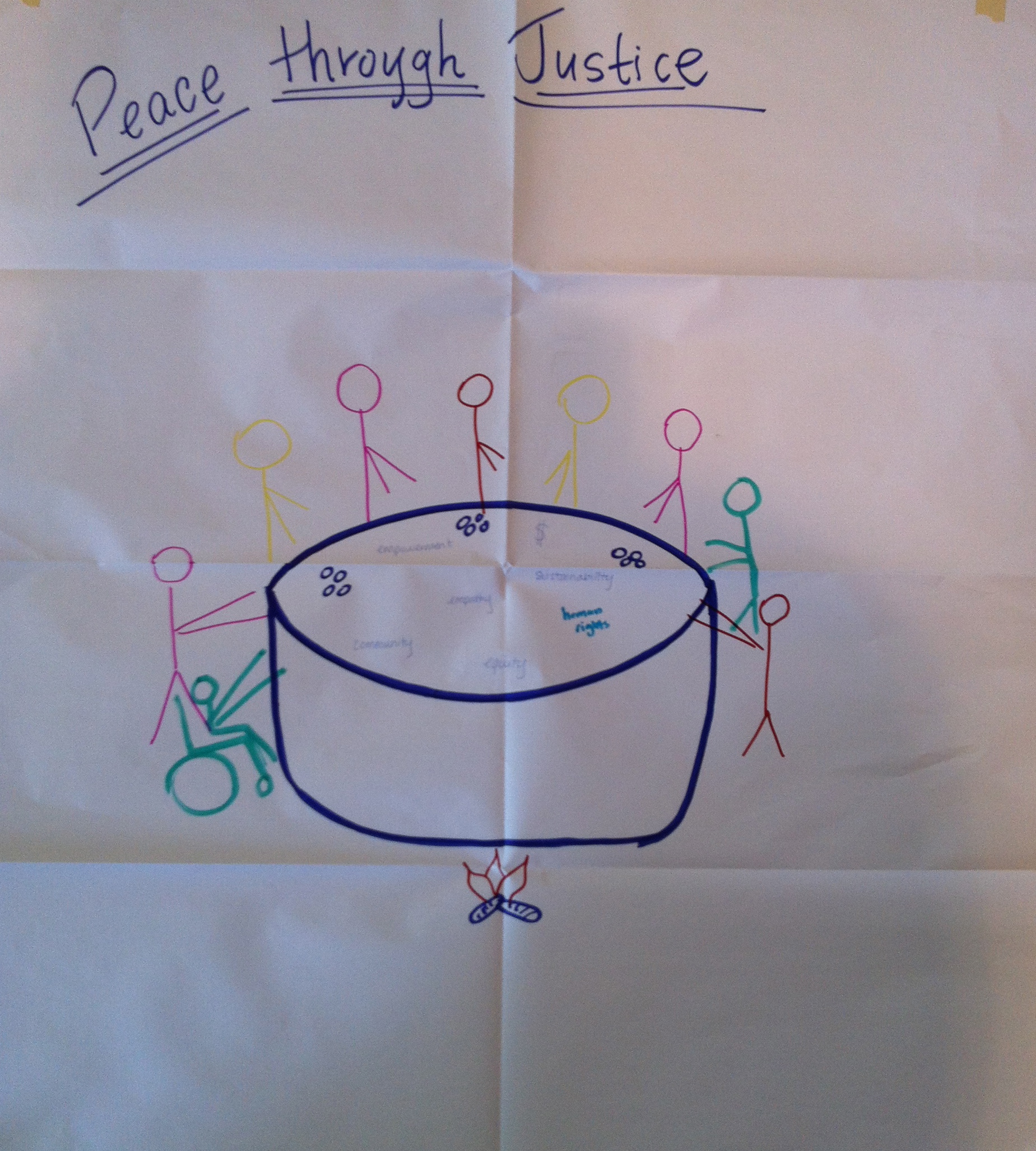
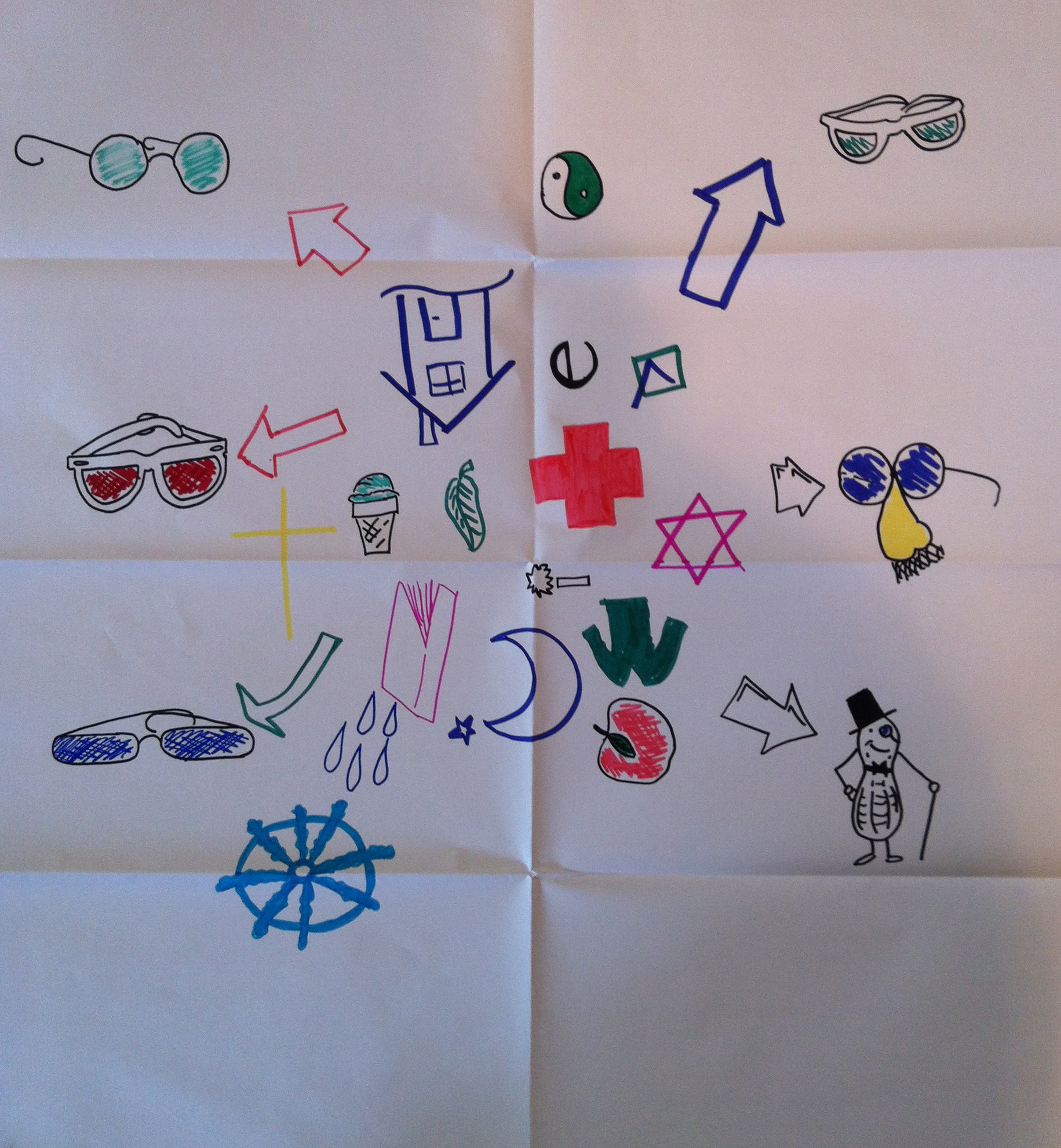
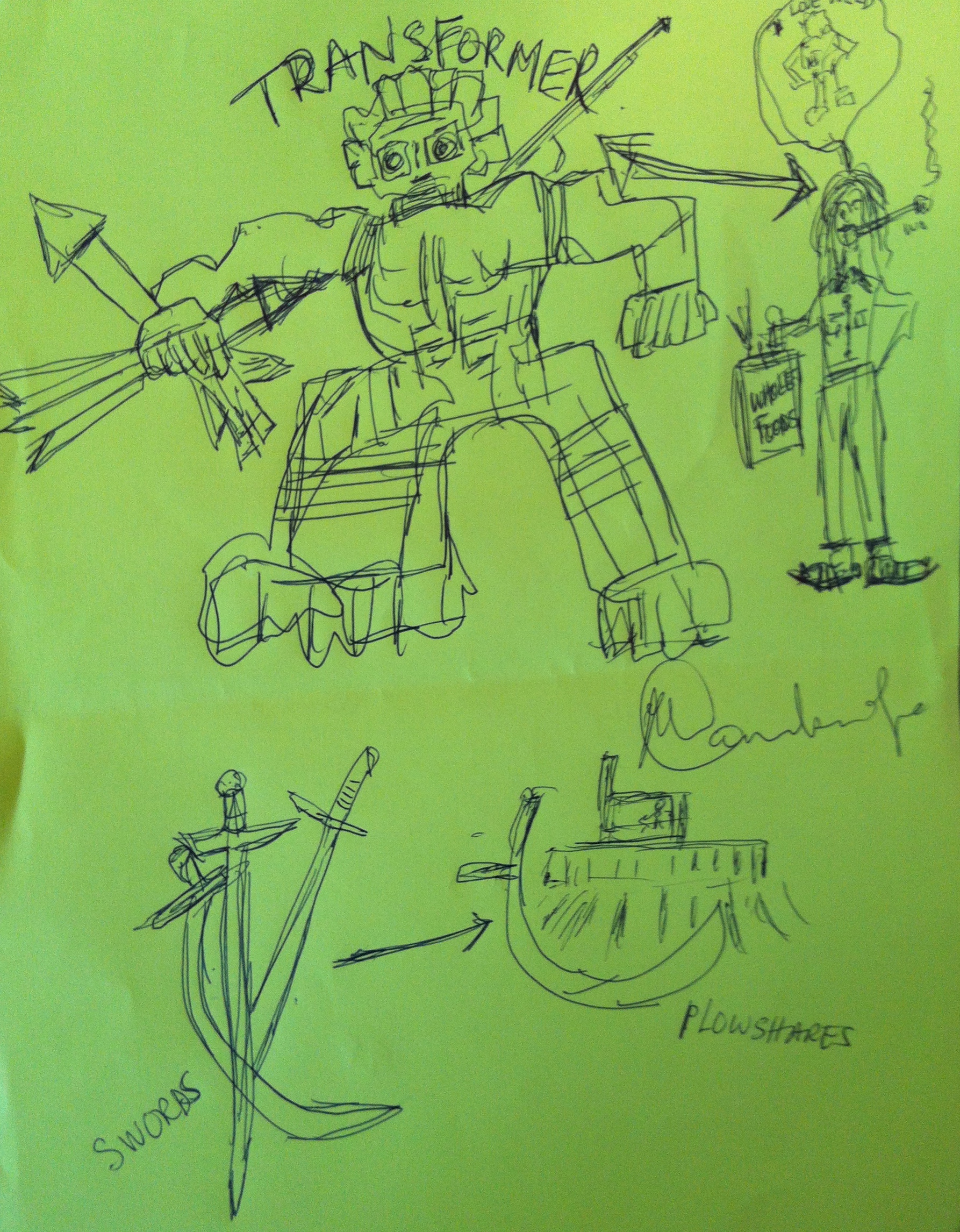
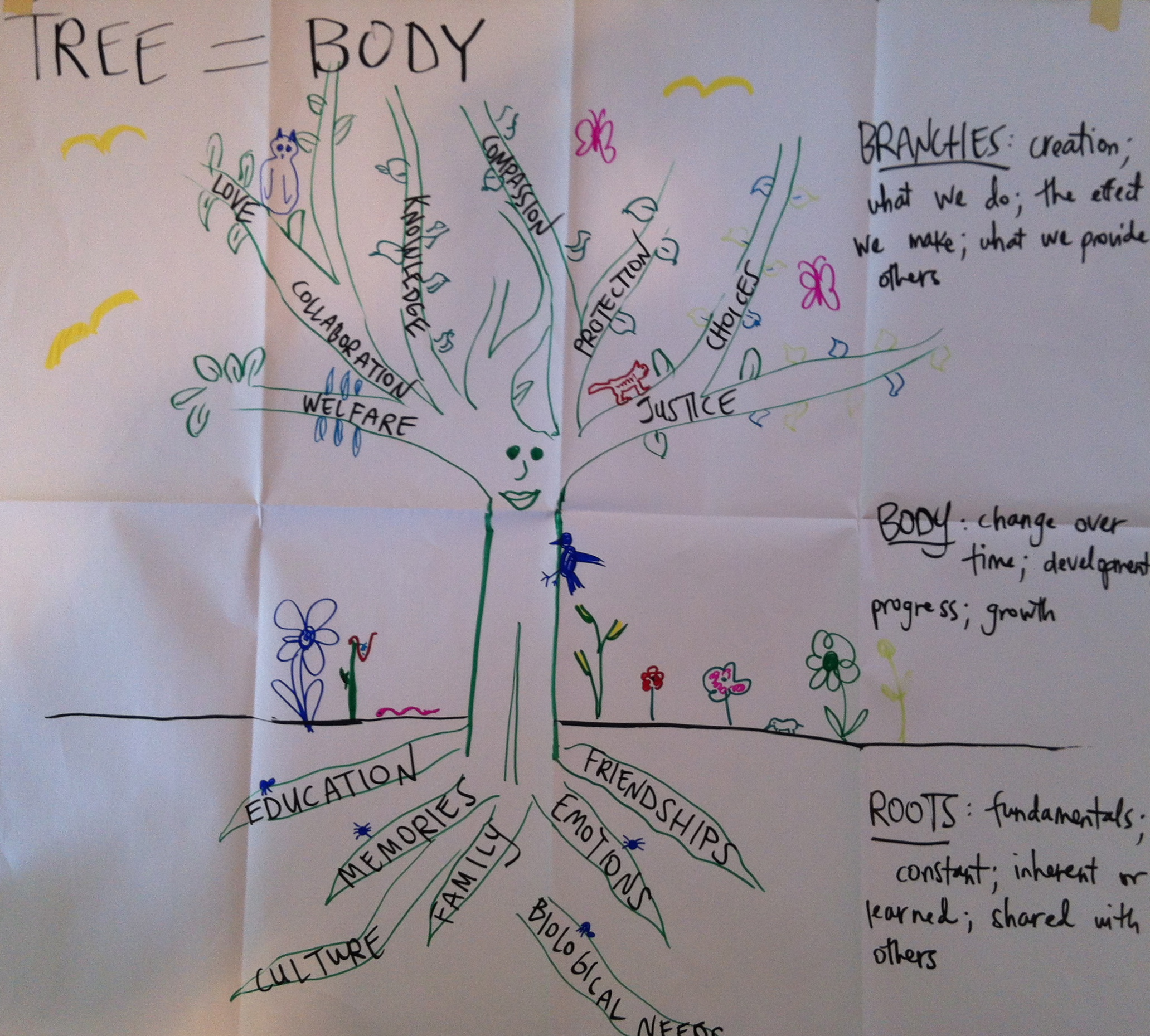
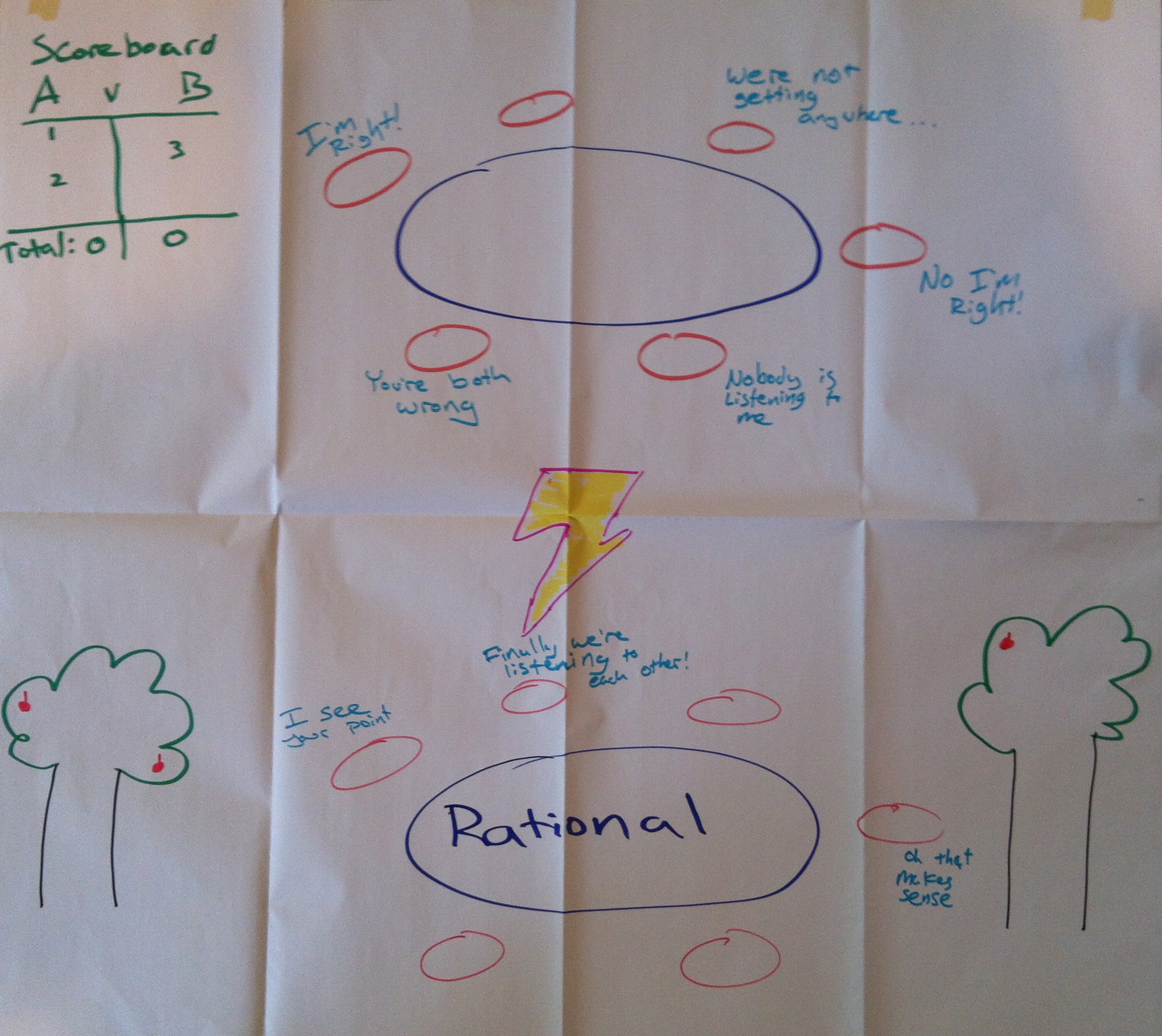
During our class on 09-19-12 we explored Ian Harris’ strategies for peace.  The class broke up into groups based on which strategy for peace they felt most aligned with their worldview.  Each groups was then tasked with creating a visual representation of that strategy.  Here is what we created.  The discussions of the artistic creations were quite enlightening.

Peace Through Sustainability

Peace through Politics (Institutions)


Peace through Justice

Peace through Transformation

Jane Goodall’s Roots and Shoots

POSTED ON BEHALF OF MAGGIE MEENEHAN

One of my hero’s growing up was Dr. Jane Goodall.  Here  was a woman,  in the 1960’s, going alone into the jungles of Tanzania with a notebook and binoculars to study and save chimpanzees.    Though she met with extraordinary difficulties and  fierce adversaries,  she has managed to become a world renown authority on chimpanzees, conservation and the plight of endangered species world wide.  She is a  leading, passionate force for change  through her Jane Goodall Institute and now has “branched out” to schools and youth with her Roots and Shoots Foundation.

Dr. Jane Goodall, a UN Messenger of Peace, is the founder of the Roots and Shoots Program,  which aims to connect students to real life service learning projects of THEIR OWN choosing.   Dr. Jane began this project in 1991, when she felt that she was meeting so many children who lacked hope for the future.  She wanted to provide them with an opportunity to “think about the world’s problems and to roll up their sleeves and tackle them”.

The projects are curriculum based and encourage youth (elementary through college) to make positive changes in their own communities.  The projects have three components, which intertwine and depend upon one another.  These components are: the animal community, the human community and the environment.  The students are encouraged to identify problems and to take concrete actions.  In working together students gain a sense of empowerment that comes from helping others.

The service projects are looked upon as campaigns.   Students act as participants but also as leaders.  The web site gives examples of past campaigns but encourages students to create meaningful projects for their own communities.   The site has lesson plans to access,  Professional Development Opportunities, Career Explorations, Projects of the Month, Extension Activities,  and Family Activities.

The web site helps students and teachers plan, organize, coordinate and report/register their campaigns.  An important aspect of the projects is engaging the communities.  Dr. Jane believes that community centered conservation programs are critical to the survival of endangered species and conservation projects.

This is a fantastic, well designed and well supported,  global environmental humanitarian youth program that relies on the participants to “work for peace”.  Currently operating in  120 countries with 150,000 members, www.rootsandshoots.org  is an amazing example of a peaceable skill building and community building organization.  As we “Peacelearners” say…..check it out!

MindUP- A Social and Emotional Learning Curriculum

POSTED ON BEHALF OF MAGGIE MEENEHAN

In these days of celebrity excesses and their often and very public demonstrations of questionable/objectionable behaviors;  it is refreshing to see that one celebrity is throwing her weight towards children’s success in school.

Goldie Hawn has started a foundation that focuses on the social and emotional learning of children.  She wanted to “bring children back to a sense of well-being”, and was distraught over the high dropout rates, violence in schools, the culture of bullying and was looking for a way to improve kid’s focus, energy and to help teachers to build classroom community.   Her program called MindUP has conducted research into “mindfulness” in the classroom, provides mentors for participating schools and has developed a book and curriculum to give teachers the tools to use in their classrooms.  These lessons fit into any schedule and require minimal prep time; they are geared towards grades 3 through 5.

I was most struck by the children and their reactions to MindUP.  As you can see in the video, the students really felt the benefits of mindfulness.  It helped them to calm down, to focus and to evaluate situations more clearly. They even taught the practices to their siblings and parents. Now that is true learning!

In learning “mindfulness” the children were learning about HOW they think.  They took “brain breaks” to breath and to relax, to quiet down their emotions and focus (3 or 4 times a day for two to five minutes).   In quieting down, the prefrontal cortex lights up and this is where executive functioning (creating, innovating, retaining information, and making connections) takes place.   Truly, this type of focusing is important for learning.

MindUP is currently being used in schools in the US, in Canada, Britain and Venezuela.  The research has shown so far that bullying and aggression has gone down on the playgrounds of participating schools.

There are four tenets of the MindUP program.  The first is “Let’s Get Focused” which helps the children learn about brain functionality.  The second is “Pay Attention to Our Senses” which prepares and teaches the students about mindful listening and exploring the senses.  The third is “It’s All About Attitude” helping the students choose optimism and lastly the fourth is “Taking Action Mindfully” which includes lessons on acting with gratitude.  (Recently, there have been several articles in the Washington Post on Happiness or the Pursuit of Happiness, which strongly link happiness with gratefulness).  This all sounds a bit preachy but I found it to be quite down to earth and doable.  The lessons can easily segue into language arts, science, social studies and math curriculums.

My favorite example was of a teacher who placed a huge water bottle full of water in front of her students and had them practice their “mindfulness” while she added drops of food coloring to the water.  She gradually worked this lesson into a lesson of the color chart and what happens to and how colors mix.  She let the children explain how watching the color disperses made them feel, or what it looked like to them.  It gave the students wonderful images to call upon during their daily mindfulness sessions.

The MindUP program addresses at least two pillars of peace.  Certainly, this methodology is develops Community Building by directing attention to the classroom as a place of safety and support and by going beyond the classroom to teach children concrete means of dealing with emotions and feelings.  Also, this program acts to Nurture our Emotional Intelligences by recognizing that everyone needs to take breaks during the day, to breath, to reflect, and to listen to his or her hearts.

Note:  The book MindUP Curriculum is for sale for $18.74 through Scholastic Books.  The website www.thehawnfoundation.org/mindup  outlines the process for becoming a MindUP school.

World Wise Schools

POSTED ON BEHALF OF MAGGIE MEENEHAN

World Wise Schools is an amazing collection of resources conceived and supported by the Peace Corps to help teachers provide real world cross-cultural understanding and learning through a global education format.  This site integrates global understanding and cultural awareness in core content area’s including: art/music, foreign language, health, language arts, science, social studies, environmental education, geography and even TESOL, for grades K-12.  The Lessons Plans are varied, hands-on, student centered and thought provoking.  A few of the sample topics of the lessons are:  traditional greetings, narrative cartoons, making books on comparing water access, Kenyan sign language, conducting interviews, global food security, educating girls, and What is Wealth?   All of the lessons deal with cross- cultural issues and bridging the communication gap between peoples of the world.  Videos slide shows, stories, folk tales enhance the lessons, and classroom speakers can even be contacted to visit your classroom for free!

World Wise Schools began in 1989, under then Peace Corp Director Paul D.  Coverdell.   In addition to the many, many lesson plans available there are several other programs that would attract the interest of teachers.  One is the Correspondence Match Program, in which a teacher signs up to have a direct relationship with a Peace Corp volunteer in the field, where they commit to exchange e-mails, letters, video’s, and photographs with each other for two years.  Students become part of this exciting exchange of cross-cultural understanding.   The relationship can develop naturally – no timetables or defined expectations, just communication.

There are also ideas for Service Learning Projects, Language Lessons, Podcasts and E-books and an E-Newsletter.    It is truly a wonderful resource for global understanding; students can easily make connections through meaningful contact with Peace Corp Volunteers and with the people and region selected.  Regions include: Africa, Central and Eastern Europe, Asia and the Pacific Islands, and Latin America and the Caribbean.

Clearly, this web site addresses the twin Goals of Community Building and Skill Building in Peace Education.   As we build community throughout this world, we become more aware of the needs, wants and desires of others, AND more aware of how our needs, wants and desires are connected to theirs.  We are brothers and sisters on this wildly, spinning, water planet.  We need each other, we must help each other, and we must learn to live with each other in peace.  This web site gives us the tools to increase our communication skills with others across the globe, building real skills towards peace.

Go to: peacecorps.gov/wws/about