High Hopes on High Ropes

Running around a track has its place, but what if your P.E. class got a facelift? High 5 Adventure Learning Center has challenged the way traditional physical education classes operate by introducing team building challenge courses that are appropriate for students k – 12. The courses can range from “low ropes” elements that engage a whole group of kids to “high ropes” elements that lift students high up into the air with a harness.  The elements that students face together are designed to bring them closer to each other as well as learn about themselves individually.

So often students are in competition to receive high grades in order to gain admission into selective universities. Rather than defaulting onto typical sports that often still allow for individuals to take the spotlight, the different elements require individuals to come together. These courses help to develop and stretch students by pushing them to rely on one another and working as a united team. An added benefit to these elements is that there often is not a single correct way to accomplish a task. Because of this, teams have to engage their creative problem solving skills. In a setting that so often has a single correct answer, this setting puts the student in the educational drivers seat.

Perhaps high adventure courses have previously been limited to those that are gutsy enough to spend a week at a summer camp, but High 5 has challenged this notion. On their website, High 5 boasts several testimonials including the NHL’s Boston Bruins team, AmeriCorps, and the Alaska National Guard. Most privy though, are the Bridgeport Public Schools. High school P.E. classes have been radically changed in Bridgeport Ct. Over 12,500 students of all ages have gone through the challenge course to date, and the schools have noticed as significant change in their students.

Ways to Use this Resource

The elements available for purchase are individually, though they suggest that groups of schools invest in a challenge course. Course building is a 2 or 3-year process and can be an expensive investment. Though there are certain benefits from investing in a specific challenge course, there are also ways to develop a teambuilding program without breaking the bank. The site offers a vast amount of reading materials and game/program bags that help teachers to hone their teambuilding skills. These books and bags are a bit more feasible for teachers that have a budget to keep in mind.

high5adventure.org
From Hostility to Hospitality

William Ury’s TED talk from October 2010 is an excellent tool for introducing new learners to the field of conflict transformation. The simplicity of Ury’s language, his use of stories and visuals, and the brevity of the lecture make this video appropriate for a broad audience, and it would be best suited for students in high school or older, in both formal and informal settings. The lecture is a wonderful way to introduce the field of conflict/peace studies to students because it incorporates key concepts such as creativity, interrelatedness, perspective, narrative, and humanization through specific examples that make these ideas easy to understand for novices.

Ury’s lecture would be a good way to begin a course or training session (such as training students and/or adults in mediation or facilitation), and should be followed with small-group discussion in order to draw out and reinforce themes. As the screening and discussion could be conducted in as little as 35 minutes, this program could serve as an “icebreaker,” allowing participants to get to know one another informally (through discussion) but also setting the scene by introducing key concepts, and inspiring the group with both emotional and rational appeals.

This program incorporates aspects of multiculturalism, conflict resolution, international relations, and even human rights. Its implementation would ideally develop a basic understanding of important themes in conflict transformation, as well as a positive attitude and optimism toward the creation of peace. Ury’s talk also inspires creativity, analysis, and reflection.

(By Emily Ludwin Miller, emillerk@gmu.edu)

Voices [Education Project]

POSTED ON BEHALF OF EDEN MESGHENNA

The mission of Voices is to share unbiased accounts of war by those who have experienced war first hand in order to “heal the wounds and lay the ground work for peaceful world”.

In addition to the stories told by soldiers and civilians, the site provided a wealth of resources for educators such as books, curricula, education packets, and instructional activities that assist with the critical exploration and dialogue of peace education. In addition to the personal narratives, the visual media that is made available through this site provides for a rich background for facilitators.

Stories of Arrival: Youth Voices, a component of the project, allow students who have recently immigrated from countries that are experiencing the hardships of war, to share their experiences using poetry. These stories are heartbreaking but powerful in that they produce a direct connection to young students that have never experienced the reality of war. To listen and share Youth Voices go to: http://www.jackstraw.org/programs/ed/youth/foster.shtml

For information go explore at:

http://www.voiceseducation.org

Nonviolent Campaigns: Who, What, Where, When, How and Why

POSTED ON BEHALF OF MONICA SHAH

So you’ve heard a lot about the powers and successes of nonviolent action but are ready to move beyond teaching about Gandhi and Dr. King. Thanks to a project lead by George Lakey at Swarthmore College, there is now a Global Nonviolent Action Database that provides free access to the hundreds of cases of nonviolent campaigns around the world! The intention of this database is, “to assist researchers and activists to better understand the special features of nonviolent struggle that make it different from both violent and institutional politics.”

Lakey, the Director of Training for Change and 2010 Peace Educator of the Year, explains that “nonviolent action” is also commonly known as:

  • People Power
  • Civil Resistance
  • Satyagraha
  • Nonviolent Resistance
  • Direct Action
  • Pacifica Militancia
  • Positive Action

The database includes cases that are identified as “campaigns”, not “movements” because they consider movements to typically consist of a number of campaigns aimed at achieving large goals. Also, the campaigns researched are ones that have reached their point of completion. Each “case” is presented as a database file and narrative that describes the issues behind the campaign.

The database can be searched by country, issue, or method used. The campaigns are grouped by the following categories: democracy, economic justice, environment, human rights (religious and women’s rights), national/ethnic identity (and anti-colonial struggles), and peace. You can learn about nonviolent action that took place everywhere from Afghanistan to Norway to Zimbabwe. You can even find campaigns that occurred as early as Before A.D. in Italy to present-day in Egypt. If you are interested in learning about the larger movements, you can search under “Waves of Campaigns” to find information about:

  • African Democracy Campaigns
  • Arab Awakening
  • Asian Democracy Campaigns
  • Colour Revolutions
  • Soviet Bloc Independence Campaigns
  • U.S. Civil Rights Movement

Here is an example:  “Egyptians campaign to oust President Mubarak, 2011”

On this page you will find the time period, the description of the location, the goals, methods and classification of the case. You can also find information about the campaign’s influences, leaders, partners, allies and opponents, order of social groups and the success outcome. Lastly, everyone also has access to the sources used to compile the information to learn even more about the study!

This resource supports three Pillars of Peace Education: 1) Exploring Approaches to Peace; 2) Reframing History; and 3) Transforming Conflict Nonviolently. Students can learn how people around the world aim to achieve peace. Furthermore, they can look at history through the lens of nonviolent actions – narratives that are often left out in schools’ historical texts. Lastly, the database acknowledges that conflicts do exist, and it provides examples of a variety of methods that people use to approach conflict alternatively—nonviolently.

With regard to the uses of the database, the team included this wonderful message: “Strategists, activist organizers, scholars, and teachers will find many uses for the database, as well as citizens wanting to expand their horizons. Even before release to the public, for example, a teacher who knew the database team was using our cases to assist middle school pupils to develop plays. Any school that teaches about the environment, civil rights, or other issues may find the curriculum enlivened by sending students to the database. History students might enjoy doing the detective work of finding the hidden stories in their local area that could be developed into cases. The database also offers an invitation to geographical learning.”

I would recommend this database to be used by students starting in middle school. Though I believe that educators can incorporate this across the curriculum, it may be most welcome in a Social Studies department. The information provided can truly open students’ eyes and deepen their understanding of nonviolence, people power, and the struggle for justice, peace, democracy or human rights around the world. It may also help students to better grasp the tactics and motivations of the ongoing “Occupy” movements across the nation. The database can be utilized in formal or community education settings. It can also be beneficial for organizers of future movements to scan through this database to examine the advantages or limitations of strategies of previous campaigns.

The 2011/2012 Peace Exchange and Other Peaceful Art Projects

The Create Peace Project is a San Francisco-based non-profit that uses art and creative expression to help create more peaceful schools and give students a creative outlet and teach them peacebuilding skills.

For the third year in a row, The Create Peace Project is engaging in “The Peace Exchange”, a program that allows students from the US and Canada to exchange messages of peace with students in Ghana, Colombia, and Nepal. Students write notes and draw pictures on special post cards, and The Create Peace Project delivers the messages to partner students around the world and returns with messages from those students. Download a flyer!

From the Create Peace Project website:

“The Peace Exchange is about connection. Connecting students to themselves, their creativity, their wisdom, and their heart. Connecting students to each other, in their classrooms, in their schools, and across continents as we bridge cultural, religious, and racial boundaries to inspire and enrich the lives of all participants.

The Peace Exchange gives students a platform from which to raise their voice for peace, acknowledge and honor each other, express themselves through their art and with words with the intention that the power of being peaceful and sharing ones self with another can create a ripple of kindness, love, and possibility felt by young people around the world.”

This project is tailored toward students age 8-18, and can be integrated into a formal school setting on a class-by-class basis or through a school-wide assembly. Resources for both options are available from The Create Peace Project. The exchange allows students to participate in something national and international and creates the space for local and international dialogue about peace.

For smaller groups or informal settings The Create Peace Project has other art options available:

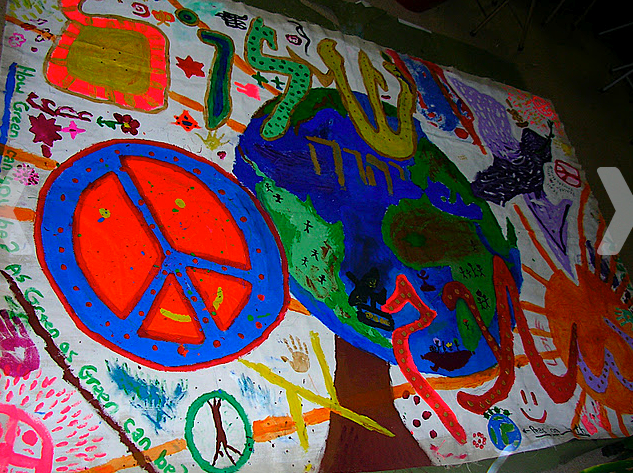
Banners for Peace is a collaborative painting workshop that promotes team building and collaboration through a 10-week workshop that works on the creation of a unique, giant piece of art that is later displayed in a communal area. Beyond building art skills and learning to work as a team, participants have a chance to design something that can inspire peace and create a space for peace dialogue. Download a Flyer!

For a shorter-term project or a more diverse group of participants, check out the Collaborate and Create workshop, a one-day activity that allows participants to bring together objects and art supplies to create a collection of art work through collaborative creative games and activities. One great thing about this project is that it can be tailored to include as more or less emphasis on emotional expression and community building depending on the venue or event.

These resources help to build community and nurture emotional intelligence, allowing participants to express their feelings and ideas in a safe and welcoming space and explore the meanings of peace in a community setting.

Get your school involved! Or for more information contact: info@createpeaceproject.org

Radical Math

POSTED ON BEHALF OF MONICA SHAH

It is a myth that peace and social justice issues can only be taught in a peace studies course. It is an even greater myth that there is no place for peace and social justice in mathematics, science, engineering or technology curricula. This post aims to bring attention to a resource for math and economics teachers of all levels who want their students to study issues of social and economic justice.  Radical Math is a site that contains more than 700 lesson plans, articles, books, charts, graphs, data sets, maps, and websites that will help lead students to not only understand issues of social, political and economic injustices through a mathematical framework, but also to learn how to develop just, realistic and mathematically-sound solutions.

Far too often students have complained about their required math courses and asked, “When will I ever use this?” Fusing social justice and math education allows students to be able to do more than memorize formulas and solve equations; they can use math as a tool to understand and change their society. Social Justice Math has two main purposes: 1) to use mathematics to teach and learn about social and economic justice and 2) to develop mathematical literacy and learn math through the study of social justice issues.  Radical Math resources can be utilized in upper elementary, middle, high school, and college classes. Such curriculum can also be integrated in community programs and classes geared to teach math, financial or computer literacy to citizens, immigrants or ESOL students.

Check out this guide created by Jonathan Osler:

A Guide for Integrating Issues of Social and Economic Justice in Mathematics Curriculum

http://www.radicalmath.org/docs/SJMathGuide.pdf

One relevant (and very current) topic that can be introduced and discussed in a math or economics classroom is the Occupy Wall Street and other “occupy” demonstrations around the nation protesting economic and social inequalities, corporate greed and injustices, and corruption. For example, students can learn about the Gini coefficient and how that is calculated, evaluate the disparities in income and wealth distribution, and calculate corporate taxes and profits.

On the site, students and teachers can search by math topic, social justice issue or resource type. Below are all of the searchable topics and themes:

By Math Topic: Algebra,  Annual Percent Rate (APR), Area, Averages, Bar Graph, Basic Math Concepts, Budgeting Money, Budgets, Cartesian, Chance, Charts, Compound Interest, Correlation, Currency Conversion, Data, Data Analysis, Equivalent Fractions, Extrapolation, Geometry, Graphs, Graphing, Fractals, Fractions, Histograms, Interest, Least Common Denominators, Line Graphs, Mapping, Maps, Mean-Median-Mode, Measurement, Net Worth, Patterns, Percent Growth, Percents, Polar, Polls, Probability, Proportions, Rates, Ratios, Real Dollars, Numbers, Sampling, Scatter plots, Statistics, Survey, Symmetry, Tessellations.

By Social Justice Issue: Achievement Gaps, African Americans, Banking, Criminal Justice System, Death Penalty, Defense Budgets,  Economic Development, Ethnomathematics, Environment (pollution, hunger, food and water resources), Financial Literacy/Education (saving, managing debt, paying for college, credit cards, loans, taxes), Gentrification, Globalization, GLTBQ, Health Care, Higher Education, Homeownership, Housing, Hurricane Katrina, Immigration, Juvenile Justice, Latino/Hispanic, Minimum/Living Wage, Lottery, Military Recruitment, New York, Poverty, Poverty Line, Predatory Lending, Prisons, Public Education, Public Health, Racial Profiling, Racism, Single Mothers, Standardized Testing, Sweatshops, Taxes, Teaching, Unemployment, Voting, Wars, Wealth, Welfare, Women

By Resource Type: Article, Book, Chart, Curriculum, Film, Graph, Map, Syllabus, Table, Website

If you have any ideas or have created a lesson plan or projects on a math topic related to a social justice issue that you would like to share with others, you can e-mail info@radicalmath.org.

Happy United Nations Day!

Tomorrow marks United Nations Day, the anniversary of the creation of the United Nations, and a day that we take time to look at the work of this important organization and talk about its impact on the world.

“Secretary-General Ban Ki-moon stated in 2010: “UN Day is a day on which we resolve to do more. More to protect those caught up in armed conflict, to fight climate change and avert nuclear catastrophe; more to expand opportunities for women and girls, and to combat injustice and impunity; more to meet the Millennium Development Goals.””

No matter what age group, or what subject matter, a discussion of one of the Millennium Development Goals, can be integrated into class today. Younger grades may enjoy learning about what education looks like in other parts of the world for kids like them. Science and health classes can tackle child health, maternal health and HIV/AIDS. Economics, government/civics classes, and other social sciences may find global partnership and gender equity fitting themes for discussion. Some groups may want to find ways to live more sustainable lives or help end hunger. Find out how close we are to reaching these goals and what you/your students can do to help. Use a video/interactive media resource to add a new twist to your lesson!

Check out tomorrow’s ongoing events at the UN and promotional materials on the live webcast.

See how the UN is participating in New York City Public Schools and find examples of resources to use with high school students.

For a holiday themed addition, transform Halloween into a time to give back: check out Trick or Treat for UNICEF to learn about the campaign and see how you can incorporate donation boxes into your school or neighborhood’s celebration.

For other education resources from the UN to incorporate tomorrow and year-round check out the cyber school bus!

These resources and activities designed to recognize this day and this institution can help to build community by creating common goals for the class to work for and think about through class-wide, school-wide, or community-wide projects. A look at the UN can also help students explore approaches to peace by recognizing the physical, structural, and cultural violence that exists in the world, and highlighting the global community’s efforts to eradicate that violence.

Peace Week 2011

Peace Week 2011 is a free global telesummit that involves “an extraordinary week of presentations, forums, music, art and reflection on the prospects of creating a sustainable culture of peace.”  There are 52 peacebuilders who will be speaking throughout the week.  I learned about this event from one of the people I follow on Twitter.  Upon opening up the website and learning more about the program, I immediately signed up to participate.

I find this to be a great peace education resource to bring into classrooms because its an opportunity to expose students to a global network of peacebuilders working in a variety of fields.  I think its most appropriate for high school, under grad, or graduate students, as I assume from the topics being covered, that the different sessions are somewhat advanced and would require some background in peace studies to fully appreciate or grasp the subject matter.  Given the large amount of presentations and the week-long schedule, I think this program could be incorporated into either formal or nonformal educational settings.

Continue reading

New resource from Educators for Social Responsibility

Book by Book, by Carol Spiegel, is a valuable resource for librarians, teachers, guidance counselors, and parents to find books to complement the standard language arts curriculum for teaching important peacemaking and social and emotional learning concepts. Written by a veteran peace educator, Book by Book leads adults to children’s literature that will help students explore themes related to conflict and its resolution, social justice, and appreciation for diversity.

Learn more…