Men Make a Difference in Prince Georges County

POSTED ON BEHALF OF MARG BRENNAN

Every year in October, Prince George’s County schools participate in National Men Make a Difference Day throughout different schools. Below are two news briefs, photos, and a slideshow about the event that were released by the county:

http://www1.pgcps.org/communications/press.aspx?id=165385

http://www1.pgcps.org/communications/press.aspx?id=164724 (various events throughout the day)

https://picasaweb.google.com/PGCPSphotos/2012MenMakeADifferenceDay?authuser=0&feat=directlink

At my middle school, the event runs for the entire day. Fathers, uncles, siblings, cousins, and many other community members are invited to come in for breakfast, participate in workshops throughout the day, and attend or participate in any student classes. We had over 100 participants this year (which in the three years I’ve been at the school has been the greatest turnout yet) and my students thoroughly enjoyed bringing guests into the classroom and interacting with the other participants. Some spoke about their careers or families and answered any questions that students had.  Participants could join the children for lunch and they had a closing lunch provided for them, as well as a round-table discussion with students. Some of the participants were already established mentors within our community and informed students of resources available to them.

I think that this event can be incorporated into any subject or class. As a math teacher, I really enjoyed having the participants in and out of my classroom all day, but I would have said that regardless of the subject I teach, as their contributions really didn’t have much to do with math specifically. With more planning, I think that these participants could be incorporated into subject-specific lesson plans, but it was definitely not necessary to do that.

Many of my students do not consistently have a positive male role model and most responded very well to the visitors in the classroom. For these students in particular it was helpful that some of the participants were established community mentors and it opens some doors for students outside of school. Because many of our guests spoke to students about careers and future decisions, the type of event we planned I think works best with middle and high school students, who have the capacity to have those conversations; the same type of event could definitely be used with younger children as well, who are just as much in need of the mentoring. The formal educational setting worked well, although I could definitely envision this in a less formal community venue as well.

In my opinion, the potential for the knowledge, skills and attitudes that students could develop from participating in this event and engaging with the guests is significant. I speak to many parents and guardians that start conversations with something like, “Well I’m trying my best, but I’m working two or three jobs and it’s just me.” I have several students who don’t have the opportunity often to have meaningful conversations with adults beyond their teachers and this provides the opportunity for them to really learn from others in their community. Students learn about opportunities to become involved in events outside of school – many are not involved in sports, after-school activities, or any outside activities and end up with a lot of unsupervised downtime; they are exposed to different opportunities with events like these.

From my vantage point, this event supported multiple pillars of peace education, but I saw the most from Community Building (as discussed above) and Skill Building. Some of these role models really went above and beyond and discussed relevant issues with students.  I watched some of my more resistant students open up, even if it was only in the form of letting them help them with classwork. I am often asked when “so and so’s dad” or “that police officer” will be coming back to the room. They touched on things like conflict and related it to when they were in middle school or trying to fit in and figure out who you are. For many of my students, this message, and especially where it was coming from – men from their community that they were able to relate to – had an impact. My students are at an age where they start to make decisions that will have a lasting impact on the rest of their lives and they often do not have the capacity to make the best decisions in those situations. This program, which I wish happened more often, plants some seeds for more informed, thoughtful decisions.
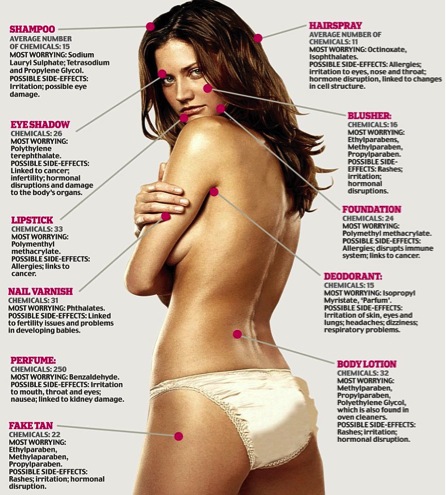
All Natural Beauty Products

POSTED ON BEHALF OF BETH JIMERSON

Take a look at the alarming picture above. It points out the large number of chemicals that most of us come into contact with on a daily basis. How many chemicals do you recognize or come into contact with every day?

Not only do the chemicals found in everyday household and beauty products harm our bodies, but they also harm the environment. After being awakened to the alarming number of chemicals found in everyday products that we actually put onto our bodies on a daily basis, I decided to do some research into what exactly those harmful chemicals were, in order to avoid them. I then decided to go one step further to find natural ways to produce my own products as alternatives both to get away from the commercialism involved in beauty products and also to save some money, and the environment! Although this started out on more of a personal journey to health and well-being, I started to see the bigger picture of creating less waste and allowing fewer chemicals into our environment. The link below shows one of the websites that I found most useful and interesting, though there are many if you search around:

http://tlc.howstuffworks.com/style/50-all-natural-beauty-products-you-can-make-yourself.htm

The chart (perhaps minus the half-naked model) could be used to exemplify some of the harmful chemicals that we come in contact with on a daily basis and start dialogue about what other products might contain these chemicals (such as cleaning products?). As the beginning of a lesson, students could check out the labels of products they use daily or ones that are in their cupboards for any of the above chemicals. They will probably be surprised at the amount of chemicals they come into contact with on a daily basis! They could then look at natural alternatives and decide what natural products have which properties. For example, one of the products often found in natural beauty aid is lavender. A quick search even on Wikipedia highlights the benefits of lavender as:

believed to soothe insect bites, burns, and headaches. Bunches of lavender repel insects. In pillows, lavender seeds and flowers aid sleep and relaxation.[9] An infusion of flowerheads added to a cup of boiling water is used to sooth and relax at bedtime[citation needed]. Lavender oil (or extract of Lavender) is used to treat acne when diluted 1:10 with water, rosewater, or witch hazel; it also treats skin burns and inflammatory conditions.[citation needed] A recent clinical study investigated anxiolytic effects and influence on sleep quality. Lavender oil with a high percentage of linalool and linalyl acetate, in the form of capsules, was generally well tolerated. It showed meaningful efficacy in alleviating anxiety and related sleep disturbances.[18]Lavender can be used to treat different types of cancers, such as, breast cancer, ovarian cancer, prostate cancer, pancreatic cancer, and liver cancer. Although it has not been completely proven that lavender is effective towards these cancers, many studies have shown that lavender has led to disease stabilization or tumor regression.[19]Lavender may be very effective with wounds; however, Lavender Honey (created from bees feeding on lavender plants), instead of lavender essential oil has the best effects of uninfected wounds. (http://en.wikipedia.org/wiki/Lavender)

Students can explore using the recipes in the website, finding their own websites, or even experimenting with developing their own natural products through careful research on the different properties of natural products. It is important to point out that there can be negative effects of certain products as well, and allergies related to them. Even something as seemingly innocuous as lavender has shown to have the following negative effects:

Lavender oil can be a powerful allergen, and it is also recommended that it should not be ingested during pregnancy and breastfeeding.[21]

In vitro, lavender oil is cytotoxic. It increases photosensitivity as well. Lavender oil is cytotoxic to human skin cells in vitro (endothelial cells and fibroblasts) at a concentration of 0.25%. Linalool, a component of lavender oil, may be its active component.[22] Aqueous extracts reduced mitotic index, but induced chromosomal aberrations and mitotic aberrations in comparison with control, significantly. Aqueous extracts induced breaks, stickiness, pole deviations and micronuclei. These effects were related to extract concentrations.[23]

However, according to a 2005 study “although it was recently reported that lavender oil, and its major constituent linalyl acetate, are toxic to human skin cells in vitro, contact dermatitis to lavender oil appears to occur at only a very low frequency. The relevance of this in vitro toxicity to dermatological application of lavender oils remains unclear.”[24]

In terms of phototoxicity, a 2007 investigative report from European researchers stated that, “Lavender oil and sandalwood oil did not induce photohaemolysis in our test system. However, a few reports on photosensitivity reactions due to these substances have been published, e.g. one patient with persistent light reaction and a positive photo-patch test to sandalwood oil.”[25]

In 2007, a study was published in the New England Journal of Medicine which indicated that studies in human cell lines indicated that both lavender oil and tea tree oil had estrogenic and antiandrogenic activities. They concluded that repeated topical exposure to lavender and tea tree oils probably caused prepubertal gynaecomastia in some boys.[26] The Aromatherapy Trade Council of the UK has issued a rebuttal, [27] and it is also disputed by the Australian Tea Tree Association, a group that promotes the interests of Australian tea tree industry.[28](http://en.wikipedia.org/wiki/Lavender)

Also keep in mind that more extensive research can be done on the properties of such oils.

This exercise or one similar to it touches on the pillars of exploring approaches to peace by looking at peace as an environmental standpoint, and skill building by building, practicing and adopting life skills that bring about peace through attention to our environment. As is stated in our module on peace through environmental education, many agree that “life on Earth has entered its most precarious phase in history.” Environmental education considers how to balance respect for nature and its sustained health with human needs. While we might argue that we need certain products to feel good and feel good about ourselves, there are options to do so without harming our bodies or the environment. I challenge everyone to try just one of these recipes and cut out some amount of harmful chemicals from our daily routines not just for the environment, but for ourselves!

Tourettes and Public Speaking

POSTED ON BEHALF OF KI’TAY DAVIDSON

Content

The content of this lesson is centered on a spoken word performance performed  by a young man on HBO’s Brave New Voices (a series focused on illuminating the power of youth poetry) .  This video was found on youtube and can be easily accessed on the internet.

Context

This lesson plan is tailored to high school students in their junior or senior year and students predominantly in lower level classes, alternative schools and special education. Moreover,  this lesson plan would be most beneficial to students working with a speech pathologist.  The entire lesson is focused on speech and learning differences and empowerment through ownership, creativity and self acceptance. As a result, the classroom atmosphere would need to be formal, and a “safe space.” Overall, the presentation of a young person being proud of their disability will be both empowering and unique for most students in these classrooms. Hopefully, each student would leave with a divergent perspective on disability and would reclaim their own power and skillset to succeed not in spite of their disability, but because of their disability.

Goals and Objectives

Schedule of the Lesson (50 minute class):

(1) Watch video as a class (5 minutes)

(2) Write poem about yourself in relation to the poem (15 minutes)

(3) Perform poems in front of class (if students do not want to perform in front of the class they can perform to the  teacher by themselves on a separate date) (30 minutes)

Overall, this lesson plan will incorporate peace education by focusing on multiple intelligences and community building.  Public speaking is a skill that is beneficial and useful for most individuals; however, rarely are students given the opportunity to present or sharpen their speaking skills. As a result, this lesson plan will have each student write a poem about themselves and an asset that many have labeled as negative, but they feel is positive. From there, each student will have the opportunity to share in front of the class or present separately to the student. The teacher can tailor the length of this activity depending on the number of students. As a general note, each student should expect their poem to be about 1 to 2 minutes. Each student will have emot, as well as an activity that boost their public speaking skills.

Furthermore, this lesson plan will incorporate community building by facilitating an activity that promotes active listening, shared experiences and empathy.  Students may hear other stories that relate to their own and will respect the courage of their peers to share potentially vulnerable experiences in their own lives.

Where Is Iraq on the Map?

POSTED ON BEHALF OF EMILY FLEITZ

Where is Iraq on the map?  This question haunted me as a middle and high school student.  Post September 11, Iraq and Afghanistan were all over the media, yet most Americans could not point them out on a map.  Seventh grade US History was spent memorizing the countries of the world and their capitals so that we would at least be able to point out the general vicinity of where US soldiers were stationed.  I did a good job on these tests, but without any context for my knowledge I quickly forgot the capital of Hungary and the location of Taiwan.

ProjectExplorer.org works to solve America’s geographical incompetence.  It is a nonprofit organization developed by Jenny M. Buccos in 2003 that produces free, online global travel series. Designed for family and classroom, ProjectExplorer.org provides students with access to peoples and places they may never have seen or knew existed.

The website include suggested materials for Upper Elementary, Middle School and High School students, as well as ideas for family use.  Students can explore the website at their own pace and select different spots on the map to watch videos and learn about a specific country’s culture.  I loved the segment on India, it captured the culture of a vast country in a short video clip that was engaging and informative.  Other sections require students to read blogs written by visitors to the country.  Hyperlinks allow students to expand their learning with more information on historical or geographical concepts.

This activity would be good for addressing different learning styles.  Learning about a country through a visual/audio interactive experience would help students with certain learning styles to more fully grasp the nuances of foreign cultures.

Peace Players International

POSTED ON BEHALF OF DANIEL KNOLL

http://www.peaceplayersintl.org/

When I was in 9th grade I took part in the Jewish Youth Philanthropy Institute. With 25 peers we were tasked with donating a certain amount of money to what we considered worthy non-profits. The catch was that we were being asked for more than we had, and we had to allocate our money wisely. Growing up I played a lot of sports, so I feel in love with one organization, Peace Players International (PPI). 14 year old me loved the idea of combining conflict resolution and sports, and the concept has stuck with me for all these years. PPI’s motto is simple – “Children who can play together can learn to live together.” What started as an idea between 2 brothers from Washington DC turned into an international movement, with programs located in Northern Ireland, Israel / West Bank, Cyprus and South Africa.

Each region provides a diverse set of learning opportunities for ‘would be’ conflict communities. The primary focus of the sports programs are designed for youth between the ages of 6 and 14. By creating opportunities in a non-formal setting, PPI creates long-term relationships between its participants, even offering ‘graduate’ programs on leadership in the community for those who are too old for the original curriculum. One problem PPI faces is “exceptional” thinking. Too often participants think their teammate is the “exception,” and that the rest of the ‘other group’ is bad. Coaches emphasize making sure lessons stick off the court by encouraging their students to think “outside the box” and develop a way of “interacting with those around us that honors both others’ humanity and our own responsibility for change.”

As an educator programs such as these encourage the concept of peace building through cooperation necessary to accomplish a common task. Whether it’s scoring a basket, completing a puzzle or writing a group paper, the objective is the same: teaching students how to work together. What I particularly enjoy about PPI is the incorporation of the bodily kinesthetic side of students, which is often difficult to present in a traditional classroom setting.  And the curriculum can be tailored to the needs of the community. In South Africa, athletes are taught about making healthy decisions and HIV/AIDS education. In Northern Ireland, students focus on how to handle “the complexities of growing up in a post-conflict society.”

South Africa – http://www.peaceplayersintl.org/locations/south-africa

Northern Ireland – http://www.peaceplayersintl.org/locations/northern-ireland

When looking at the 7 pillars of peace education, PPI is built around community building and transforming conflict non-violently. By giving the youth within conflict communities an opportunity to build their own perceptions of the conflict in a nonviolent way on the court, PPI reshapes the future discussion between the parties. Often times conflict is so rooted with in the culture and fabric of peoples history that the best way to break the cycle of conflict is by giving children the chance to build relationships in their own way. Their team becomes their community. A diverse community that sets the example that the two sides cannot just peacefully coexist, but thrive and succeed together. While studying abroad in Israel and seeing first hand the separation between Israel and the West Bank it is inspiring to see children creating a possibility of peace in the future through success on the basketball court.

http://www.youtube.com/watch?v=XqhyDArfvfA – PPI was even featured on an ESPN segment about Conflict in the Middle East. The 5 minute segment has some very interesting interviews from coaches, athletes and parents.

Strange Days on Planet Earth

POSTED ON BEHALF OF KATIE KASSOF

“Strange Days on Planet Earth”, a special miniseries produced by National Geographic for PBS, explains the interconnectedness of natural and made-made systems on earth in an easy to understand way.  It’s formatted a bit like a detective show starting with a problem, like an increase in baboon population in Ghana, and traces it backwards to the root cause, like over fishing in our oceans.  Many global problems are explored.  Ultimately the show provides an excellent explanation of the ripple effect, something that happens in one part of the earth can have severe effects somewhere else entirely.  Two episodes are available on Netflix Streaming and the entire series (two seasons with six total episodes) is available for purchase from PBS online.  There are educational resources available for middle school aged students on the PBS website as well.

The way I envision using this film, though, is with a high school environmental science class, documentary film class, or combination thereof.  I think that by focusing on this film with an older group of students, we can delve deeper into the educational content as well as the communication styles employed by the movie.

This film will be watched as inspiration for a one to two month production project.  Since the film explores a problem and works backward to the cause of the problem, then gives viewers a solution to the problem, this is an excellent opportunity for the students to recreate the template.  They will research a local environmental problem of their choice, becoming an expert in the problem, its cause and steps to overcome said problem, and develop relationships with people working on the solution.  Then they will develop a targeted communication plan including determining their target audience, the format of their film, and writing the script.  Finally, they will create a 3-5 minute documentary which will explain the cause and effects of their chosen problem and present at least one solution.  Expanding the project might include creating other materials to go with the film such as a website, call to action event in cooperation with a non-profit in the area, or a screening of the film for the community.

This project will engage multiple intelligences by having the students involved in every aspect of the production process as well as building skills necessary for effective communication of a problem, good research habits, and technical film skills.

Could Lincoln Be Elected Today?

POSTED ON BEHALF OF ADAM C. EVANS

http://www.flackcheck.org/

This website was brought to my attention through a publication for members of the National Council for the Social Studies.  In an attempt to promote responsible rhetoric, FlackCheck.org fights hyperbole in political advertisements by analyzing the criticism candidates give one another – often through mischaracterization.

During any election season we are constantly bombarded with political advertisements.  Students come often enter the classroom with little understanding of the actual candidates and issues.  Instead, they remember the inflammatory rhetoric in these advertisements or some overly simplistic version of the truth.

In an effort to reframe history to better understand today, flackcheck.org has produced a series of attack ads that help answer the question, “Could Lincoln be Elected Today?”  I have used similar resources in U.S. History classes from fifth to twelfth grade.

http://www.flackcheck.org/lincoln-campaign/

Each of these advertisements treats the volatile election of 1864 as a modern election, complete with Super PAC funded advertisements for the two main candidates.  The Civil War raged as Lincoln ran against a former general who promised a swift end to the war, even if it meant losing the Southern states.  Politics in the era were not gentlemanly or more civilized than today.  The methods of delivering the message – and the language employed – were of a different era, but the desire to win at any cost has been a part of American politics from as early as 1824 with the “Corrupt Bargain.”

I plan to use these attack advertisements in the coming weeks as students study the Civil War at the same time as the 2012 Presidential election.  We have already analyzed political advertisements in the twentieth century via the website LivingroomCandidate.org, and students are paying closer attention to this election’s advertisements.  My plan is to have students fact check the Lincoln advertisements in order to develop their research and critical thinking skills.

One goal of utilizing this resource is to reframe history in such a way that students understand the past is complicated.  Lincoln was not guaranteed a second term and the nation would be vastly different if he had been defeated by George McClellan.  The election was contentious, and many people looked to McClellan to bring peace.  The war certainly would have ended, but we know the absence of war does not necessarily mean peace.  These advertisements can help students understand the divided nature of the country, even among those on the side of the Union.  This can help students understand Lincoln as something more than a man carved in marble.

The other pillar of peace education implicit in this resource is community building.  By analyzing attack ads from another century, students are far enough removed from the era so they can look more closely at the political tactics in the advertisements.  In doing so, students learn the skills necessary to evaluate political advertisements for the 2012 election.  The use of this resource takes the contentiousness away from a political discussion, which can help build community among a heterogeneous group of students.

Drug Use Prevention in Schools

POSTED ON BEHALF OF AUDREY VAN GILDER

Thinking back to my own elementary and middle school experiences, I’m becoming more aware of the shortcomings of my school district’s health education approach. While it was no doubt better than some programs found in public schools (health classes were either required electives or part of the curriculum for several middle school years), simply inserting a tsunami of information into a school day filled with many other educational priorities is usually ineffective. Specifically, my health education about drug use and abuse was limited, outdated, often unrealistic and – generally – not part of a peace-promoting curriculum.

The consequences of such programs become clear later in a child’s education, when exposure to drugs and alcohol is more common. Among certain communities, a resurgence of drug abuse has many concerned about the necessity of reforming health education programs to be more holistic, inclusive and – although it’s not always stated explicitly – part of broader peace-based curricula. This UNICEF manual for educators provides an excellent guide to developing such a program:

http://www.unicef.org/lifeskills/files/DrugUsePreventionTrainingManual.pdf

It is general enough that educators can adapt or excerpt it to their needs, but also very thorough and based on self-evaluation, skills development, and reflection. I envision American middle and high schools reworking their health education programs to take into greater account the realities of learners’ communities, pressures put on young people by society, as well as the own self-determination, problem-solving capability and autonomy of students.

I think there are great opportunities to encourage introspection and creativity within drug education programs. Young students aren’t clueless; even if drug abuse is not of huge concern to them or their particular community, attitudes toward drugs and alcohol definitely change over time, and early drug education programs must take into account this transformation. This video was created by students at my friend’s high school to directly confront drug abuse in the community with honesty and reflection: http://www.neuquaondrugs.org/

A program called CASASTART addresses this by assessing risk, basing its programs on the fact that young people who lack human and social support systems are more likely to continue and intensify substance abuse that may not be as much of a danger to young people with those systems in place. You can read more about CASASTART and many, many other alternatives to health education programs here: http://www2.potsdam.edu/hansondj/Controversies/20070111184521.html.

Two of the pillars of peace education that such an initiative will address are community building and transforming conflict nonviolently. First, a realistic peace-based drug education curriculum can’t exist within a vacuum, as I believe mine did. Honesty and pragmatism is required on the teacher’s part, as is a safe learning space and strong sense of community within the classroom. Second, if drug use and abuse is understood as a likely conflict that young people will face, steps can be taken to transform that potential for conflict – and to avoid all the other conflicts that can follow drug abuse – before it even happens. If students are encouraged to be self-aware and resilient, and have a more holistic, peaceful, and informed idea of how they might react to drugs in real life, the dangers of drug abuse in a community will be lessened.

The Farm at Walker Jones

POSTED ON BEHALF OF SARAH JACKSON

The Farm at Walker Jones was founded by my friend and former colleague, David Hilmy. David and I used to teach together at Lasalle-Backus Educational Campus in Northeast DC.  David is absolutely passionate about educating our youth through a service-learning, hands-on approach. He has his students learn about, grow, tend, harvest, and cook all their own food. He has D.C. kids eating eggplant! It’s a true breakthrough. The food they grow goes to their families and to local farmers’ markets throughout the city.

This learning resource would be great for kids of all ages – including grown ones. We all could stand to learn more about our food source and the benefits of growing and eating local food to create a sustainable existence.  It could be part of a formal curriculum or informal, depending on how thoroughly one would want to become involved with The Farm.

I would incorporate this into peace education in multiple ways. I would extrapolate curriculum that discussed how health, environment, economics, and community affect the choices we make in life and how this impacts our interactions with others. I would focus on how all of these areas of living overlap at The Farm and other places like it.

Students would build their awareness of the choices they possess in how they treat their own bodies, their environment, and others. They would journal and chart their own transformation both physically and emotionally through their experience at The Farm; perhaps even financially, depending on the involvement.

The two pillars of Peace Education supported by this resource are skill-building and engaging multiple intelligences. Through their work at The Farm at Walker Jones, students would learn how to create their own food source. This is a transformative learning experience, as it allows one to consider everything he/she does that impacts the environment and ultimately what grows in the environment. In addition, students would access a wide variety of their intelligences: interpersonal, naturalistic, kinesthetic, visual, logical/mathematical in the process of caring for the plants and bees at The Farm.

Let’s Hold Hands: A Lesson in Peace for Young Learners

POSTED ON BEHALF OF LEAH THOMPSON

I’m excited to share an activity I have facilitated to young learners in North Carolina, Egypt, and Bolivia.   The Let’s Hold Hands project was created by illustrator and author Susan L. Roth.  Roth co-authored Listen to the Wind, the children’s version of Greg Mortenson’s Three Cups of Tea.  This picture book uses minimal text to tell the story of a community working to build a new school, and is best known for its unique illustrations.  Roth uses bits of scraps, fabric, pieces of paper, and other materials to create textural collages for the book’s illustrations.  See example below:

Stemming from the book’s illustrations, the Let’s Hold Hands project was created.  The purpose of this project is for students from around the world to create self-portrait dolls to serve as “ambassadors of friendship.”  As part of the activity, students are instructed to use creative materials (yarn, traditional fabrics, recycled paper, etc) to create a paper doll that represents who they are.   The dolls are meant to be connected and displayed holding hands with other dolls.  When I facilitated this activity in an international setting, I took with me dolls created by American students to be connected with the dolls made by students in Egypt and Bolivia.

Here are examples of dolls created by my students in Bolivia:

Dolls created by my students in Egypt:

Susan Roth’s website features a page for the Let’s Hold Hands project: http://susanlroth.com/letsholdhands/index.htm

The website provides specific instructions for how to make the dolls, including a list of materials and a printable pattern.  There is also a link for students and teachers to submit their dolls to be exhibited on the website.

I think this activity is most appropriate for young learners, though I have done this activity with students ranging from kindergarten to high school.  Creating the dolls and using recycled materials as part of the learning experience is a lot of fun.  Students use fabrics native to their region, and dress them in traditional attire specific to their country.  A main objective of this activity is to develop a conversation around what it means to hold hands with people from around the world.  Students begin to consider how their doll will be connected, hand-to-hand  with another doll, sometimes from another part of the state, country, or world.  What does holding hands symbolize? What does it mean that all the dolls do not look the same?  What does it mean to be a part of the global community?  As always, the discussion can be tailored to be appropriate for the age level of the participants.  This activity works best when classrooms around the world can connect to share dolls across boarders.  I think of this activity as something akin to a modern day version of pen pals.

This activity best supports the two pillars of Community building and Engaging Multiple Intelligences.   I recognize it as community building because it allows students to find similarities and unite with others, while still celebrating their individual differences.  Students are encouraged to consider what makes them unique and special, and how despite any differences, they are capable of connecting with others.  The activity also utilizes the Multiple Intelligences, encouraging students to be creative and artistic, and developing interpersonal skills.  By using recycled materials, students have the opportunity to be “nature smart” and use resources from the natural environment to create their self-portrait doll.

On her website, Susan L. Roth says “these hand-made collages will be symbols for the good will of today’s children as they work towards being tomorrow’s peaceful, accepting, respectful, adult friends.
 Put out your hand to find a new friend. Hold hands across the street, across the city, state or country. Hold hands across the ocean.”