Case Study Iceberg

By: Kathia López


Hello, Peace Learners!

I would like to share this educational resource you can use when teaching youth about narratives and hate speech. It is called the “Case Study Iceberg”.

Relevance of this Resource

We are living in particular violent times and unfortunately, narratives against certain social, cultural and ethnic groups are being spread out, increasing the spiral of violence. The internet and social media are serving now as an amplifier of the repressive narratives behind hate speeches, and the freedom of expression is being used to justify them. We are witnessing an increase in gender backlash, a surge in antiimmigrant sentiment and more frequent attacks in the name of religion and national security. These trends are intensified by rising online polarization and disinformation, which make harmful narratives travel, unfiltered.

This affects youth in an exceptional way, since they are more avid users of these online platforms, where they can feel shielded and entitled to attack, threat, dehumanize others, and even call for violent acts to be committed. Conversely, the youth who aren’t involved in such acts are also highly exposed to such content and so is their sense of identity, belonging, safety, their self-esteem and their mental health.

Considering this current context, I have come up with the “Case Study Iceberg”, an educational resource based on the “Case Study Activity” and other tools and ideas included in the Youth4Peace Training Toolkit, created by the United Network of Young Peacebuilders (UNOY). In other words, “Case Study Iceberg” is my adaptation of the “Case Study Activity”.
The Youth4Peace Training Toolkit helps beginners and intermediate educators introduce peace and conflict concepts to young people in non-formal settings (I highly encourage you to take a look at it, by clicking on the hyperlink above, since it is a practical and comprehensive peace education resource).

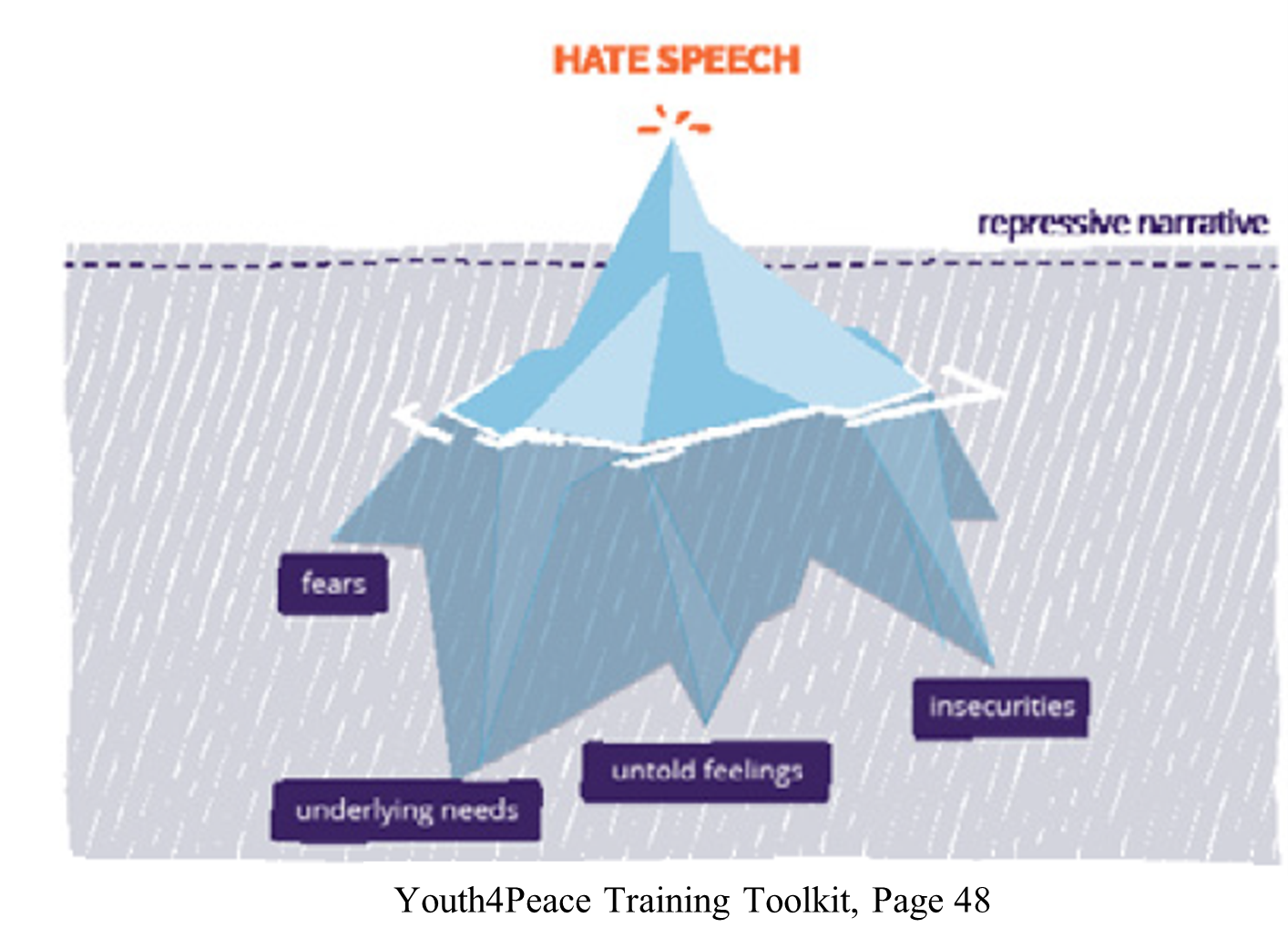
One of their lessons is about “Strategies to (re) act to hate speech narratives” and its purpose is to explain the definition of hate speech as a form of violence and learn the multiple ways youth can deal with it. To explain this, they use the symbolism of the iceberg. The list of strategies to deal with or manage hate speech are: Avoid, Draw a line, Report, Refute, Alternative (transformation) and, Dialogue Transformation (See page 39 of the Toolkit).

About my adaptation

I think the “Case Study Activity” can be very useful if educators just want to convey theory about narrative and tools to respond to forms of harm such as hate speeches. But it is possible to bring a more transformative approach to it by using the iceberg image to promote global agency, critical thinking, empathy and help avoid or reduce conflict. The analysis of such symbol can lead participants from cognitive to experiential learning by reflecting on what’s underneath the visible part of the iceberg. The humanization of the other and the use of strategies that stem from that humanization process are the ultimate learning goals of this resource.

If your educational work aims to transform violence and promote peace, I think my adaptation to the “Case Study Activity”, the “Case Study Iceberg” will fit perfectly with you and your students.

Scenarios

When creating the scenarios think of current realities and themes that affect the youth you work with, for instance: bullying, ethnic identity, sense of belonging, gender. Examples of the scenarios can be:

  1. In a Snapchat school group, someone posts: “Why are people like you in this group? Go back to your country!
  2. On a viral Tik-Tok video a famous influencer showed a group of high school students wearing their religious/cultural garments on a science fair and they claim that “we are in a western and modern society; they should be dressed as normal people”.
  3. On a YouTube video that shows female students in a debate panel about woman’s rights, somebody comments that “woman need to stop thinking they are better than men”.

How much time would it require to use this resource?

60-90 minutes, depending on the number of participants.

Materials

Printed images, markers, flipcharts, projectors, slides, different color sticky notes (whichever is accessible for you).

How to use it

  1. Introduce the hate speech definition by showing the iceberg image and the strategies as well.  
  2. Place several iceberg images (they can be printed or drawn) in different spots of the room.
  3. Show them 3 hate speech scenarios and assign one to the different groups of participants, which will be divided into targets, community members and bystanders.
  4. Ask them to identify what is visible (words, images/memes, actions) and what might be underneath (feelings, needs, history, experiences, insecurities.) Prompt questions to help students analyze beyond what is obvious, such as: why do you think they are saying that? Are they trying to protect something? These questions will depend on the scenarios given.
  5. Ask them to write their answers on sticky notes they will place on the iceberg image.
  6. Invert the iceberg image (you can use a separate iceberg image) and display the list of strategies to re(act) to hate speech (printed or in a projection).
  7. Invite them to think about what would be visible if the needs were met in a positive, healthy way or if the perception of them being unmet changed positively?
  8. Ask them again to write their answers down on (different color) sticky notes and place them on the inverted icebergs.
  9. Now invite them to think, from their role or position, (targets, community members and bystanders). Ask them to answer on the strategies they would apply to deal with the hate speech.
  10. Invite them to share their ideas with the whole group.
  11. Debrief questions. You can use some of the questions included in the Toolkit such as: How did you feel during the activity? Which scenarios did you find most difficult to respond to and why? Has the activity made you look at hate speech in a different way?

Additions
I would even be more ambitious and add a lesson on Nonviolent Communication (See pages 41-42 from the Toolkit), along with the hate speech and strategies theoretical framework, to inspire students to think of more developed strategies to re(act) to hate speech.

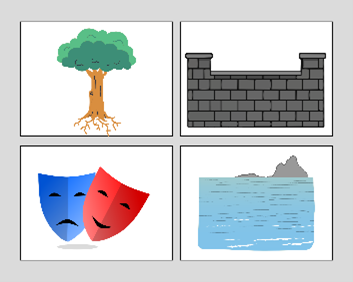
If the symbol of the iceberg doesn’t resonate or it is not too familiar to the participants, you can use other images (as long as they represent an object with visible and not visible sides). Examples: a tree, a wall, a mask or the ocean.

Trauma Sensitivity and Emotional Safety

Be trauma sensitive and consider emotional safety when you think of the scenarios and while running this activity. There is a risk of triggering emotions and hurtful lived experiences. Educators should be aware that many young people have experienced bullying, discrimination, xenophobia, misogyny, or online harassment, and even a fictional scenario can echo something deeply personal. To reduce this risk, you can:

  • Allow the participants to step out of the room, pass, or engage in their own way.
  • Avoid showing the scenarios with images and creating very specific scenarios.
  • Remind them they do not need to share personal or familiar experiences; there is no need to share stories if they do not want to or are nor ready for it.

Who is this resource helpful for?

This resource can be very helpful for teachers in school settings, counselors, educators in non-formal educational settings. It can be adapted to any sociocultural context. I would even say it can work with young adults, but it is specially designed for young people from 15-25 years old.

Knowledge, skills, or attitudes developed with this resource

  • Knowledge: about hate speech, repressive narrative, multiple ways (strategies) to deal with hate speech, nonviolent communication.
  • Skills: conflict analysis, critical thinking, understanding of different perspectives, nonviolent communication, responding to harm in a healthy way, humanization.
  • Attitudes: recognition of positive and constructive approaches to conflict, empathy, curiosity, sense of agency.

The resource’s effectiveness for building peace in an educational setting

I believe the “Case Study Iceberg” activity can be effective for building peace in an educational setting. The adaptation I have made deepens the humanization component and therefore goes beyond understanding to promote empathy and critical thinking. This resource also provides tools that can be used in real life situations to re(act) nonviolently to hate speech, which teaches them the ability to create counter narratives and address harm in a positive way, even when they are not the direct targets.

Pedagogies you can use to strength the use of this resource

  • Transformative Pedagogy, which would encourage youth to “critically examine their contexts, beliefs, values, knowledge and attitudes with the goal of developing spaces for self-reflection, appreciation of diversity and critical thinking”[1]
  • At the end of the activity, you’d be asking the participants how they felt while dong it, they just don’t think and discuss. This is Experiential Learning.
  • Critical Feminist Pedagogy can also strength the use of this resource. Think about feminist curiosity, which allows us to position ourselves where the other stands and find what’s behind what we can see.

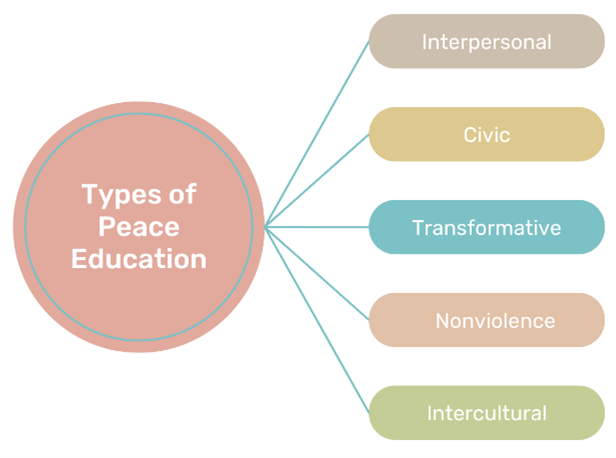
Types of Peace Education that are most supported by this resource
Comments

Please leave any comments about how useful you think this resource is for peace education. Would you use it? What adaptations or suggestions would you make? Do you have any other particular comments about it?

Audience

I think this resource can be useful for many stakeholders, but I would like to invite two people who can benefit a lot from it (and from the Peace Learners website), considering the type of work they do. These people are:

  1. Isabella Cuevas: She is a student at the Carter School for Peace and Conflict Resolution who is about to graduate. She works as a facilitator with young people living in vulnerable conditions, and she is a member of Legacy International Second Story.
  2. Daniel Ortiz: He is a Rover Scouter from a Scout group of Salvador. He works with young people from 18 to 25 years old, on the creation of projects oriented to impact the community and the Scout’s clan promoting dialogue, respect, empathy, tolerance, healthy interpersonal relationships, and global agency to foster conflict resolution and acts of service.

I hope this resource is useful for you!!!


[1] You can learn more about Transformative Pedagogy by reading the “Transformative Pedagogy for Peace-Building: A Guide for Teachers” created by the UNESCO and the International Institute of Capacity Building in Africa. Transformative pedagogy for peace-building: a guide for teachers – UNESCO Digital Library

Who Will Take the Heat?

POSTED ON BEHALF OF ANNSLEIGH CARTER

For this blog, I wanted to look for an activity that addressed some of the things we talked about during our last class about environmental education. As a class, we discussed the degree to which we should include environmental education in schools, which led to an interesting conversation about priority of values and if teaching about climate change is pushing a political agenda in the classroom. To address that concern, I found an experiential learning lesson plan from PBS about environmental political negotiation called “Who will take the heat?” Here’s the link: http://www.pbs.org/wgbh/nova/worldbalance/roleplay/heat.html.

This is a policy negotiation role-play activity, and the players are the US, China, environmental movement, and international business. This activity requires the reading/discussion skills of high school or college students. For the first part of the activity, students are broken into groups and given readings for one of these four roles. Students should understand that this is a role-play, not a debate, and the lesson defines negotiation as “a process in which two or more parties seek to understand one another’s interests and create options that will reduce or remove a conflict between them.” In teams, students have to figure out what is most important to their group, what they could compromise on, and propose solutions. Before the negotiation, they go over the following terms:

  • Interests: What a group wants and its reasons for wanting them.
  • Beliefs: There are two types of beliefs—values and truths. Values are the group’s belief that it has a “right” to something or a belief in the way the world “should” be. Truth is its understanding of how and why things happen and how the world “is.”
  • Identities: These are the words a group uses to name itself and encompasses its history, culture, qualities, and characteristics.
  • Emotions: This is how a group feels about something.

Then, the teams come together in order to create a solution that fits the necessities of all of the groups. As it says in this lesson plan, this part might extend over more than one class period.

After the negotiation, the class should debrief by talking about what went well and what could have been better in the negotiation, as well as a discussion of some of the major points that were brought up. There is also a closing evaluation, and the site gives a few different options for that. Personally, I would like to close this activity by having the students pick a solution that they agreed with from the negotiation and write about their role in real life would be in the commitment. This would require them to reflect on their level of engagement with climate change, and this might create a sort of negotiation with the self about what we are and are not willing to do.

I appreciate that the activity implies that something must be done to limit our harm to the environment, but it lets students come to their own decision about what must be done about it. It does not really push a political agenda, but forces students to take on a role in a real world issue. Through discussion and negotiation, students realize how environmental policy works. The negotiation skills they will learn from this activity will be useful for them as well.

I think this class fits well into our class themes of environmental sustainability and conflict resolution. It forces students to look at environmental sustainability on a global scale, then with the closing activity that I chose, makes them apply what they learned to their own lives. At the heart of the activity is peaceful negotiation and mediation of conflicting ideals. Students have to learn how to compromise to get what they want and to listen to others.

Peace Learner Commitments

The above podcast was recorded on Wednesday, November 14th 2012 during the Peace Pedagogy (EDU-596) course I facilitate each year at American University.  As a final assignment for the class I asked each student to develop what I called a “Peace Learner Commitment.”  A Peace Learner Commitment is:

“…a pledge to yourself, and shared with our community, to achieve a goal that seeks to build and foster peaceable learning environments.  This environment can be built in the classroom, your community, among your peers, with your family, in the work place, or for yourself.  The choice is yours.

“The key is for an element of this course that resonated with you – skill, content, activity, attitude, technique, perspective, etc. – to bear fruit outside of the (tiny) classroom we shared this semester.”

In the podcast each student shares what their commitment is.  And listening to this podcast, I can honestly say that it has been a privilege spending an entire semester with this outstanding, kind, and inspirational group of learners. The 14 students all came to the course for different reasons, with different needs, and from different professional and academic backgrounds.  Given the diversity of the learning goals and needs, as the professor for the course I really had to give deep thought to what kinds of assignments were going to actually be useful to the class.

Stand Up and Speak Out

POSTED ON BEHALF OF MARIA SCHNEIDER

After reviewing my own reflections for our Peace Learner Agreements I decided that this program anti-discrimination and bullying program known as Stand Up Speak Out (SUSOSH) that I was involved with is something that I am proud of. It deserves recognition, and I believe that it should be implemented in other schools in communities across the country. It is relevant to peace education because of the long-term goals related to the seven pillars: community building, exploring approaches to peace, re-framing history, and transforming conflict non-violently, and lastly building life skills.

[Taken from the Minneapolis South High School website:] http://south.mpls.k12.mn.us/activities_s-z Stand Up Speak Out South High (SUSOSH) is a student driven peer education event at South High School in Minneapolis, Minnesota. Led by a core group of students on the SUSOSH Leadership Committee and staff advisors, SUSOSH trains over one hundred students in the art of peer education regarding homophobia, sexism, racism, and disability awareness. For two days, these peer leaders facilitate workshops for the entire student body of South High School in hopes of raising awareness and igniting change in the community. SUSOSH participants are committed to social justice at an unprecedented level at South High School.

SUSOSH, started as an initiative by the Gay Straight Alliance, Student Government, National Honor Society and Corinth Matera a dedicated, and well-respected teacher at South High. Based on student and teachers noticing an increase in vulgar and offensive language being used in the hallways of Minneapolis South High the conversation began of how we could transform our school environment to be more accepting and respectful of all people.

I think that this initiative can be implemented in many different learning environments but it is best done in middle and high schools where students and teachers can work together to create a comprehensive and effective social justice action plan to engage students of various backgrounds and grade levels. That way it is structured and can lead the way for transformational change and peace throughout an entire school or institution, not simply in one class or one group of students. As far as how to incorporate this into a class, I think that the need has to be there and a drive from students as well a support from faculty and staff members. Otherwise, there won’t be positive response from students if they don’t see positive leadership from their peers.

One year later, after local teen suicides related to gay, lesbian, bisexual and transgender bullying, South High was recognized for its anti-bullying measures related to SUSOSH. http://www.shsoutherner.net/news/2010/11/09/south-students-respond-to-recent-suicides/

After exploring this concept of Standing Up and Speaking Out I discovered a similar program on the edutopia site http://www.edutopia.org/blog/social-justice-lessons-activities-resources-rebecca-alber aimed at teachers to help better develop social and emotional learning through social justice lesson plans and resources.

How can this program be implemented in other schools? Who is responsible for doing this? How can we spread the word?

Peace Players International

POSTED ON BEHALF OF DANIEL KNOLL

http://www.peaceplayersintl.org/

When I was in 9th grade I took part in the Jewish Youth Philanthropy Institute. With 25 peers we were tasked with donating a certain amount of money to what we considered worthy non-profits. The catch was that we were being asked for more than we had, and we had to allocate our money wisely. Growing up I played a lot of sports, so I feel in love with one organization, Peace Players International (PPI). 14 year old me loved the idea of combining conflict resolution and sports, and the concept has stuck with me for all these years. PPI’s motto is simple – “Children who can play together can learn to live together.” What started as an idea between 2 brothers from Washington DC turned into an international movement, with programs located in Northern Ireland, Israel / West Bank, Cyprus and South Africa.

Each region provides a diverse set of learning opportunities for ‘would be’ conflict communities. The primary focus of the sports programs are designed for youth between the ages of 6 and 14. By creating opportunities in a non-formal setting, PPI creates long-term relationships between its participants, even offering ‘graduate’ programs on leadership in the community for those who are too old for the original curriculum. One problem PPI faces is “exceptional” thinking. Too often participants think their teammate is the “exception,” and that the rest of the ‘other group’ is bad. Coaches emphasize making sure lessons stick off the court by encouraging their students to think “outside the box” and develop a way of “interacting with those around us that honors both others’ humanity and our own responsibility for change.”

As an educator programs such as these encourage the concept of peace building through cooperation necessary to accomplish a common task. Whether it’s scoring a basket, completing a puzzle or writing a group paper, the objective is the same: teaching students how to work together. What I particularly enjoy about PPI is the incorporation of the bodily kinesthetic side of students, which is often difficult to present in a traditional classroom setting.  And the curriculum can be tailored to the needs of the community. In South Africa, athletes are taught about making healthy decisions and HIV/AIDS education. In Northern Ireland, students focus on how to handle “the complexities of growing up in a post-conflict society.”

South Africa – http://www.peaceplayersintl.org/locations/south-africa

Northern Ireland – http://www.peaceplayersintl.org/locations/northern-ireland

When looking at the 7 pillars of peace education, PPI is built around community building and transforming conflict non-violently. By giving the youth within conflict communities an opportunity to build their own perceptions of the conflict in a nonviolent way on the court, PPI reshapes the future discussion between the parties. Often times conflict is so rooted with in the culture and fabric of peoples history that the best way to break the cycle of conflict is by giving children the chance to build relationships in their own way. Their team becomes their community. A diverse community that sets the example that the two sides cannot just peacefully coexist, but thrive and succeed together. While studying abroad in Israel and seeing first hand the separation between Israel and the West Bank it is inspiring to see children creating a possibility of peace in the future through success on the basketball court.

http://www.youtube.com/watch?v=XqhyDArfvfA – PPI was even featured on an ESPN segment about Conflict in the Middle East. The 5 minute segment has some very interesting interviews from coaches, athletes and parents.