World Wise Schools

POSTED ON BEHALF OF MAGGIE MEENEHAN

World Wise Schools is an amazing collection of resources conceived and supported by the Peace Corps to help teachers provide real world cross-cultural understanding and learning through a global education format.  This site integrates global understanding and cultural awareness in core content area’s including: art/music, foreign language, health, language arts, science, social studies, environmental education, geography and even TESOL, for grades K-12.  The Lessons Plans are varied, hands-on, student centered and thought provoking.  A few of the sample topics of the lessons are:  traditional greetings, narrative cartoons, making books on comparing water access, Kenyan sign language, conducting interviews, global food security, educating girls, and What is Wealth?   All of the lessons deal with cross- cultural issues and bridging the communication gap between peoples of the world.  Videos slide shows, stories, folk tales enhance the lessons, and classroom speakers can even be contacted to visit your classroom for free!

World Wise Schools began in 1989, under then Peace Corp Director Paul D.  Coverdell.   In addition to the many, many lesson plans available there are several other programs that would attract the interest of teachers.  One is the Correspondence Match Program, in which a teacher signs up to have a direct relationship with a Peace Corp volunteer in the field, where they commit to exchange e-mails, letters, video’s, and photographs with each other for two years.  Students become part of this exciting exchange of cross-cultural understanding.   The relationship can develop naturally – no timetables or defined expectations, just communication.

There are also ideas for Service Learning Projects, Language Lessons, Podcasts and E-books and an E-Newsletter.    It is truly a wonderful resource for global understanding; students can easily make connections through meaningful contact with Peace Corp Volunteers and with the people and region selected.  Regions include: Africa, Central and Eastern Europe, Asia and the Pacific Islands, and Latin America and the Caribbean.

Clearly, this web site addresses the twin Goals of Community Building and Skill Building in Peace Education.   As we build community throughout this world, we become more aware of the needs, wants and desires of others, AND more aware of how our needs, wants and desires are connected to theirs.  We are brothers and sisters on this wildly, spinning, water planet.  We need each other, we must help each other, and we must learn to live with each other in peace.  This web site gives us the tools to increase our communication skills with others across the globe, building real skills towards peace.

Go to: peacecorps.gov/wws/about

Voices [Education Project]

POSTED ON BEHALF OF EDEN MESGHENNA

The mission of Voices is to share unbiased accounts of war by those who have experienced war first hand in order to “heal the wounds and lay the ground work for peaceful world”.

In addition to the stories told by soldiers and civilians, the site provided a wealth of resources for educators such as books, curricula, education packets, and instructional activities that assist with the critical exploration and dialogue of peace education. In addition to the personal narratives, the visual media that is made available through this site provides for a rich background for facilitators.

Stories of Arrival: Youth Voices, a component of the project, allow students who have recently immigrated from countries that are experiencing the hardships of war, to share their experiences using poetry. These stories are heartbreaking but powerful in that they produce a direct connection to young students that have never experienced the reality of war. To listen and share Youth Voices go to: http://www.jackstraw.org/programs/ed/youth/foster.shtml

For information go explore at:

http://www.voiceseducation.org

Dance4Peace

POSTED ON BEHALF OF EDEN MESGHENNA

All teachers can appreciate that learning takes place through multiple intelligence and movement is fundamental source of expression for, most if not all, young students. Unfortunately, most curriculums do not incorporate physical motion as a means to the learning process. So when I came upon this site, I was excited to witness the interconnected themes of community building, cultural exploration, and self-discipline through focused energetic movement.

From the Dance4Peace website:

“Dance 4 Peace is a conflict resolution, civic education program that promotes empathy, understanding, mediation skills, anger management, emotional and civic engagement through dance in youth around the world. Through exercises and activities utilizing our bodies, music, emotions, experiences, and thoughts, we build emotional and social competencies for peace. “

Dance 4 Peace facilitators create curriculums that are specific to the grade and community by utilizing four key principles of social, emotional and civic competences in youth.

Dance 4 Emotional awareness

Dance 4 Active communication and dialogue

Dance 4 Diversity, cooperation and empathy

Dance 4 Anger management and mediation

“Dance 4 Peace began as Danza para la Convivencia en Bogotá, Colombia as part of Sara Potler’s Fulbright Scholarship project in 2007. In conjunction with Aulas en Paz (Peaceable Classrooms), a multi-component pedagogical project designed to promote social and civic competencies and conflict resolution among primary-school students, Dance 4 Peace was designed, implemented, and evaluated in public schools in the outskirts of Bogotá.”

Here is a sample of a project in Columbia:

“Today, the program is being implemented in Washington, D.C.; New York City; Baltimore; Colombia; the Philippines; and Nepal. We work through grassroots, local community and international-scale academic, public, and private partnerships to bring Dance 4 Peace programming to varying cultural contexts.”

Check out there work at Malcolm X public school in Washington DC:

For more info go to www.dance4peace.org

Teaching for Change: Tellin Stories

POSTED ON BEHALF OF EDEN MESGHENNA

Teaching for Change is a non-profit organization that supplies parents, teachers, and students with tools and resources that mobilize school reform by building literacy skills. Located in the Washington DC area Teaching for Change works with local schools by offering professional development, parent support connections and publication recourses for all ages that focus on building critical thought and reflection of the world inside and outside of the classroom.

Check them out at: www.teachingforchange.org

Tellin Stories is a project that aims at building parent involvement in the schools. The focus of the project is to create opportunities for parents to connect with schools by encouraging parents to come into the classroom and share their stories.  Allowing parents to share their experiences within the classroom begins a process that bridges a cultural and socioeconomic gap between schools and community. In the Telling Stories project parents have opportunities to read to students or tell personal stories about who they are in the classroom. Parents then join together with other parents to build a story quilt that binds pieces of who they are together.

I found the idea of story telling to be a very natural way of beginning the process of strengthening parent involvement in the school and was encouraged by the high level of response parents from different cultural backgrounds had towards investing in there new community.  Included is a link to a short video on the Tellin Stories project:

IndyKids

POSTED ON BEHALF OF MONICA SHAH

IndyKids is a progressive kid’s newspaper produced by volunteers including parents, students, teachers, journalists and community activists. Formed in 2005, IndyKids’ creators believe that everything is political and that no media source comes without bias; thus, they openly label their newspaper as progressive. IndyKids aims to present an alternative perspective that is typically not found in mainstream media or other kids’ news journals such as Time for Kids or Junior Scholastic because they are backed by corporate sponsors. IndyKids provides space for issues of marginalized people including kids, people of color, poor people, and immigrants whose voices may not generally be heard in conventional news and school textbooks. The organization does not believe in “talking down” to kids or restricting certain issues from being presented. Therefore, their stories range anywhere from youth activism, labor and immigrant rights and global warming, to war, the financial crisis and same-sex marriage. Aside from news, the paper also includes entertainment, recipes and puzzles.

In addition to learning about the issues themselves, IndyKids can be used in classrooms to teach media literacy. Teachers can give students articles on similar topics from various sources and ask them to compare the views of the publications. By doing this, students can pick out biases, form their own opinions based on facts or perspectives given, and most importantly, learn and practice being critical interpreters of information, instead of being passive recipients. This is a good exercise for teachers who may receive criticism for presenting progressive viewpoints, or generally for any teacher who aims to be objective and wants their students to be critical thinkers.

While the website states that the newspaper is aimed to engage kids in grades 4 to 7, I believe that the newspaper could be used from grades 3 to 8, and may be integrated best in an English/Language Arts or Social Studies class setting. What is also unique about this paper is that kids are encouraged to submit their own articles. Teachers or parents who use this newspaper in their classroom or home can make researching and submitting articles as part of a class project. On the IndyKids’ website, there are helpful resources and guides for teachers. For example, check out the November/December 2011 Issue and Teacher’s Guide – Issue 32.

IndyKids not only helps students to simply learn about current national and international events, but it can help students develop empathy, curiosity and passion, and may lead them to becoming selfless and conscientious. Another way teachers can promote peace and social justice in their classroom, school, and community, and further develop students’ research, writing, and analytical skills, is to assign students to produce their own community-based version of IndyKids focusing on local issues. After writing the articles and publishing a class newspaper, students can take an additional step and create an action plan to bring attention to a particular local issue and/or to fight a local injustice.

IndyKids supports the community building and skill building pillars of peace education. With the newspaper, students will learn about various issues, cultures and perspectives, and are encouraged to embrace the differences and similarities they may have with the people they read about. By allowing kids to write and submit their own articles, they are able to take ownership of their learning experience and see their work being acknowledged and read by a wider audience. With regard to skill building, students are empowered to actively participate in the larger peace and social justice movement locally and globally. Through reflection based activities, students’ interpersonal and intrapersonal skills will be strengthened. Furthermore, students’ analytical skills will be enhanced through media literacy lessons. Students will also learn organizing skills as they take action and show solidarity with a particular campaign, movement or group of people.

Nonviolent Campaigns: Who, What, Where, When, How and Why

POSTED ON BEHALF OF MONICA SHAH

So you’ve heard a lot about the powers and successes of nonviolent action but are ready to move beyond teaching about Gandhi and Dr. King. Thanks to a project lead by George Lakey at Swarthmore College, there is now a Global Nonviolent Action Database that provides free access to the hundreds of cases of nonviolent campaigns around the world! The intention of this database is, “to assist researchers and activists to better understand the special features of nonviolent struggle that make it different from both violent and institutional politics.”

Lakey, the Director of Training for Change and 2010 Peace Educator of the Year, explains that “nonviolent action” is also commonly known as:

  • People Power
  • Civil Resistance
  • Satyagraha
  • Nonviolent Resistance
  • Direct Action
  • Pacifica Militancia
  • Positive Action

The database includes cases that are identified as “campaigns”, not “movements” because they consider movements to typically consist of a number of campaigns aimed at achieving large goals. Also, the campaigns researched are ones that have reached their point of completion. Each “case” is presented as a database file and narrative that describes the issues behind the campaign.

The database can be searched by country, issue, or method used. The campaigns are grouped by the following categories: democracy, economic justice, environment, human rights (religious and women’s rights), national/ethnic identity (and anti-colonial struggles), and peace. You can learn about nonviolent action that took place everywhere from Afghanistan to Norway to Zimbabwe. You can even find campaigns that occurred as early as Before A.D. in Italy to present-day in Egypt. If you are interested in learning about the larger movements, you can search under “Waves of Campaigns” to find information about:

  • African Democracy Campaigns
  • Arab Awakening
  • Asian Democracy Campaigns
  • Colour Revolutions
  • Soviet Bloc Independence Campaigns
  • U.S. Civil Rights Movement

Here is an example:  “Egyptians campaign to oust President Mubarak, 2011”

On this page you will find the time period, the description of the location, the goals, methods and classification of the case. You can also find information about the campaign’s influences, leaders, partners, allies and opponents, order of social groups and the success outcome. Lastly, everyone also has access to the sources used to compile the information to learn even more about the study!

This resource supports three Pillars of Peace Education: 1) Exploring Approaches to Peace; 2) Reframing History; and 3) Transforming Conflict Nonviolently. Students can learn how people around the world aim to achieve peace. Furthermore, they can look at history through the lens of nonviolent actions – narratives that are often left out in schools’ historical texts. Lastly, the database acknowledges that conflicts do exist, and it provides examples of a variety of methods that people use to approach conflict alternatively—nonviolently.

With regard to the uses of the database, the team included this wonderful message: “Strategists, activist organizers, scholars, and teachers will find many uses for the database, as well as citizens wanting to expand their horizons. Even before release to the public, for example, a teacher who knew the database team was using our cases to assist middle school pupils to develop plays. Any school that teaches about the environment, civil rights, or other issues may find the curriculum enlivened by sending students to the database. History students might enjoy doing the detective work of finding the hidden stories in their local area that could be developed into cases. The database also offers an invitation to geographical learning.”

I would recommend this database to be used by students starting in middle school. Though I believe that educators can incorporate this across the curriculum, it may be most welcome in a Social Studies department. The information provided can truly open students’ eyes and deepen their understanding of nonviolence, people power, and the struggle for justice, peace, democracy or human rights around the world. It may also help students to better grasp the tactics and motivations of the ongoing “Occupy” movements across the nation. The database can be utilized in formal or community education settings. It can also be beneficial for organizers of future movements to scan through this database to examine the advantages or limitations of strategies of previous campaigns.

Reframing Thanksgiving

Thanksgiving cartoon

In his much-acclaimed book Lies My Teacher Told Me: Everything Your American History Textbook Got Wrong, James W. Loewen evaluates the misrepresentations and often omitting of historical truths in textbooks, explaining how myths of our history continue to be perpetuated today. The third chapter of his book, “The Truth About the First Thanksgiving,” offers a sobering and at times much more interesting outlook on one of our most celebrated holidays.

The “First Thanksgiving” story many of us have been taught involves Pilgrims coming to America on the Mayflower, landing at Plymouth Rock, and sharing in a bountiful feast with the Indians (most likely involving a giant turkey and an overflowing cornucopia, one of my favorite things to draw in elementary school). I have a distinct memory of dressing up as an Indian, complete with a leather dress and feathers in my braided pigtails, while other classmates wore Pilgrim attire, for our very own reenactment of the First Thanksgiving. Activities like these are fun for young students because they involve playing make-believe, dressing up in costumes, and eating yummy food.

But Loewen would argue that there are a lot of mistruths behind this story. What many of us don’t know, or at least what isn’t being conveyed in most American history textbooks, is that a devastating plague had swept through North and South America before the Pilgrims arrived. Loewen tells us that “for decades, British and French fishermen had fished off the Massachusetts coast…it is likely that these fishermen transmitted some illness to the people they met. The plague that ensued made the Black Death pale by comparison…within three years the plague wiped out between 90 percent and 96 percent of the inhabitants of coastal New England,” (70). The epidemic spread west, not stopping until it reached the Pacific Coast.

When the Pilgrims got to Plymouth, which, as Loewen points out, was likely not their intended destination, they found not “virgin wilderness,” as is it often characterized, but entire established, settled villages decimated and abandoned, the ground littered with corpses because no one was left to bury them. The Pilgrims faced no threat from the Indians when they arrived: “Massasoit, the Wampanoag leader, was eager to ally with the Pilgrims because the plague had so weakened his villages” (72). Loewen goes on to point out that Pilgrims stole food and crops from what few Indians remained alive, some even robbing their graves.

There is also the story of Squanto, who some of us may remember as being the Indian that knew how to speak English and taught the Pilgrims how to plant things. But what many textbooks leave out is how Squanto learned the English language, and the near-mythical journey and toil that he endured under the hands of British and Spanish slave traders. After being captured by a British captain and taken back to England, Squanto served 9 years as an employed slave, then returned back to Massachusetts, only to be seized again by another British slave raider and sold into slavery in Spain. Squanto then escaped from slavery and Spain and returned to Massachusetts by way of England and Newfoundland. When he finally arrived, he found his home village Patuxet – aka Plymouth – in ruins. He had no other choice than to comply with the Pilgrims, and “as translator, ambassador, and technical advisor, Squanto was essential to the survival of Plymouth in its first two years” (84).

Loewen shares other fascinating information about this time, including cannibalism in the early Virginia colony, and concludes this about our celebration of Thanksgiving:

“The civil ritual we practice marginalizes Indians. Our archetypal image of the first Thanksgiving portrays…the Pilgrims in their starched Sunday best next to their almost naked Indian guests…The notion that ‘we’ advanced peoples provided for the Indians, exactly the converse of the truth, is not benign. It reemerges time and again in our history to complicate race relations. For example, we are told that white plantation owners furnished food and medical care for their slaves, yet every shred of food, shelter, and clothing on the plantations was raised, built, woven, or paid for by black labor. Today Americans believe as part of our political understanding of the world that we are the most generous nation on earth in terms of foreign aid, overlooking the fact that the net dollar flow from almost every Third World nations runs toward the United States.” (86)

So even though Thanksgiving is a great time to enjoy being with family and loved ones and practice gratitude for the gifts we have been given, it’s important to know the real history behind this holiday. By being cognizant of these historical truths, we are recognizing the marginalization of Native Americans in our history, reframing history and changing the perspective of one of our country’s most significant events. Awareness of these truths, whether in a classroom setting or maybe even integrated into your own observance of Thanksgiving, can also help foster community building. By acknowledging marginalized groups and gaining a better understanding of our collective experience, we are taking ownership of our learning and creating new ties that unite us as a community of learners and Americans.

Loewen, James W. Lies My Teacher Told Me: Everything Your American History Textbook Got Wrong. New York: New Press, 1995.

  • Read an excerpt from “The Truth About the First Thanksgiving” on google books
  • Find the entire book on Amazon

The 2011/2012 Peace Exchange and Other Peaceful Art Projects

The Create Peace Project is a San Francisco-based non-profit that uses art and creative expression to help create more peaceful schools and give students a creative outlet and teach them peacebuilding skills.

For the third year in a row, The Create Peace Project is engaging in “The Peace Exchange”, a program that allows students from the US and Canada to exchange messages of peace with students in Ghana, Colombia, and Nepal. Students write notes and draw pictures on special post cards, and The Create Peace Project delivers the messages to partner students around the world and returns with messages from those students. Download a flyer!

From the Create Peace Project website:

“The Peace Exchange is about connection. Connecting students to themselves, their creativity, their wisdom, and their heart. Connecting students to each other, in their classrooms, in their schools, and across continents as we bridge cultural, religious, and racial boundaries to inspire and enrich the lives of all participants.

The Peace Exchange gives students a platform from which to raise their voice for peace, acknowledge and honor each other, express themselves through their art and with words with the intention that the power of being peaceful and sharing ones self with another can create a ripple of kindness, love, and possibility felt by young people around the world.”

This project is tailored toward students age 8-18, and can be integrated into a formal school setting on a class-by-class basis or through a school-wide assembly. Resources for both options are available from The Create Peace Project. The exchange allows students to participate in something national and international and creates the space for local and international dialogue about peace.

For smaller groups or informal settings The Create Peace Project has other art options available:

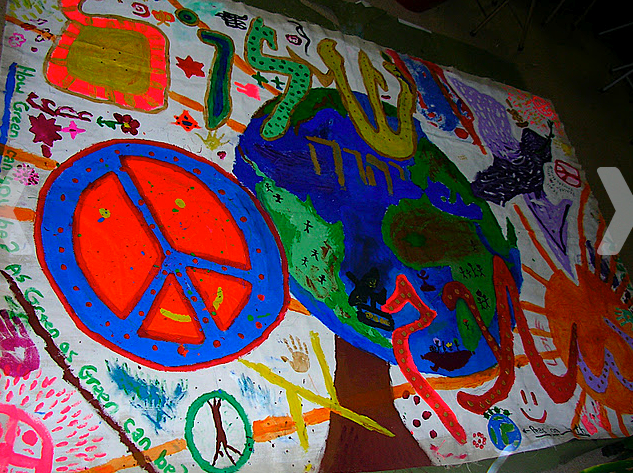
Banners for Peace is a collaborative painting workshop that promotes team building and collaboration through a 10-week workshop that works on the creation of a unique, giant piece of art that is later displayed in a communal area. Beyond building art skills and learning to work as a team, participants have a chance to design something that can inspire peace and create a space for peace dialogue. Download a Flyer!

For a shorter-term project or a more diverse group of participants, check out the Collaborate and Create workshop, a one-day activity that allows participants to bring together objects and art supplies to create a collection of art work through collaborative creative games and activities. One great thing about this project is that it can be tailored to include as more or less emphasis on emotional expression and community building depending on the venue or event.

These resources help to build community and nurture emotional intelligence, allowing participants to express their feelings and ideas in a safe and welcoming space and explore the meanings of peace in a community setting.

Get your school involved! Or for more information contact: info@createpeaceproject.org

Gopher Peace and the Peace Rangers

Last year I took a wonderful Peace Education course led by a fabulous educator and advocate for nonviolence. At the end of the semester she gave each of the class participants a gift of a peace education resource that can be used with elementary and middle-school aged children. Published by Peace Education International, the Gopher Peace workbook series provide students with a wealth of wonderful, interactive games and activities all aimed at promoting peaceful thinking and behavior. The workbooks include self-esteem building activities, word and math problems that once solved reveal important messages about how to treat others, exercises that reveal our own prejudices, games that help us identify violent behavior, crossword puzzles that help us identify “feeling” words, and picture games that help us become familiar with body language messages. In addition to activity books for students, Gopher Peace and the Peace Rangers also has a resource book for teachers which includes lesson plans that help students promote peace within their classroom. The lesson plans help teachers learn how to create a safe classroom container, and then provide a wide variety of activity ideas. Lessons include learning about how families show and receive love, what qualities make someone a friend, how to identify bullying behaviors, how to identify feeling words and the ways that our bodies communicate information, and how to communicate anger without using violence. As the lesson plans progress, they venture into more complex understandings of peace and conflict resolution tools such as the classroom “Peace Table” where children bring themselves when a conflict arises between peers. The teacher and students become familiar with and tolerant of other cultures, explore personal meanings of peace and war, and study influential peacemakers such as Nelson Mandela, Desmond Tutu, and Carl Sagan. Gopher Peace also has a variety of story books that depict individuals confronting bullies and negative behavior, and learning how to deal with such situations.

The Gopher Peace resources would be most effectively used in elementary and middle-school classrooms, but could also be very valuable in non-formal educational settings such as after school programs. The fact that the Gopher Peace resources are so fun and interactive, making learning like a game, really creates the opportunity for a wide array of applications.

All of the Gopher Peace resources, especially if used together, support all seven pillars of peace education. Skill-building is especially supported through interactive class lessons and games that familiarize students with conflict resolution, empathy, and team work. Gopher Peace nurtures emotional intelligences by helping students understand the emotions of anger and hurt, and how to peacefully resolve issues that lead to “negative” feelings. Through exposure to peace activists, particularly from underdeveloped nations, students have a chance to reframe history and their views of the world. All the activities and lessons in Gopher Peace allow students to explore a wide variety of approaches to peace through games, problems, simulations, and activities.

As the Gopher Peace work book does include some math and word problems, these lessons could feasibly be integrated into standard class periods. However, to get optimal use out of these wonderful resources, it would be very valuable to have a class period, even just once a week, dedicated to learning about peace through the Gopher Peace lesson plans and activity books. The Gopher Peace and the Peace Ranger story books should be displayed on the classroom bookshelf so that students can have access to them at their leisure. The beauty of these resources is that they holistically integrate lessons about peace, understanding, and conflict resolution into a classroom in a way that does not require an extensive change to the education system. These resources give teachers and students a way to learn about peace now, within the educational framework that we currently function within. Check out the awesome, interactive Gopher Peace website!

http://gopherpeace.com/#

DCPEACE: Cultivating Peace in D.C. Schools

DCPEACE is a program supported by the US Association for the UN University for Peace. The goal of DCPEACE is to teach conflict resolution and peace building in elementary classrooms through teachable moments and other classroom techniques. Their focus is on younger students to help them develop non-violent skills to combat violence at the earliest ages possible. The hope is that these non-violent skills will be developed before the tendencies towards violence. They host educator trainings, parent workshops, and hold Peace Clubs after school hours to further supplement their in-class programs.

Most effective, though, have been their Skills for Understanding Workshops and the Curriculum Enhancement they have been able to have teachers implement. In the workshops, they use theater, art, physical activities, and bring in outside facilitators to teach students effective skills to choose non-violent conflict resolution.

As one of the teachers in the video said, the goal of the program is to “give students the tools to solve their own problems.” Through these workshops and peace clubs, they have transformed student attitudes at Malcolm X Elementary School. Their confidence levels and self-esteem of students have increased, and they are focused on their own and others success. There has been a transition to a more community-based environment where students look out for one another.

Their website houses a program evaluation after the 2008-2009 school year at Malcolm X Elementary School. After the initial year of programming, 100% of teachers and administrators reported an increase in the students’ abilities to manage conflict. The program itself is reported to have decreased violence at the school by an average of 53%. This evaluation has great information in it, and I encourage you all to check it out. It can be found here on the main DCPEACE website.

There are not a lot of recent articles or blogs about what DCPEACE has been doing in the past year or so, as it was only a pilot program housed at Malcolm X. However, their results are promising and their data is accessible so the programs could be replicated or supported in a new setting. Their most recent updates are from the middle of 2010. I’m not sure why this program has not caught on in more high-risk DC schools. It has proven results and focuses on violence prevention and conflict resolution, which help classrooms and entire schools run more smoothly. Their evaluation does not state where funding comes from, but a lack of funding could be why the program is not expanding.