Reframing Thanksgiving

Thanksgiving cartoon

In his much-acclaimed book Lies My Teacher Told Me: Everything Your American History Textbook Got Wrong, James W. Loewen evaluates the misrepresentations and often omitting of historical truths in textbooks, explaining how myths of our history continue to be perpetuated today. The third chapter of his book, “The Truth About the First Thanksgiving,” offers a sobering and at times much more interesting outlook on one of our most celebrated holidays.

The “First Thanksgiving” story many of us have been taught involves Pilgrims coming to America on the Mayflower, landing at Plymouth Rock, and sharing in a bountiful feast with the Indians (most likely involving a giant turkey and an overflowing cornucopia, one of my favorite things to draw in elementary school). I have a distinct memory of dressing up as an Indian, complete with a leather dress and feathers in my braided pigtails, while other classmates wore Pilgrim attire, for our very own reenactment of the First Thanksgiving. Activities like these are fun for young students because they involve playing make-believe, dressing up in costumes, and eating yummy food.

But Loewen would argue that there are a lot of mistruths behind this story. What many of us don’t know, or at least what isn’t being conveyed in most American history textbooks, is that a devastating plague had swept through North and South America before the Pilgrims arrived. Loewen tells us that “for decades, British and French fishermen had fished off the Massachusetts coast…it is likely that these fishermen transmitted some illness to the people they met. The plague that ensued made the Black Death pale by comparison…within three years the plague wiped out between 90 percent and 96 percent of the inhabitants of coastal New England,” (70). The epidemic spread west, not stopping until it reached the Pacific Coast.

When the Pilgrims got to Plymouth, which, as Loewen points out, was likely not their intended destination, they found not “virgin wilderness,” as is it often characterized, but entire established, settled villages decimated and abandoned, the ground littered with corpses because no one was left to bury them. The Pilgrims faced no threat from the Indians when they arrived: “Massasoit, the Wampanoag leader, was eager to ally with the Pilgrims because the plague had so weakened his villages” (72). Loewen goes on to point out that Pilgrims stole food and crops from what few Indians remained alive, some even robbing their graves.

There is also the story of Squanto, who some of us may remember as being the Indian that knew how to speak English and taught the Pilgrims how to plant things. But what many textbooks leave out is how Squanto learned the English language, and the near-mythical journey and toil that he endured under the hands of British and Spanish slave traders. After being captured by a British captain and taken back to England, Squanto served 9 years as an employed slave, then returned back to Massachusetts, only to be seized again by another British slave raider and sold into slavery in Spain. Squanto then escaped from slavery and Spain and returned to Massachusetts by way of England and Newfoundland. When he finally arrived, he found his home village Patuxet – aka Plymouth – in ruins. He had no other choice than to comply with the Pilgrims, and “as translator, ambassador, and technical advisor, Squanto was essential to the survival of Plymouth in its first two years” (84).

Loewen shares other fascinating information about this time, including cannibalism in the early Virginia colony, and concludes this about our celebration of Thanksgiving:

“The civil ritual we practice marginalizes Indians. Our archetypal image of the first Thanksgiving portrays…the Pilgrims in their starched Sunday best next to their almost naked Indian guests…The notion that ‘we’ advanced peoples provided for the Indians, exactly the converse of the truth, is not benign. It reemerges time and again in our history to complicate race relations. For example, we are told that white plantation owners furnished food and medical care for their slaves, yet every shred of food, shelter, and clothing on the plantations was raised, built, woven, or paid for by black labor. Today Americans believe as part of our political understanding of the world that we are the most generous nation on earth in terms of foreign aid, overlooking the fact that the net dollar flow from almost every Third World nations runs toward the United States.” (86)

So even though Thanksgiving is a great time to enjoy being with family and loved ones and practice gratitude for the gifts we have been given, it’s important to know the real history behind this holiday. By being cognizant of these historical truths, we are recognizing the marginalization of Native Americans in our history, reframing history and changing the perspective of one of our country’s most significant events. Awareness of these truths, whether in a classroom setting or maybe even integrated into your own observance of Thanksgiving, can also help foster community building. By acknowledging marginalized groups and gaining a better understanding of our collective experience, we are taking ownership of our learning and creating new ties that unite us as a community of learners and Americans.

Loewen, James W. Lies My Teacher Told Me: Everything Your American History Textbook Got Wrong. New York: New Press, 1995.

  • Read an excerpt from “The Truth About the First Thanksgiving” on google books
  • Find the entire book on Amazon

The 2011/2012 Peace Exchange and Other Peaceful Art Projects

The Create Peace Project is a San Francisco-based non-profit that uses art and creative expression to help create more peaceful schools and give students a creative outlet and teach them peacebuilding skills.

For the third year in a row, The Create Peace Project is engaging in “The Peace Exchange”, a program that allows students from the US and Canada to exchange messages of peace with students in Ghana, Colombia, and Nepal. Students write notes and draw pictures on special post cards, and The Create Peace Project delivers the messages to partner students around the world and returns with messages from those students. Download a flyer!

From the Create Peace Project website:

“The Peace Exchange is about connection. Connecting students to themselves, their creativity, their wisdom, and their heart. Connecting students to each other, in their classrooms, in their schools, and across continents as we bridge cultural, religious, and racial boundaries to inspire and enrich the lives of all participants.

The Peace Exchange gives students a platform from which to raise their voice for peace, acknowledge and honor each other, express themselves through their art and with words with the intention that the power of being peaceful and sharing ones self with another can create a ripple of kindness, love, and possibility felt by young people around the world.”

This project is tailored toward students age 8-18, and can be integrated into a formal school setting on a class-by-class basis or through a school-wide assembly. Resources for both options are available from The Create Peace Project. The exchange allows students to participate in something national and international and creates the space for local and international dialogue about peace.

For smaller groups or informal settings The Create Peace Project has other art options available:

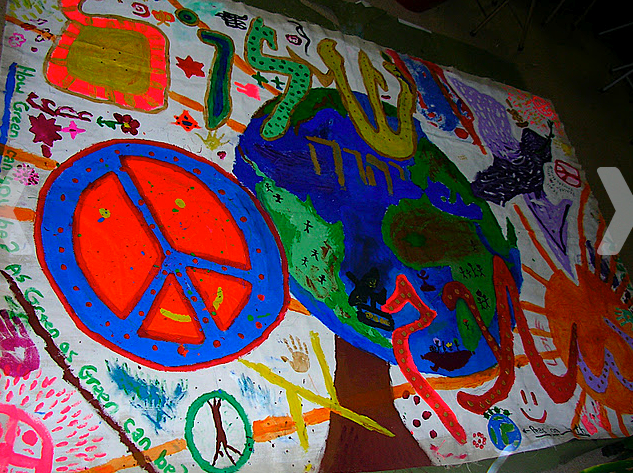
Banners for Peace is a collaborative painting workshop that promotes team building and collaboration through a 10-week workshop that works on the creation of a unique, giant piece of art that is later displayed in a communal area. Beyond building art skills and learning to work as a team, participants have a chance to design something that can inspire peace and create a space for peace dialogue. Download a Flyer!

For a shorter-term project or a more diverse group of participants, check out the Collaborate and Create workshop, a one-day activity that allows participants to bring together objects and art supplies to create a collection of art work through collaborative creative games and activities. One great thing about this project is that it can be tailored to include as more or less emphasis on emotional expression and community building depending on the venue or event.

These resources help to build community and nurture emotional intelligence, allowing participants to express their feelings and ideas in a safe and welcoming space and explore the meanings of peace in a community setting.

Get your school involved! Or for more information contact: info@createpeaceproject.org

Gopher Peace and the Peace Rangers

Last year I took a wonderful Peace Education course led by a fabulous educator and advocate for nonviolence. At the end of the semester she gave each of the class participants a gift of a peace education resource that can be used with elementary and middle-school aged children. Published by Peace Education International, the Gopher Peace workbook series provide students with a wealth of wonderful, interactive games and activities all aimed at promoting peaceful thinking and behavior. The workbooks include self-esteem building activities, word and math problems that once solved reveal important messages about how to treat others, exercises that reveal our own prejudices, games that help us identify violent behavior, crossword puzzles that help us identify “feeling” words, and picture games that help us become familiar with body language messages. In addition to activity books for students, Gopher Peace and the Peace Rangers also has a resource book for teachers which includes lesson plans that help students promote peace within their classroom. The lesson plans help teachers learn how to create a safe classroom container, and then provide a wide variety of activity ideas. Lessons include learning about how families show and receive love, what qualities make someone a friend, how to identify bullying behaviors, how to identify feeling words and the ways that our bodies communicate information, and how to communicate anger without using violence. As the lesson plans progress, they venture into more complex understandings of peace and conflict resolution tools such as the classroom “Peace Table” where children bring themselves when a conflict arises between peers. The teacher and students become familiar with and tolerant of other cultures, explore personal meanings of peace and war, and study influential peacemakers such as Nelson Mandela, Desmond Tutu, and Carl Sagan. Gopher Peace also has a variety of story books that depict individuals confronting bullies and negative behavior, and learning how to deal with such situations.

The Gopher Peace resources would be most effectively used in elementary and middle-school classrooms, but could also be very valuable in non-formal educational settings such as after school programs. The fact that the Gopher Peace resources are so fun and interactive, making learning like a game, really creates the opportunity for a wide array of applications.

All of the Gopher Peace resources, especially if used together, support all seven pillars of peace education. Skill-building is especially supported through interactive class lessons and games that familiarize students with conflict resolution, empathy, and team work. Gopher Peace nurtures emotional intelligences by helping students understand the emotions of anger and hurt, and how to peacefully resolve issues that lead to “negative” feelings. Through exposure to peace activists, particularly from underdeveloped nations, students have a chance to reframe history and their views of the world. All the activities and lessons in Gopher Peace allow students to explore a wide variety of approaches to peace through games, problems, simulations, and activities.

As the Gopher Peace work book does include some math and word problems, these lessons could feasibly be integrated into standard class periods. However, to get optimal use out of these wonderful resources, it would be very valuable to have a class period, even just once a week, dedicated to learning about peace through the Gopher Peace lesson plans and activity books. The Gopher Peace and the Peace Ranger story books should be displayed on the classroom bookshelf so that students can have access to them at their leisure. The beauty of these resources is that they holistically integrate lessons about peace, understanding, and conflict resolution into a classroom in a way that does not require an extensive change to the education system. These resources give teachers and students a way to learn about peace now, within the educational framework that we currently function within. Check out the awesome, interactive Gopher Peace website!

http://gopherpeace.com/#

DCPEACE: Cultivating Peace in D.C. Schools

DCPEACE is a program supported by the US Association for the UN University for Peace. The goal of DCPEACE is to teach conflict resolution and peace building in elementary classrooms through teachable moments and other classroom techniques. Their focus is on younger students to help them develop non-violent skills to combat violence at the earliest ages possible. The hope is that these non-violent skills will be developed before the tendencies towards violence. They host educator trainings, parent workshops, and hold Peace Clubs after school hours to further supplement their in-class programs.

Most effective, though, have been their Skills for Understanding Workshops and the Curriculum Enhancement they have been able to have teachers implement. In the workshops, they use theater, art, physical activities, and bring in outside facilitators to teach students effective skills to choose non-violent conflict resolution.

As one of the teachers in the video said, the goal of the program is to “give students the tools to solve their own problems.” Through these workshops and peace clubs, they have transformed student attitudes at Malcolm X Elementary School. Their confidence levels and self-esteem of students have increased, and they are focused on their own and others success. There has been a transition to a more community-based environment where students look out for one another.

Their website houses a program evaluation after the 2008-2009 school year at Malcolm X Elementary School. After the initial year of programming, 100% of teachers and administrators reported an increase in the students’ abilities to manage conflict. The program itself is reported to have decreased violence at the school by an average of 53%. This evaluation has great information in it, and I encourage you all to check it out. It can be found here on the main DCPEACE website.

There are not a lot of recent articles or blogs about what DCPEACE has been doing in the past year or so, as it was only a pilot program housed at Malcolm X. However, their results are promising and their data is accessible so the programs could be replicated or supported in a new setting. Their most recent updates are from the middle of 2010. I’m not sure why this program has not caught on in more high-risk DC schools. It has proven results and focuses on violence prevention and conflict resolution, which help classrooms and entire schools run more smoothly. Their evaluation does not state where funding comes from, but a lack of funding could be why the program is not expanding.

Radical Math

POSTED ON BEHALF OF MONICA SHAH

It is a myth that peace and social justice issues can only be taught in a peace studies course. It is an even greater myth that there is no place for peace and social justice in mathematics, science, engineering or technology curricula. This post aims to bring attention to a resource for math and economics teachers of all levels who want their students to study issues of social and economic justice.  Radical Math is a site that contains more than 700 lesson plans, articles, books, charts, graphs, data sets, maps, and websites that will help lead students to not only understand issues of social, political and economic injustices through a mathematical framework, but also to learn how to develop just, realistic and mathematically-sound solutions.

Far too often students have complained about their required math courses and asked, “When will I ever use this?” Fusing social justice and math education allows students to be able to do more than memorize formulas and solve equations; they can use math as a tool to understand and change their society. Social Justice Math has two main purposes: 1) to use mathematics to teach and learn about social and economic justice and 2) to develop mathematical literacy and learn math through the study of social justice issues.  Radical Math resources can be utilized in upper elementary, middle, high school, and college classes. Such curriculum can also be integrated in community programs and classes geared to teach math, financial or computer literacy to citizens, immigrants or ESOL students.

Check out this guide created by Jonathan Osler:

A Guide for Integrating Issues of Social and Economic Justice in Mathematics Curriculum

http://www.radicalmath.org/docs/SJMathGuide.pdf

One relevant (and very current) topic that can be introduced and discussed in a math or economics classroom is the Occupy Wall Street and other “occupy” demonstrations around the nation protesting economic and social inequalities, corporate greed and injustices, and corruption. For example, students can learn about the Gini coefficient and how that is calculated, evaluate the disparities in income and wealth distribution, and calculate corporate taxes and profits.

On the site, students and teachers can search by math topic, social justice issue or resource type. Below are all of the searchable topics and themes:

By Math Topic: Algebra,  Annual Percent Rate (APR), Area, Averages, Bar Graph, Basic Math Concepts, Budgeting Money, Budgets, Cartesian, Chance, Charts, Compound Interest, Correlation, Currency Conversion, Data, Data Analysis, Equivalent Fractions, Extrapolation, Geometry, Graphs, Graphing, Fractals, Fractions, Histograms, Interest, Least Common Denominators, Line Graphs, Mapping, Maps, Mean-Median-Mode, Measurement, Net Worth, Patterns, Percent Growth, Percents, Polar, Polls, Probability, Proportions, Rates, Ratios, Real Dollars, Numbers, Sampling, Scatter plots, Statistics, Survey, Symmetry, Tessellations.

By Social Justice Issue: Achievement Gaps, African Americans, Banking, Criminal Justice System, Death Penalty, Defense Budgets,  Economic Development, Ethnomathematics, Environment (pollution, hunger, food and water resources), Financial Literacy/Education (saving, managing debt, paying for college, credit cards, loans, taxes), Gentrification, Globalization, GLTBQ, Health Care, Higher Education, Homeownership, Housing, Hurricane Katrina, Immigration, Juvenile Justice, Latino/Hispanic, Minimum/Living Wage, Lottery, Military Recruitment, New York, Poverty, Poverty Line, Predatory Lending, Prisons, Public Education, Public Health, Racial Profiling, Racism, Single Mothers, Standardized Testing, Sweatshops, Taxes, Teaching, Unemployment, Voting, Wars, Wealth, Welfare, Women

By Resource Type: Article, Book, Chart, Curriculum, Film, Graph, Map, Syllabus, Table, Website

If you have any ideas or have created a lesson plan or projects on a math topic related to a social justice issue that you would like to share with others, you can e-mail info@radicalmath.org.

Operation Ceasefire

Operation Ceasefire is a project that was developed by David Kennedy, a self-taught criminologist and director at the Center for Crime Prevention and Control at John Jay College of Criminal Justice in New York City. Kennedy developed the idea for Operation Ceasefire after visiting a public housing complex in south-central Los Angeles in 1985. Kennedy’s visit had a powerful impact on him as he witnessed the impact of drugs, gangs, and violence on this community. Kennedy dedicated his career to reducing gang and drug-related inner-city violence. He traveled around the United States, meeting with police officials and attorney generals in areas with significant drug markets, and first developed a program in Boston which has now been applied in 70 other cities. The program has been effective in reducing youth homicide rates by as much as sixty percent. “It is incredibly dangerous,” says Kennedy. “If you talk to these guys, what they say is, ‘I’m terrified … I got shot … My brother’s dead … I’ve been shot at … And they are trying to shoot me …’ That [is] their everyday world.” Kennedy’s homicide-reduction program, Operation Ceasefire, established meetings involving gang members, community members that the gang members respected, social services representatives, and law enforcement. Part of the strategy involved making it known to gang members that the police did not want to arrest them, but wanted them to stay alive and out of the criminal justice system. The police did intend to aggressively target people engaged in violent retaliation against one another. Involving the mothers of drug dealers in these meetings was also a crucial factor in reducing community violence. “We said, ‘Your son is at a turning point. He could be arrested right this minute, but we don’t want to do that. We understand how much that damages him and his community. There’s going to be a meeting in a week. Please come with your son to the meeting”. Nearly all invitees to these meetings came. This has been shown to have a significant effect on closing down open-air drug markets.

Kennedy developed this program to be implemented in informal educational settings, bringing together a diverse array of participants. Gang members, their families – especially the mothers, members of the community at large, and law enforcement officials must be involved in order for the program to be successful. Because this program is intergenerational, it does not work without involving both the older and younger generations. In a way, the older generation becomes part of the educational process by speaking with the young generation both about how much they care about them and about how much they are being hurt by these dangerous activities such as drug dealing and violence.

Community building is thoroughly upheld by this program by strengthening the relationships between generations and between gang members and the rest of society. Additionally, this project explores approaches to peace by bringing together unlikely partners aimed at achieving the same ends – eradicating violence in affected communities.

While the program itself is a peace education activity targeted at the affected communities, it would be very beneficial for students, particularly in high school to learn about this project. High school students are at the age where they are most likely to join a gang, and also most likely to suffer from gang violence. A part of the cycle of violence is that many of the gang members themselves are afraid, which leads to retaliation as a product of fear. Perhaps bringing this program directly into high schools could curb this fear and change detrimental behaviors before they start.

Let’s talk about peace and possibly get rewarded for it: National Peace Essay Contest for High School Students

The National Peace Essay Contest for high school students sponsored by the The Academy for International Conflict Management and Peacebuilding, the education and training sector of the United States Institute of Peace, is a way to incentivize high school educators and students to include peace talks as part of curriculum especially for history, government and social studies content areas. According to the institute the goal of the contest is to “promote serious discussion among high school students, teachers, and national leaders about international peace and conflict resolution today and in the future.”

The incentives for educators include the fact that the activity complements existing curricula and other scholastic activities and meets National Contents Standards, which is the direction that most school districts, including the District of Columbia is heading in. Students’ incentives include skill building in the areas of research, writing, and reasoning skills. Additionally, first place state winners receive scholarships and are invited to Washington for a five-day awards program. The Institute pays for expenses related to the program, including travel, lodging, meals and entertainment. This unique five-day program promotes an understanding of the nature and process of international peacemaking by focusing on a region and/or theme related to the current essay contest.

Educators can incorporate this contest as part of a reframing history activity by having students analyze past national or world conflicts and reevaluate outcomes applying the concepts of peace studies such as exploring approaches to peace and how those past violent conflicts could have been transformed non-violently. Students will be exposed to a different way to view conflict in the world and begin to generate ideas about how to resolve those conflicts while maintaining peace, justice, human rights and security in the world, as well as begin to examine what their personal roles are as global citizens in the effort for peace.

Check out contest information at: http://www.usip.org/npec

Happy United Nations Day!

Tomorrow marks United Nations Day, the anniversary of the creation of the United Nations, and a day that we take time to look at the work of this important organization and talk about its impact on the world.

“Secretary-General Ban Ki-moon stated in 2010: “UN Day is a day on which we resolve to do more. More to protect those caught up in armed conflict, to fight climate change and avert nuclear catastrophe; more to expand opportunities for women and girls, and to combat injustice and impunity; more to meet the Millennium Development Goals.””

No matter what age group, or what subject matter, a discussion of one of the Millennium Development Goals, can be integrated into class today. Younger grades may enjoy learning about what education looks like in other parts of the world for kids like them. Science and health classes can tackle child health, maternal health and HIV/AIDS. Economics, government/civics classes, and other social sciences may find global partnership and gender equity fitting themes for discussion. Some groups may want to find ways to live more sustainable lives or help end hunger. Find out how close we are to reaching these goals and what you/your students can do to help. Use a video/interactive media resource to add a new twist to your lesson!

Check out tomorrow’s ongoing events at the UN and promotional materials on the live webcast.

See how the UN is participating in New York City Public Schools and find examples of resources to use with high school students.

For a holiday themed addition, transform Halloween into a time to give back: check out Trick or Treat for UNICEF to learn about the campaign and see how you can incorporate donation boxes into your school or neighborhood’s celebration.

For other education resources from the UN to incorporate tomorrow and year-round check out the cyber school bus!

These resources and activities designed to recognize this day and this institution can help to build community by creating common goals for the class to work for and think about through class-wide, school-wide, or community-wide projects. A look at the UN can also help students explore approaches to peace by recognizing the physical, structural, and cultural violence that exists in the world, and highlighting the global community’s efforts to eradicate that violence.

A Peace of Art

Roger Shimomura

While field trips are not always accessible for every classroom, one of the many nice things about living in Washington, DC is the plethora of free museums and art galleries around the city. One of those free venues is the National Portrait Gallery (NPG), a museum which, “through the visual arts, performing arts and new media…portrays poets and presidents, visionaries and villains, actors and activists whose lives tell the American story.”

NPG offers guided, interactive themed tours for school groups, several of which address marginalized societies in America. These tours are standards-based and fit into many art, history, social studies and language arts curricula. For instance, teachers can select “The Struggle for Justice” tour, which “showcases major cultural and political figures—from key nineteenth-century historical figures to contemporary leaders—who struggled to achieve civil rights for disenfranchised or marginalized groups.” Students can view portraits of Susan B. Anthony, César Chávez, Leonard Crow Dog, Ellen DeGeneres, Frederick Douglass, Martin Luther King Jr., Larry Kramer, Rosa Parks, Eunice Kennedy Shriver, and others. Seeing these portraits up close offers students the opportunity to make visual and artistic connections with the historical and literary figures they have learned about in the classroom and in texts.

Currently, there is also a temporary exhibit at the NPG dedicated to contemporary portraiture entitled “Portraiture Now: Asian American Portraits of Encounter.” The exhibit features seven artists showcasing Asian American portraiture and helps to enlighten viewers to the Asian American experience, offering “representations against and beyond the stereotypes that have long obscured the complexity of being Asian in America.” Teachers can also arrange for a guided tour of this and other contemporary portraiture exhibits at the gallery. This exhibit gives students a visual tool for relating to and understanding the Asian American culture and experience, helping them identify and break down stereotypes of a marginalized group in our society.

While seeing these portraits and exhibits up close can be a powerful experience for students, the great thing about these tours is that they are also offered online, along with lesson plans and materials for teachers to use if they are not able to take a field trip to the gallery. The tours mentioned above are suggested as suitable for grades 6-12. And even if you are not in the classroom, these are terrific exhibits to explore on your own or with a family, some friends, or a community group.

One other exhibit worth mentioning is “30 Americans,” a showcase of works by many of the most important African American artists of the past 30 years. The exhibition is at the Corcoran Gallery of Art and “focuses on issues of racial, sexual, and historical identity in contemporary culture while exploring the powerful influence of artistic legacy and community across generations.” The Corcoran does charge for admission of visitors over the age of 12, however – tickets are $8 for students and seniors, and $10 for adults. Nonetheless, the exhibition has already garnered praise; The Root calls it “massively ambitious” and says “the artists featured in the exhibit provoke, disturb, enlighten, inspire.”

These various exhibitions seek to give a voice to marginalized groups and bring attention to justice and peace in our society. Anyone viewing these collections, whether a student or an adult, is afforded the opportunity to practice community building by taking into account others’ experiences and noticing and appreciating their differences. The powerful nature of the exhibits and tours might also channel empathy and compassion, allowing viewers to nurture emotional intelligence. Viewers are given the opportunity to utilize other intelligences as well by combining what they have learned in the classroom or in texts with visual and verbal information about the subjects in the artwork, obtaining new knowledge along the way as well.

Important Info and Dates:

Portraiture Now: Asian American Portraits of Encounter
August 12, 2011 – October 14, 2012
http://www.npg.si.edu/exhibit/encounter/index.html

30 Americans
October 1, 2011 – February 12, 2012
http://www2.corcoran.org/30americans/

National Portrait Gallery Resources

Info about school programs: http://www.npg.si.edu/education/schoolteach.html

Online exhibitions and lesson plans: http://www.npg.si.edu/education/resource2.html

Professional Development Programs for teachers: http://www.npg.si.edu/education/teachprog.html

Yoga in Schools

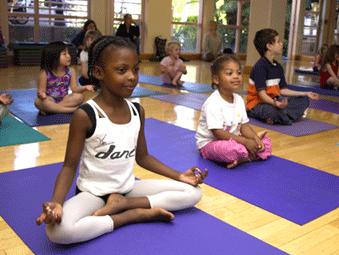
The popularity of yoga practice has skyrocketed over the past few years. This added interest has made yoga much more widely accepted—no longer are hippies and new agers the only ones going to ashrams. As the popularity of yoga has expanded, new outlets of practice have emerged—from public museums to city jails to public schools.

The most interesting outcome of the new attention is the use of yoga and meditation in public schools. City public schools can be some of the most depressing and dangerous places to be in America. Be it decrepit buildings, harassment and bullying, physical fighting, or drugs, many of our schools do not create a peaceful learning environment for our children. How can some of our most struggling students be expected to succeed in an environment where they feel unsafe?

The use of yoga in public schools not only serves as exercise, it also alleviates stress, creates more peaceful interactions with others, decreases discipline problems, and can even lead to an increase in grades. Some schools go so far as offering yoga as an alternative to regular P.E. classes. Other programs are implemented in a regular classroom setting and involve more meditation and focus than physical yoga practice.

Yoga Ed is one of the frontrunners in the push for yoga in public schools. Their program started in the state of California but has become nationwide, offering instructors to teach yoga in schools and seminars to train current teachers on implementing classroom yoga. Yoga Ed even offers lists of resources on their website.  They have recommended music, children’s books, and have tips on practicing yoga in schools.

Yoga can be used in any school setting from Pre-K to 12th grade (or even into college). It seems just as effective in the lower grades (increased concentration, less fighting) as in middle and high schools (less stress). The two pillars most supported by yoga in schools are Skill Building and Community Building. Yoga is a resource that kids can carry with them throughout their lives to handle conflicts and daily problems in a non-violent way. It also creates a more cohesive, peaceful group dynamic in the school setting.

If a principal seems unwilling to set up a school-wide yoga program, individual teachers can take trainings or find meditation techniques online to use in their classrooms. Yoga is a very accessible (and often free) resource for teachers to build their classrooms into communities and alleviate discipline problems.

Also, for reference (and cuteness), here is a video of classroom yoga in Los Angeles by Sat Naam’s “Yoga in Schools” program.

Here are two other great resources for those who want to learn more about yoga in schools!

http://www.yogaed.com/resources/Non-Violence_in_School_through_Yoga.pdf

http://www.nytimes.com/2011/10/09/nyregion/in-yoga-classes-at-schools-teachers-avoid-the-spiritual.html