History Education: Conversations about Racial Injustices in the United States

Background

Einstein’s Parable of Quantum Insanity – “Insanity is doing the same thing over and over and expecting different results.”

Einstein’s parable perfectly expresses why we need to teach history in classrooms in the United States. Continuous teaching and reflection on our failures and successes as a country is the only way to prevent us from repeating the mistakes of the past and causing further harm. Furthermore, history provides us with some parameters within which we act and engage with others. For example, we know objectively that slavery was horrific, so we will never return to a time where slavery is normal or accepted.

History education also helps us to understand the context behind the current realities of different demographics within the U.S and what we could do to rectify certain inequalities. While slavery isn’t accepted in the United States, we can still see the remnants of slavery in different aspects of life. This is particularly true for wages for non-white people, the way school and electoral districts are drawn, access to education/education resources, incarceration rates etc. Understanding how history impacted all of these systemic issues will help us to cultivate long lasting solutions. Acknowledging the history is the only way to fully dismantle these avenues of systemic oppression.

Despite its importance, the teaching of history has been threatened by political agendas. Several lawmakers have put forth legislation in a number of states that would ban the teaching of critical race theory, which encompasses lessons on slavery, segregation, and systemic racism. Of course, this is not a new phenomenon. Even during the civil rights movements white people controlled what was able to be taught in schools. In Jarvis Givens seminar on the fugitive life of black teaching, he explains how teachers were being closely monitored in schools to ensure they were teaching only the approved materials. Teachers would rebel and carefully include material on slavery and segregation in their lesson plans.

The politicians that are raising the legislation claim that teaching this in schools creates more division and makes students feel uncomfortable. These politicians want to provide children with an incomplete education that only portrays white men and women as honorable. They don’t want to show how cruel some people were to other fellow humans. If we don’t teach students that, how can we expect them to be any better in the future especially as the world is increasingly globalized and interconnected. We have to continue to teach children that everyone is equal regardless of their skin color or race otherwise, we could very well find ourselves back in a slavery mindset. 

This blog post contains some tips for talking about slavery, racism, and racial injustice within a classroom setting. The blog will also provide opening activities that teachers can do with their students prior to having these conversations to help prepare the students for having these difficult conversations. This activity would be most suited for students in the ninth-twelfth grades since they should have a bit more background on these topics and are a bit more emotionally and intellectually mature. It would make sense that these conversations and activity take place in history or social studies classes. While I am suggesting this activity and discussion be done in a classroom setting, the activity can be adapted for more informal community settings since most of the same principles will apply. A classroom setting is one of the best spaces for this because teachers will have had the opportunity to build trust and rapport with their students throughout the semester, which makes these conversations a little bit easier to have. When done in a more informal community setting, it will be harder to have the needed levels of trust within the group.

This blog post was inspired by some recent conversations about how the education system in the United States teaches about slavery and racism. I came to the conclusion that our system doesn’t do a great job. I think people are sometimes afraid to offend someone, say the wrong thing, or just don’t think this topic is appropriate for kids. I would argue, however, that we need to start teaching children at a young age about racism and racial injustices. Having this knowledge will affect how they interact with an increasingly globalized world.

Activities

Pre-activity: Establishing codes of ethics

This activity is prepared under the assumption that the teachers and students in the classroom have built up some trust. In order to reinforce the trust, the teacher should begin the class by collaborating with students to set some ground rules and codes of conduct for students and the teacher to adhere to while engaging in the discussions on race. Students should take the lead on suggesting ideas, but the teacher can help fill in gaps where they deem necessary. The objective of this activity is for students to share what is necessary for them to feel like they are in a safe space and to establish a mechanism whereby student can alert the teacher and other students if they are feeling too stretched by the conversation.

This activity could also be done at the beginning of the school year and then revisited prior to lessons on race, slavery, and racial injustice.

Time needed: 25 minutes

Materials needed: A marker and a large sheet of paper (a blackboard can also be used)

Instructions:

  1. Teacher should facilitate the brainstorming session and act as note taker.
  2. Ask students to provide ground rules and codes of conduct for the discussion (examples: not talking over each other, respect other students’ identities, keep an open mind, etc)
  3. Ask students to brainstorm (aloud) how they can indicate when they feel that the code of conduct is being violated or if the conversation is triggering to them.
  4. Have students come to a consensus on what to include and have everyone (including the teacher) agree to follow the rules.
  5. The teacher should port these rules in a visible place. 

Warm-up activity: Who am I?

This activity has been adapted from The Learning Network’s repository of lesson plans on race, racism, and injustice. This activity can be used as a way to get ease them into talking about issues of identity and race by starting with something they can relate to on a personal level.

Click here for more details on the full lesson plan and other resources.

The goal of this activity is to really get students thinking about their own identities and how they affect how people see them. Having this conversation is a good way to lead into a conversation about racism and how it affects all aspects of life. It will also be useful when explaining that although slavery and Jim Crow are over, we can still see remnants of that kind of thinking in our lives today.

Time needed: 30 minutes.

Materials needed: Pen and paper.

Instructions: 

  1. Ask students to take 5 minutes to think about their personal identities that are directly related to their race. Ask them to describe their identity in less than ten words.
  2. Next, ask students to turn to their neighbor and do a pair and share for about 5 minutes. This should help students feel more comfortable sharing.
  3. Next, ask for volunteers to share with the class if they are comfortable. This step is optional. 
  4. For the remaining time, the teacher can ask how the students identities affect how they see the world or how they think other people see them. It would be beneficial for the teacher to share about their own identities and experiences here as well to model to the students that this is a space to discuss.

Tips for Having Conversations About Racism and Racial Injustice in the Classroom

  1. Start building trust between you and your students on the first day of class. Trust is absolutely necessary for having conversations about race and racial injustices. Students won’t be willing to be vulnerable or uncomfortable in a space where they don’t trust the teacher or other students. Do your best to establish your classroom as a safe space from day one.
  2. Being uncomfortable is okay. Talking about slavery and segregation are never going to be comfortable for any race. However, we have to learn how to sit in uncomfortableness and recognize that it was far worse for people affected by slavery. We then need to take that uncomfortable feeling and use it to make the needed changes. We need to redeem uncomfortable for true equality and freedom.
  3. Be knowledgeable on the subject. Make sure that you have done thorough research before discussing topics like this. It is important to go beyond base level knowledge that most school curriculums call for. Dig into other sources so that you can provide students with different perspectives. Part of this process is to acknowledge what you don’t know. Then, go and find out more. You should encourage your students to do this as well. Because the reality is that you won’t have the time to cover everything.
  4. Know when to say you don’t know, especially when it comes to things that don’t relate to your identities. I think this is particularly important for white educators who are facilitating these conversations. Reach out to your colleagues for their perspectives and advice. The more perspectives that can be raised the better.
  5. Prior to starting your lessons, remind students of the code of conduct they agreed to. You can use this time to make any needed amendments or additions.
  6. End each class with a debrief. You can ask students how they are feeling after the lessons, what they found most interesting/impactful, things they might want to know more about, and any other thoughts they might have. The conversation can get heavy, so it is important to talk through some of things they might be thinking or feeling after each class.
Emotional Intelligence and Social Change: A Conflict skills and Peacemaking Activity

Designed by Haley Nelson

Background Information/Content

Social-emotional intelligence is central to group dynamics and conflict. Yet, the exploration of emotional intelligence has historically been neglected in conflict resolution and peacebuilding conversations. The absence of emotional intelligence in conflicts can hinder the ability of group members to navigate conflict, empathize with others, and manage relationships (Schwarz, 2002). When emotional intelligence is considered at the educational, community, or organizational level, group members can learn to harness emotion as a community and relationship-building tool. 

This activity explores emotional intelligence in the context of peace education. This resource draws inspiration from psychology surrounding basic emotions, emotional wheels, and the origin of emotion, as well as conflict resolution and peacebuilding research on emotions and conflict. This activity will support groups in building emotional intelligence on the individual and social levels. This activity is best suited for groups with a common goal, such as classrooms, community organizations, and the workplace. 

Context

This activity is best suited for high school students, college-age students, and adults. The formality of this activity can be adapted to various education settings but is neutral in its current form. The activity consists of two phases and will take approximately 30 minutes per phase. The length of this activity may vary based on the depth of conversation and volume of participation.

The recommended group size for this activity is 4-10 people. Increased group size will increase duration, allowing for productive discussion among group members. This activity would be best supported by materials such as sticky notes, note cards, and a whiteboard. However, this exercise can be completed via discussion if these resources are unavailable.  

Implementation

Phase 1: (30-45 minutes)

  • Introduction (2-3 minutes):
    • Check-in on how everyone feels and provide context for the activity. The purpose of this introduction is to reveal that the activity will encourage participants to explore and feel daily emotions and tensions. The facilitator should consider establishing a controlled environment where participants can explore emotions safely. An introductory example is below:
      • “We are going to discuss emotional intelligence today. We will create a respective space where real emotions will be felt. We will go through a simulation designed to stimulate emotions in scenarios we feel and experience in our daily lives. If you feel the need to leave the space and take a moment for yourself at any time, please do so.”
    • Describe the importance of emotional intelligence when managing conflict.
  • Description of the simulation (2-3 minutes):
    • Provide a scenario, context, and discussion topic for the audience to navigate. For example, a dinner party discussing travel destinations will generate conversation and allow participants a neutral space to explore group dynamics.Assign behavioral traits to participants randomly: Each participant will be assigned a behavioral trait designed to generate tension, such as disruptive talking, withdrawn behavior, and overconfidence.
      • Remind the audience of the difference between behavior and emotions, acknowledging that the two might contrast during the activity.
    • Open conversation for any questions before beginning.
  • Simulation (5-10 minutes)
    • During the simulation, the participants will navigate conversation based on the context and behavioral traits provided. The group may find conversation challenging to navigate. The goal of the activity is to stimulate emotions based on the role assigned, the conversations at hand, or the simulation process itself.
  • Reflection: (5 minutes)
    • Take a moment to check in with participants. Ask the audience to write down the emotions 1. They experienced during the role play, and 2. Behaviors that might indicate others’ emotions during the role play.
    • After listing these observations on a notecard or sticky note, ask participants to hold on to their observations for later conversation (allowing for further engagement).
  • Individual level emotional intelligence? (10 minutes)
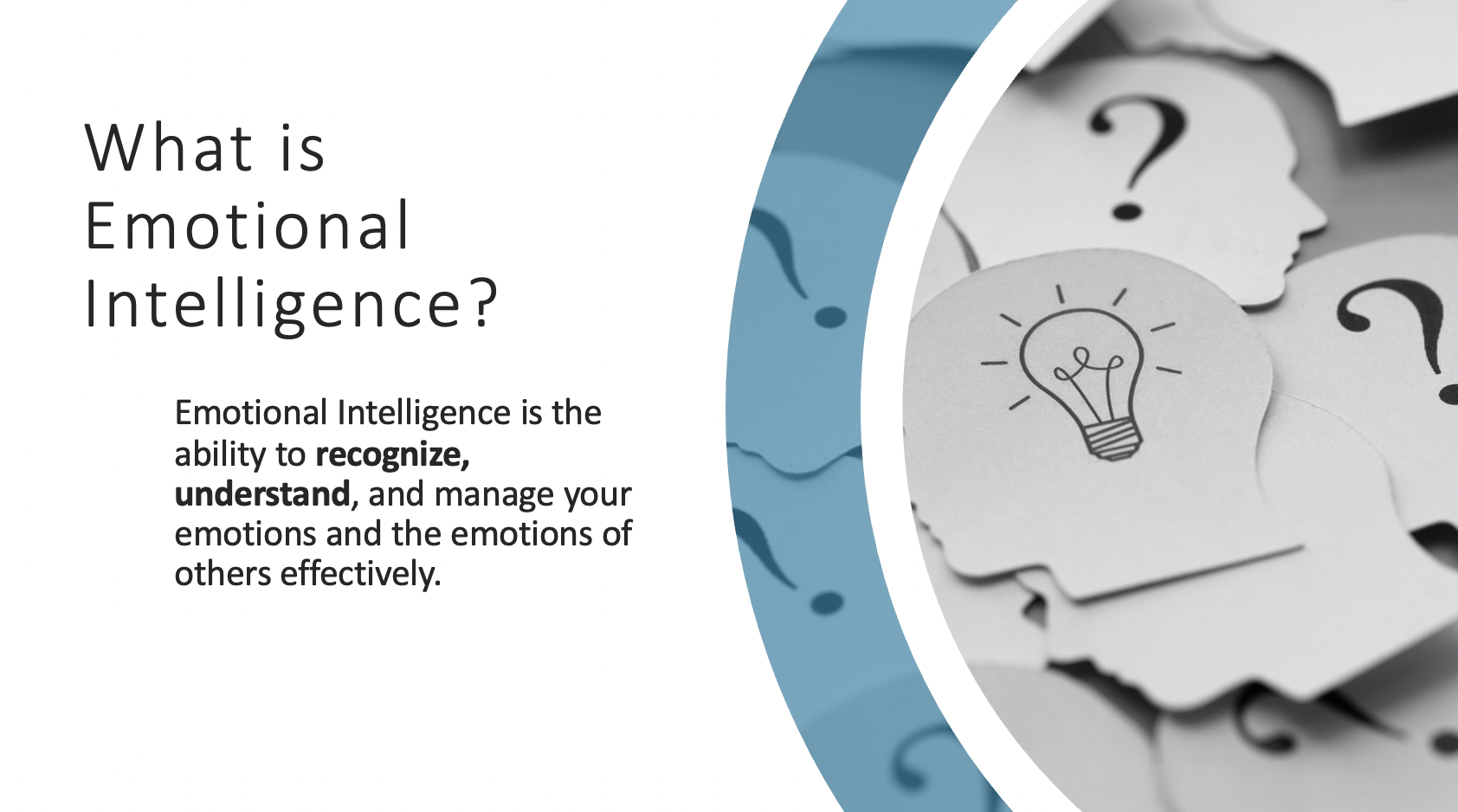
    • Define emotional intelligence and explore this definition with the group. This is an excellent opportunity to explore the meaning behind emotional intelligence and clarify any questions regarding emotional intelligence with the group.
    • After defining emotional intelligence, ask group members to share the emotions they experienced during the activity with the group. Ask the participants to refrain from group observations until later.
      • Explore the dynamic of emotions as they arise:
        • Did members experience multiple emotions? Were those emotions in harmony with one another? Did emotions contrast with each other?
  • Clarifying emotions (5-10 minutes):
    • Explore the six types of basic emotions with the group: happiness, sadness, fear, disgust, anger, and surprise. Then, explore emotions surrounding each category and how they can be clarified. For example: if a group member said they felt anxious during the activity, that emotion is rooted in fear. If a group member said they felt confused during the activity, that emotion is rooted in surprise. Provide examples for the group, then encourage them to clarify their shared emotions.
    • Many people, especially adults, will provide cognitive responses instead of emotions when asked how they feel. When asked what emotions they experienced during the activity, a cognitive response might sound like, “conversations about travel destinations made me want to explore the world more.” Encourage using the emotional wheel to assist participants in shifting from cognitive responses to emotional responses. Ask the participant which emotion is closest to their shared responses and explore the differences between emotion and cognition.

Phase 2: (20-30 minutes)

  • Social-emotional intelligence (5-10 minutes)
    • Ask the participants to return to their group observational notes from the simulation. Consider what cues clued participants in on how others might have been feeling.Provide an example of clarifying social emotions for the group:
      • “I noticed that you were quiet after being interrupted. Did you feel sad after that interaction?” Remind the group to use core emotion vocabulary (i.e., happiness, sadness, fear, disgust, anger, surprise). 
      Allow group members to share their observations. 
    • Open a conversation to ask how accurate their observations were.
      • Why were my observations accurate/inaccurate? How can I better observe the emotions in groups moving forward? 
  • Further discussion: (15-20 minutes)
    • Allow the group to discuss their experience with the activity in depth. Some guiding questions might include the following:
      • How aware were you in the moment of your emotions? Others? 
      • Did you feel that other people’s emotions influenced yours? How? 
      • What were your reactions to emotions in the space? How/did you respond?
      • How might you manage your reactions to emotions in the future?
      • How difficult was it to clarify your emotions? 

Ways to further curate this resource:

  • Pedagogies that may strengthen this resource involve increased participant freedom and involvement. The facilitator of this exercise might increase participant freedom by:
    • Encouraging group members to create their own activities to stimulate everyday emotions.
    • Allowing group members to redefine emotional intelligence for themselves based on shared interests.
    • Involving artistic approaches to exploring emotions such as paintings, photographs, and music. This might involve emotional responses to the creation of artwork or the observation of artwork.

Goal

This activity focuses on individual and social-emotional intelligence. As an introduction to emotional intelligence, this activity seeks to help group members identify their emotions and clarify the origin of their emotions. At the group level, this activity seeks to increase awareness of group dynamics through observations and clarification of emotion. This activity aims to foster empathy and connection within a group by discussing the relationship between individual and social emotions. 

After this activity, participants should be able to:

  • Understand the meaning and importance of emotional intelligence.
  • Clarify everyday emotions into the six core emotions.
  • Have increased awareness of the connection between individual and social emotions. 

Resources

Further reading on emotions and insight into social-emotional intelligence:

Cherry, K. (2022, December). The 6 types of basic emotions and their effect on human behavior. Verywell Mind. Retrieved 2022, from https://www.verywellmind.com/an-overview-of-the-types-of-emotions-4163976 

The Junto Emotion Wheel. The Junto Institute. (2022). Retrieved 2022, from https://www.thejuntoinstitute.com/emotion-wheels/ 

Schwarz, R. (2002). Ch 12: Dealing With Emotions. In The skilled facilitator: A comprehensive resource for consultants, facilitators, managers, trainers, and coaches. essay, Jossey-Bass. 

An Art Activity for Reflection and Generalization of Learning

Designed by Yuriko Noda

This is an activity designed and can be utilized effectively at the end of a series of training, seminar, course, etc. that is conducted based on the principles of experiential learning which facilitates participants learning through their experiences.

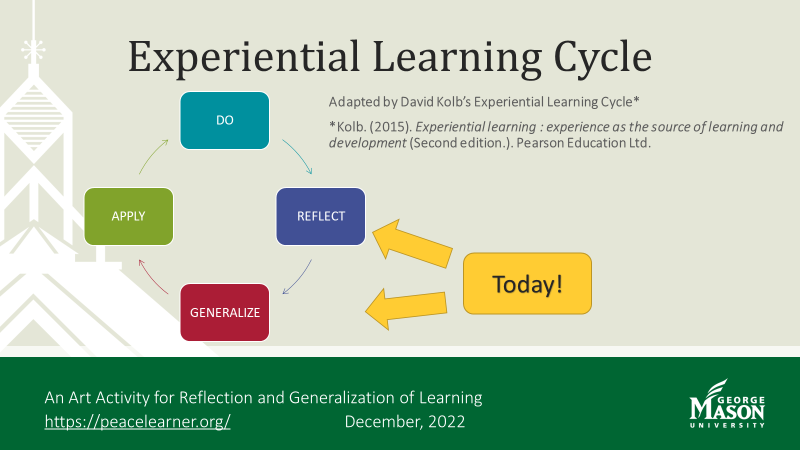
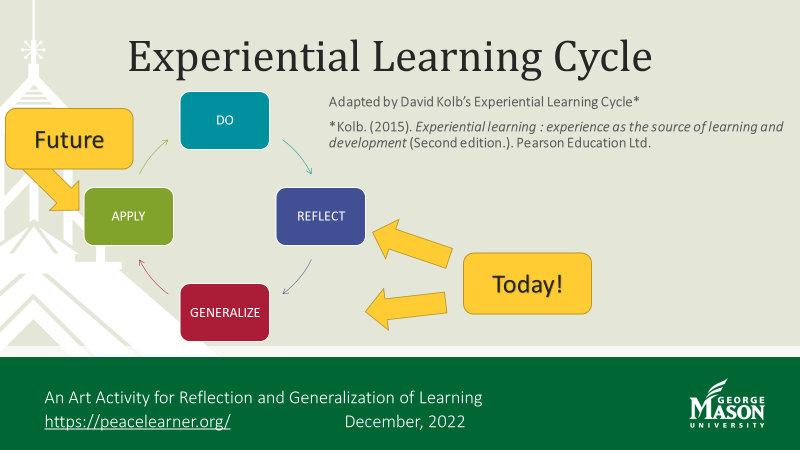
Based on the experiential learning cycle adapted from Kolb (2015), it is argued that people can learn from experiences, but just experiencing something is not enough to actually learn from it. For the effective experiential learning, the process of “Reflection” and “Generalization” are important in order to be able to “Apply” the learning in the future. Therefore, this activity is designed to be helpful for participants to reflect and generalize their learning from their experiences.


Outline of the activity:

  • Overview: The participants take time to work on their own to reflect their series of experiences, make a short story about it, and put it into an art piece. After that, the participants present it to the group, and the facilitator lead a short discussion about each presentation with the group, as well as a short reflection about this entire activity.
  • Time: 45-60 minutes
  • Number of participants: Any number more than 3
  • Age group: Any age, depending on the expected depth of the reflections, generalizations, and discussions
  • Settings: In-person or online.
    • For in-person settings, a variety of materials need to be prepared.
    • For online settings, it’s helpful to notify the participants in advance so that they can bring their own materials ready.
  • Goals: By the end of this activity, the participants would be able to
    • Become more aware of their biggest learning from the series of experiences
    • Express and present their biggest learning from the series of experiences
    • Have ideas how to apply their biggest learning from the series of experiences in their future
    • Remember their biggest learning from the series of experiences even after the completion
  • Pre-Work:
    • This 45–60-minutes activity is designed to be conducted after each participant taking time to reflect their series of experiences. So it is recommended to either give them heads-up to reflect the experiences on their own or set time for reflection together before this activity.
    • If it’s conducted online, it is also helpful to tell the participants briefly what we are going to do, and ask them to bring materials they may want to use (paper, pens, musical instruments, etc.).
  • Flow and instructions:
    • Introduction (1 min): Why we are doing this activity (purpose).
      • Presenting the learning cycle of DO – REFLECT – GENERALIZE – APPLY from the experiential learning, explain that this activity will help their reflection and generalization process of their learning and their preparation for application. DO part should have been done during the series of experiences.
      • Motivate them to try to grab the most important learning and express it in the form of art.
    • Instructions (4 min):
      • You will have 10 minutes to work on your piece of art by yourself. You are going to think and express the followings in a form of art, and present with the group after that (how to present, time to present depends on the number of the participants).
      • You can use any form of art. It could be a little one-man sketch or skit, making a song, rewriting lyrics of a famous song, drawing a picture, drawing a poster, making a sculpture using what you have at hand, write a poem, etc. But please try to avoid long sentences or wordy explanations. Using hands like handwriting is encouraged rather than typing or drawing on computer. Be creative!
      • Contents of the art is like a story which should include ALL of the following:
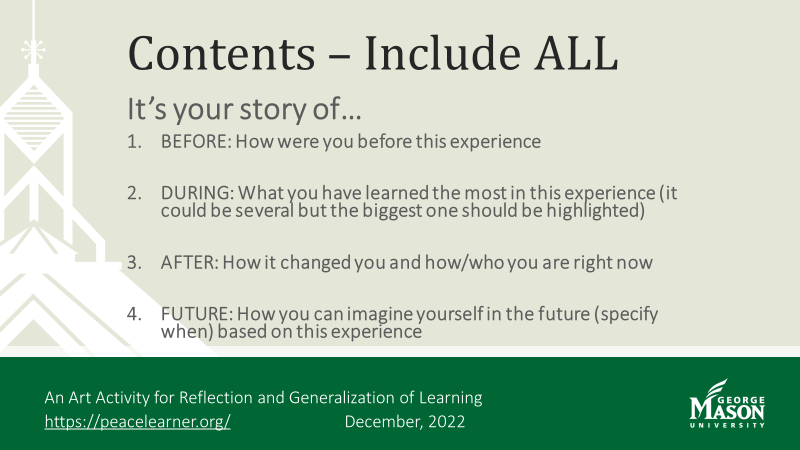
        1. BEFORE: How were you before this experience
        2. DURING: What you have learned the most in this experience (it could be several but the biggest one should be highlighted)
        3. AFTER: How it changed you and how/who you are right now
        4. FUTURE: How you can imagine yourself in the future (specify when) based on this experience
      • Time to work by yourself is 10 minutes. Time for you to present is 2 minutes. The facilitator will give you reminders of time (5 minutes to go, 1 mininute to go).
      • Any questions?
    • Individual crafting time (10-15 min). Playing a nice music is a good option. Set a timer and facilitator will give reminders 5 minutes and 1 minute before the end.
    • Presentation and discussion (20 min):
      • We get together after the crafting time is over.
      • Some or all of the partiicpants present their art pieces.
      • After each person’s presentation, other participants are welcome to make short comments, if any.
      • Facilitator will also acknowledge and make a comment on the presentation.
    • Small reflection of this activity (5 min):
      • Open to the floor to share their reflections and learning (if any) of this activity.
    • Wrap up (5 min):
      • Show appreciation for their works and make a brief comment by the facilitator
      • Put up the learning cycle again to highlight that in the experiential learning, it starts with DO but through the process of REFLECT and GENERALIZE, the learners can bring their learning as transferable or applicable knowledge, skills or attitudes. That’s why we did this activity and hope it will be helpful for you to utilize or apply your learning (not only the biggest one but other small ones, too) in your life in the future in different contexts

Resource:
Kolb. (2015). Experiential learning : experience as the source of learning and development (Second edition.). Pearson Education Ltd.

*This activity was designed by Yuriko Noda, a PhD stuent at from Jimmy and Rosalynn Carter School for Peace and Conflict Resolution, George Mason University

Delicious, Nutritious Peace: Building Peace through Food

Image

I don’t know about you, but I love food. Most people relish the opportunity to satiate hunger, to dine with friends, to share a holiday meal with family. A resource I believe can be incredibly effective in building peace is commonplace. In the United States of America, most of us are fortunate to have this resource waiting in our cabinet at home or in the cafeteria at school. Food, in abundance for the majority of this nation’s citizens, can be a driving force in building peace within communities.

“Food is our common ground, a universal experience” – James Beard

Food can be very informative about a region and a culture. In my online research into building peace through discussing food, I happened upon a lesson plan titled “What Do People Around the World Eat?” created by Learning to Give. This 45 minute lesson plan is designed for high school students and can be easily employed in history, nutrition, or economics classes. If I was facilitating this lesson in a history or nutrition class, I would add several components.

This lesson plan first involves an activity in which students stand by a poster with a continent’s name written on it, guessing which one has the healthiest food and eating habits. Next, a slide show “What the World Eats” created by Time will be presented. Pairs will discuss why people from around the world eat such diverse food in different quantities. A volunteer will take notes on the poster about students’ observations. Discussion will then shift to the differences in observations across continents.

If this was my own lesson plan, I’d add my component after the section described above. I would add discussion about the cultures of the students. Split into 5 small groups, students would discuss traditional foods and eating norms in their culture. They can also speak more about their family and their eating style. Do they eat out all the time? Do they share family meals often? Experiences with foods from other cultures can also be brought up. As they discussed, each group would prepare a simple dish from one continent being presented. Students will grow in community with each other and understanding of the culture, as well as get several snacks to enjoy while they enter into the next round of discussion. This would add approximately 45 minutes. The dishes will be chosen based on ease, short cooking time, and appeal. Food preparation is not be feasible in all situations, but a discussion of the students’ cultural experiences with food should be included.

According to the lesson plan, after this portion, discussion will shift again to comparison of attributes of the foods (cost per week per person, nutritional value, quantity per person, variety of food groups). The class will split into groups to discuss these attributes, soon presenting a class with a summary of their observation. If computers are available, a summary with research should be expected.

This lesson plan ends with two excellent questions: “How do these differences show that there is an injustice in food availability?  Whose responsibility is it to take action to address the injustice of food availability?” After a brief discussion of this, I’d expect students to write an essay or reflection about their thoughts on the matter.

This lesson plan reflects many of the pillars of peace education, particularly community building, engaging multiple intelligences, and skill building. Students build community with each other, gain understanding of one another’s cultures, and are introduced to the outside world’s experiences with food. They have the opportunity to discuss, to view a presentation, to walk around the class, to create food—engaging verbal, visual, and kinesthetic learners. Finally, this helps develop skills in analysis, comparison, and cooking.

This lesson plan would be great for high school teachers, particularly those that lead history or nutrition classes. This can be adapted for economics classes, for younger students, or for college-level courses. Informally, I could see this project fitting very well in Saturday community projects, with Girl and Boy Scout troops, in youth groups at churches, and in community enrichment classes.

For more information about building peace through making food, The PeaceMeal Project is a good place to start.

Theories of Change in Education

Theories of Change in Education

Change Theories in Education

Posted by

By Merrilee Henk, WTWL Writer

Merrilee3Merrilee Henk is a teacher and life long learner. She has a background in psychology and emotional and behavioral disabilities. Merrilee currently teaches elementary special education and is working on her doctorate in education. She has written numerous articles on parenting, discipline, behavior modification, and other child related topics. Merrilee gives presentations for the Wisconsin Public Library Summer Reading Program for Children and recently began writing for eHow. Follow these links to view non-teaching related articles by this author: How to Attack the “After Christmas Naughty” and How to Change Your Life. . .Pick Your Vice.

Public education has been evolving with society since its conception, and reform efforts continue to drive that evolution. Reform efforts that do not address reform from a systemic perspective have overwhelmed public education institutions (Gabriele, 2000). Ravitch (2004) described the existing failure of many reform efforts as, “… forgotten innovations [that] continue to live in schools where they were introduced with great fanfare . . . schools are like archeological sites; digging would reveal layer after layer of fossilized school reforms and obsolete programs” (as cited in Jones, 2007, p. 189).

Different theories approach systemic educational change from varying philosophies, strategies, models, and methods (Gabriele, 2000), searching for the theory that will create conditions necessary for systemic change. Gabriele declared these conditions to include an “ideal-based, holistic, continuing, participatory, user-friendly, easy to adjust/improve, and emancipatory” for effective change to occur. Three theories of change utilized by school districts are institutional theory, free market theory, and round table theory.

Institutional Change Theory

John Meyer and colleagues developed the institutional change theory in the 1970’s (Huerta & Zuckerman, 2009). Institutional change theory is a framework based on the relationship between schools and their cultural environments. Society’s cultural norms shape organizational structure by encouraging schools to conform to the accepted rules and rituals of an institution. Scott (2003) described institutional theory as “[emphasizing] the influence that an organization’s cultural environment has on organizational structure and behavior, and it seeks to understand the ways in which cultural rules from the environment shape or constrain organizational action” (as cited in Huerta and Zuckerman, p. 415).

Established institutions, operating with rules and rituals that have come to represent legitimate schooling, become role models for other institutions seeking legitimacy. But not all institutions want to maintain the status quo and are constrained by societal and institutional norms. Huerta and Zuckerman (2009) cited the example of charter schools seeking to break away from the “long-standing institutionalized patterns of teaching and learning…” (p. 416). The institutionalization of the public school system has provided direction and limitations concurrently.

Free market theory

The free market theory proposes that educational change occurs as schools compete for excellence (Marion, 2002). The assumption that all schools begin with an equal opportunity to achieve excellence is attractive to proponents of school choice because it justifies the removal of their children from a failing school to one of greater success. According to the free market theory, the blame for failure lies with the school district.

Adnett and Davies (2000) and Lubienski (2006) proclaimed that federal regulations make it impossible for educational institutions to be genuine free markets, resulting in the failure of the free market theory in educational change (as cited in Eyal, 2008). Eyal deduced that a free market system, if possible to create in the public school system, would fail to produce significant change because the characteristics of the free market system would not create an environment conducive to change.

Roundtable Theory

The roundtable theory (RT) is a shared leadership theory for school change. Gabriele (2002) explained RT as distributing leadership and learning equally across participants. Involving stakeholders in the decision-making process through shared leadership can lead to higher levels of commitment. Gabriele described the ideal RT practice as being run according to a Leader’s Guide developed by consensus and periodically reviewed. The RT sessions would include a reading and review of literature on a topic during a 60 minute session, a time for participants to respond individually and uninterrupted by other members, and all participants would have an equal voice.

A change theory positively focused on strengths, rather than problems would be an ideal choice for school change. Gabriele described the RT model as based on achieving an ideal state, including all stakeholders, and being conducted within the regular school day. RT is an on-going process allowing schools to progress toward excellence. Gabriele noted that RT is a research-based model proven to lead organizations toward the “self-transformation of participants and goal attainment.
Discussion

Change will affect staff regardless of the change theory chosen or the changes proposed. Bueker (2005) stated, “One of the most difficult aspects of implementing a whole school reform is striking a balance between proper program implementation and individual teacher flexibility” (p. 411). Bueker noted that empowering teachers, treating teachers with professional respect, and providing structured and continuing support for staff, could minimize the negative effects of school change.

National trends, such as the accountability movement and federal mandates like the No Child Left Behind Act, can prescribe change. H. K. Meyer and Rowan (2006) described the affect that trends can have on education when they stated, “we might apply new institutional constructs that can account for both an evolving theory and its application to changing policy contexts, including the “tightening control of government over the core technology of schooling” linked to standards and accountability reforms” (as cited in Huerta and Zuckerman, (2009), p. 417). The choice for school reform can be beyond the control of the school district, the administration, and the teachers it will affect.

Conclusions

School change is constant. Eyal (2008) suggested, “despite the prevalent image of public institutions as highly conservative and stagnant, it might be interesting to investigate their potential as sources of innovations that are no less radical than the alternatives proposed by free-market ideologues” (p. 487). School reform creates stress on all stakeholders and requires careful consideration of theoretical framework. Vernez, et al. (2004) reported that there is little evidence to support the validity and effectiveness of many school reform initiative policies, which makes research of the different strategies essential.

An analysis of change theory models prior to setting a course is critical. The RT model described by Gabriele is research-based and proven to be an effective school change theory. The effectiveness of the RT model in practice, during the call for reform to meet the skills of the 21st Century, warrants further research on the applicability of RT in meeting the educational needs of the future. School structure will continue to evolve, and the reform theories proven effective by research will continue to be refined.

References

Bueker, C. (2005). Teachers’ reports of the effects of a whole-school literacy reform model on teacher turnover. Elementary School Journal, 105(4), 395-416. http://search.ebscohost.com.ezproxy.apollolibrary.com

Eyal, O. (2009). Degeneracy, resilience and free markets in educational innovation. Systems Research & Behavioral Science, 26(4), 487-491. http://search.ebscohost.com.ezproxy.apollolibrary.com, doi:10.1002/sres.940

Huerta, L. & Zuckerman, A. (2009). An institutional theory analysis of charter schools: Addressing institutional challenges to scale. PJE. Peabody Journal of Education, 84(3), 414-431. http://search.ebscohost.com.ezproxy.apollolibrary.com, doi:10.1080/01619560902973621

Gabriele, S. F. (2002). The “roundtable” for school learning and planning groups: Planting a seed for systemic renewal. Kybernetes: Special Double Issue: Systems and Cybernetics: New…, 31(9/10), 1361-1368. Retrieved October 10, 2009, from Research Library. (Document ID: 277870851).

Marion, R. (2002). Leadership in education: Organizational theory for the practitioner. Long Grove, IL: Waveland Press, Inc.

Jones, B. A. (2007). “Table top theory” as a policy framework for gauging the confluence of teaching and private sector interests. Teacher Education Quarterly, 34(2), 185-204.

Related posts:

  1. Empowering Change in Education Teachers in every district face the frustrations of working under…
  2. Radical change and wikis: teaching new literacies. Luce-Kapler, R.  (2007, November).  Radical change and wikis:  teaching new…
  3. The Edge of Education Carnival. Issue 3 Welcome to the third issue of the Edge of Education…
  4. Activating the desire to learn. An Annotation by Laurie Walsh Internal control psychology’s choice theory…
  5. “Choice theory” and student success. Glasser, W. Glasser, W.  (1997).  “Choice theory” and student success.  Phi Delta…

Visual Peacemakers

Image

Connecting with people across lines of difference is a fundamental goal in conflict resolution and this process has, in some ways, become more accessible due to the presence of the internet and social media tools.  Through a course I am taking focusing on Art as a means of social change, I came across the online resource visualpeacemaker.org.  This site is essentially a host for the collaborative project coordinated by the International Guild of Visual Peacemakers.  Working with such partners as Peace Catalyst International, the Guild of visual artist and photographers challenge stereotypes and prejudices by capturing the beauty of diversity.

The International Guild of Visual Peacemakers resource consists of collections of photographs, documentaries, and photo blogs that work to promote the message of the Guild as described in their manifesto.  By capturing the human elements of cultures, the project seeks to build peace.

Throughout history people have fallen into the trap of making enemies with, demonizing, stereotyping, and fighting the “other.” There has been a flood of conflict based on ethnic, cultural, and religious identity in the post-cold war era that has ended the lives of millions, destroyed economies, and torn apart families.

Much of this has been fueled by the growing availability of technology, especially photography and videography. While the written word carries an expectation for honesty, there is a void regarding the ethics of images due to their subjective nature. This void has opened the door for photographers to exploit people’s desire to confirm their thoughts about the “other”—mobilizing innumerable people towards slander, violence, and other fear-based responses.

Since 9/11, conflicts between Muslim cultures and western cultures have been growing in intensity. There are deep misunderstandings and stereotypes that are producing widespread fear and anger.

The International Guild of Visual Peacemakers (IGVP) was created to build bridges of peace across ethnic, cultural, and religious lines through visual communication that is both accountable to an ethical standard and created by those who authentically care about people.

This resource can be used in both the formal and informal learning space due to its accessibility and the intelligible nature of the content.  Visually the images are powerful and the stories that the pictures tell are worth sharing with students and learners of all ages.  This resource can incite discussions about toleration, diversity, and the beauty and dignity of human life which is aptly illustrated in this project.  This approach to facilitating understanding and appreciation of diverse cultures while also educating the international audience about global issues is creative response to the political, social, and religious conflicts that are prolific in our contemporary landscape.

Using this resources students will not only be exposed to global conflict as humanized by the International Guild of Visual Peacemakers, but will also gain insight into the varied approaches experts in the field of Conflict Analysis and Resolution are tackling and implementing.

Video Games for Peace

Three of the top ten best-selling video games of 2011 are characterized by explicit violence and main objectives which celebrate using various means by the user character to destroy other characters (1). While there has been very little clear evidence linking violence portrayed in video games to violence by users, the game market is notably void of games made explicitly for peace.  Video games can be used by educators to promote peaceful ways to conflict resolution without distracting from the education system’s core curriculum.

Video games as explicit means of peace education do not form an established genre in the gaming world. But, some games have been developed that reward peaceful means of conflict resolution and penalize violent behavior. For example, the video game Civilization tasks the user with building a thriving civilization from the ground up, but the user is penalized if major violence and riots occur in the user’s civilization. The 2007 video game PeaceMaker, tasks the user with taking one side of the Israeli-Palestinian conflict and implementing a peaceful two-state solution, all the while being challenged by realistic events occuring during the user’s play.

http://www.youtube.com/watch?v=7iPvWefuPwo

A short video on PeaceMaker

In what context can video games for peace be used in learning? What type of lesson plan can be used with the goal of peace learning in mind? One possible context is for these video games to be integrated into the computer classes present in primary and secondary education. Simple point-and-click mini-games, which reward win-win situations between the user and computer intelligence and penalize aggressive behavior, can demonstrate peaceful ways to deal with conflict and are appropriate for users with relatively basic computer skills. These games can be used by educators to reward excellence and progress in computer classes, and since they are cheap and easy to produce, can be integrated into existing computer literacy programs. Certain classes in the social sciences could play a short video game that explains peaceful methods of conflict resolution and challenges students with finding the most peaceful solution in relations between people and groups of people. Students with advanced computer skills could play role-playing games, such as Civilization and PeaceMaker, in classes, clubs, and camps. In all these examples, it is essential for the educator to review the rewards-and-penalties systems existing in the game and prompt the students to reflect on how these games simulate decision making in conflicts.

Implementation of a lesson plan using video games is hampered by two problems: a lack of resources and a lack of pedagogy. Many education systems do not have computers available for student use aside from special computer literacy courses or lack adequate computer labs for students to use in this lesson plan. The use of video games geared for peace in a school curriculum could face problems in implementation because video games are often associated with laziness and distractions from education, rather than a form of education itself. Peace education through video games would receive less criticism in being implemented if educators demonstrated the success of other interactive games in teaching educational topics and assisting core curricula.

Video games can be used as an educational resource for peace. Video games designed specifically for demonstrating and rewarding peaceful solutions to conflicts can be integrated into existing educational settings and can fit into larger lesson plans on conflict and peace. Peace educators can use video games as a way for students to explore peace in an accessible environment and apply peace education topics to simulated conflicts.

(1): These three games, (Call of Duty: Black Ops, Mortal Kombat and L.A. Noire), are noted by the Entertainment Software Rating Board for blood, gore, and intensive violence.  The best-seller rating comes from a CNBC article.

Useful Links:

Antony Adolf article on peace-based video games

PeaceMaker video game official website (can be purchased for download)