This simulation is originally adapted by Karen Ridd, Training for Change, in Thailand, 1995, from a game led by Pom, Thai student and grassroots environmental activist, 1994. The exercise was sourced from 350.org, a international grassroots movement advocating for dismantling the fossil fuel industry and building a world of community-centered renewable energy for all. 350.org provides trainings and resources for facilitators already involved in the climate change movement or those just starting out.
Context
This activity is best suited for high school students, college-age students, and adults. This activity can be conducted in 45 minutes, but more time is recommended to have a more robust discussion and debrief following the activity. This simulation can be delivered as a stand-alone activity, but it is best suited as an activity in supplement to discussion of nonviolent tactics, movements, or specific group goals.
This activity is best done with at least 2 facilitators, but if the activity is delivered in a shorter timeframe (>45 minutes) there should be one facilitator per group. Groups can be anywhere 3-10 but smaller groups are recommended.
Goals
The goal of this training are to provide an opportunity for participants to experience nonviolent action. This can be utilized in a variety of ways included:
Experiential learning for students studying nonviolent movements
Opportunity for budding activists to experience a situation where their community is threatened and action needs to be taken
Team building for existing or new activists groups to practice collective action
Scenario planning for real life situations participants may face
This activity also provides groups an opportunity to build their ideal community and share their experience and values. Please note that this might not be well suited for participant groups who have experience significant community destruction that has not address as it may be triggering.
Implementation
The below implementation is the adapted 45 minute delivery of the the village game. Village game run times are typically between 1-2 hours.
Set Up: Activity should be set up in advance. Set up tables with newspaper and numerous markers. This activity can also be done on the floor if desired. If you attackers will be using markers instead of tearing newspapers exclude red marker for your participants. Attackers will use red markers during their attack. Newspapers can be prepped with landmarks such as rivers, mountains, roads as needed to get the participants started.
Introduction (3 minutes): Prime the group by establishing that there are no rules besides physical violence/destruction of property in this activity. Expanded ground rules may need to be set given the location and context, but it is imperative to emphasis creativity for this exercise especially with unexperienced groups. Divide participants into groups consisting of at least three individuals and and assign a facilitator to each group (this will be referred to as village facilitator). If participants are known before the delivery time can be saved by making assignments in advance.
Building Villages (10 minutes): Prompt villagers to begin making their dream village. This can be done in the plenary or by the village facilitator. Encourage creativity and connection to the village by prompting questions as needed. Peaceful music can be turned on to create a more immersive simulation. It is critical during this portion of that participants get ideas onto their newspaper. Inform participants that they will be presenting their village to the other village groups.
Touring Villages (5 minutes): Have groups hold their newspaper village up and talk about the important features of their village for one minute. Groups can also walk around and “tour” the other villages.
Revising Villages (2 minutes): Invite participants to return to their village and add any remaining items as desired. Ask participants to remove chairs if tables are being used. Facilitators who who are playing the role of attackers should change their outfit in some way such as adding a tie or clipboard to denote their changed role. If there enough facilitators, attackers should be in addition to village facilitators.
Village Attack/Defense (10 minutes): Music should be changed to construction, destruction, or other appropriate sound track depending on the antagonist role. Attackers should introduce themselves to the whole group and explain who/what they are. Some antagonist examples are: Oil/Fracking company, Corporation, Government group, or another group with asymmetrical power.
Attackers will then begin destroying villages by scribbling out or ripping off different sections of the newspaper village. Keep the attacks minimal to avoiding overly-distressing villagers or causing them to give up. Attackers should move away from the village to give them time to plan/recover between attacks. Village facilitators can begin prompting participants that they can be creative in their reactions or asking them questions about the attack.
Attackers should return to the village as many times as needed to destroy more sections of the village. As time continues and if participants do not take action, village facilitators can prompt the participants with ideas to prevent further attacks. Potential ideas are: negotiating, sitting on the village (if on the floor), covering the village up, blocking the attackers from the village, picking the village up and hiding it from the attackers. Attacks should continue until villagers successful stop attackers or time finishes. If there is more time is available the activity should continue until attack is successful stopped.
Debrief (10 minutes): Depending on the purpose of the simulation debrief discussion should be adjusted. Below are some example debrief ideas depending on the goal of the simulation. Since debrief time is so short facilitators should provide participants with a resources or additional ideas to explore on their own. If time allows or additional activities are planned alongside this simulation the debrief can be more expansive.
Experiential learning for students studying nonviolent movements
Ask participants about barriers to action in saving their village. Connect barriers to nonviolence movement participants have studied.
Explore conversation about ideas that surfaced versus reading about nonviolence versus participating and nonviolence simulation.
Opportunity for budding activists to experience a situation where their community is threatened and action needs to be taken
Ask participants about their inital reactions or feelings that surfaced in this activity?
Explore how participants felt during the village destruction and what prompted them to act.
Provide resources to nonviolent tactics or action steps if participants wish to become involved in activist settings.
Team building for existing or new activists groups to practice collective action
Ask participant how it felt to collective build their ideal village and what they learned about their fellow participants.
Ask participants about the group dynamics while under stress in this activity. Have them explore how group actions effect nonviolent movements.
Scenario planning for real life situations participants may face
Discuss what worked and what didn’t work and apply to participants’ context. Provide resources or ideas about nonviolent tactics.
Explore the differences that might occur in the simulation versus real situation. Additional role playing may be utilized or participants can share learnings from their experiences.
Resources
These resources are not expansive, but rather a starting place for facilitators that will depend on context and participants.
In my work with a middle shool peer mediation course, I failed to explore their emotional vocabulary first. I backed up and took the time to explore emotion words more deeply -and was glad I did.
I introduced the concept of the red haze- the idea that when we are emotionally charged, we are unable to think clearly. Highly charged emotions create a brain fog that we imagine being red, meaning danger. I then defined remorse as deep regret for wrongdoing, students shared experiences of remorse. They realized that the regrettable behavior was almost always while in an emotional red haze. I then asked them what emotions tend to create this red haze. Their list included: mad, sad, bad, and, after a long pause, somebody added ‘pissed off’. This was the list with which they felt comfortable. They were, of course, familiar with feelings but they seemed either uncomfortable or ill-equipped to express emotions. So, how do we lift that red haze in order to talk about conflict constructively?
Students reflected on the phrase, “You can’t have the good without the bad.” They deduced that the conflict stories had to do with a shift from positive feelings to negative feelings, so we need to talk about all emotions, good and bad, in order to understand where things went off the rails.
We created our own exhaustive list of emotions. They shredded dictionaries, old school style, in their search for terms that they thought might be helpful in pinpointing emotions, both positive (enjoyable to experience because they meet our emotional needs) and negative (unpleasant to experience because they do not indicate that our emotional needs are getting met). They found some fun ones! Once our long list was compiled, we spent the next two weeks getting comfortable with these words. We played charades. We lumped synonymous words together and created spectrums of those synonyms, from high energy words to low energy words. We matched antonyms and explained how we understood them to mean opposite things, for example- is love the opposite of hate? or is apathy? They discussed this for days! We compared our satisfaction levels after listening to computer generated voices versus great storytellers and discussed the long history of storytelling. We read our favorite passages from books using voices that reflected an assigned emotion. These were all meant to be fun and playful as this exploration into emotions can leave some students feeling vulnerable.
Feeling better prepared to capture the meaning in the storytelling component of peer mediation, we went back to learning the peer mediation process. When they began peer mediation sessions, they found the process beyond storytelling went much faster than they expected. Disputants would say with relief “Yes! That is exactly how I feel!” and the processes of identifying needs, seeking options, and crafting an agreement were much easier than they imagined.
What was going on?
When the peer mediators were able to help the disputants move away from “you” messages and instead identify and own their specific emotions in a safe space, both parties felt heard and understood. Storytelling allowed them to clear the red haze. It was the storytelling that promoted compassion and sometimes renewed friendships. The peer mediation students were discovering how to open an emotional release valve in their disputants …and they felt a little magical in doing so. Perhaps they developed an unrealistic expectation of the ease of conflict resolution? Perhaps it was a shift to SEL that needed attention first?
These lessons align best with Social Emotional Learning strategies, the research tells us that more SEL (Social Emotional Learning) is critical for student success, learn more about the need for more SEL at: Impact of sel SEL: The Time Is Now
Further Conflict resolution plans like the ones I went back into after this exploration can be found at:
80% of this Peer Mediation class stayed with me for a second semester course called “Peer Helping”, I gave them the tools to effectively tutor other students and during those tutoring sessions, they were able to use their story capturing skills to help students work through the emotional blocks preventing them from achieving academic success. Partnered up with students who were failing across-the-board, by the end of that semester they saw changes, not just in academic scores, but in their attitudes toward their futures.
When reaching out to these peer mediation students years later, they expressed some frustration. On the positive side, they felt confident in expressing their needs and concerns constructively when in conflict. Their frustration was that conflict resolution felt rather one-sided; they had to do the heavy lifting when in conflict because they felt few people have the constructive conflict resolution skills that they had acquired.
Below are some more strategies we used in our exploration of emotions and some links for similar activities. They are appropriate for middle and high school classrooms and clubs which meet regularly. All of them require very little prep or materials and can be done in less than 30-40 minutes or over a period of time in pieces. Discussion of emotions requires a degree of trust building; sharing of personal feelings should be kept optional and minimal while laying the foundation of trust within the group.
Activity #1
The Wheel of Emotions
Time: 40 minutes
Tools: A copy of the Wheel of emotions (below).
Students will identify words useful in pinpointing emotions with more specificity.
Students will compare the feeling they associate with emotion vocabulary and compare it to their classmates feeling.
The emotions wheel gives us a chance to look at how emotional vocabulary can be helpful. Sad doesn’t mean a lot; but powerless tells much more, and yet, is the word alone enough to covey an understanding?
The “mild to spicy” continuum explained: A feeling word may be more or less charged (mild or spicy) for each of us, we might feel it differently in our bodies than others. Notice the words on the outside are more specific than the words on the inside of the wheel.
If annoyed is a ‘mild’ feeling for you (low charge, low energy), move toward that end of the room. If you think it’s ‘spicy’ go to this end (high energy/high charge)
*This example may be helpful: When exploring the word “Annoyed,” Angelo may feel as though he lives in a constant state of mild ‘annoyance’ (the alarm clock, a long assignment, etc) and typically dismisses that feeling (low charge) VS Isabelle, who may find being ‘annoyed’ by a particular person/situation a sensation that just makes her want to break things (high charge)!
Explore 10-12 words in this continuum style. “Annoyed, embarrassed, enraged, worried, overwhelmed, anxious, concerned, sad, depressed, lonely, isolated, nervous, afraid.”
Debrief:
We all have a unique sense of any emotionally charged term, it may be very similar or different for each of us. Does our group seem to have a more common understanding of emotions, or do certain words feel differently in our bodies?
How might you attempt to get a sense of the energy behind someone’s words?
Imagine a favorite book that replaced much of the action with a single word, like “Jon was nervous” rather than showing us that John was nervous. Do emotion words alone paint a clear picture of the sensations we have in our bodies to others?
When we have feelings that are not pleasant, is it a single feeling or a mix of many feelings?
How can checking for understanding of one emotion lead to discovering more?
Activity #2
Ups and Downs
Time: 30 minutes
Tools: This requires paper, pencils, markers, post-it notes and either a short animated clip, a smart phone, or a poster of emoji’s.
Students will reflect on visual emotional expressions cues and list as many emotion words as they can.
Students will explore whether we tend to focus on the negative or positive experiences of our day.
Students will consider the importance of expressing all emotions to tell a story.
Students write emotion words (on personal lists or shared with a tablemate) that come to mind while prompted by film clips or emoji’s. Encourage then to include other common phrases/slang for emotions.
If you use the Disney Inside Out clips posted here, be sure to ask them for more specific emotion words.
Trade lists with another group and add to their list.
At the front of the room, ask for a positive emotion. The first group with a representative up front with a single post-it note containing a positive emotion gets a point. Place it in a category of pisitive. Everyone should cross it off their list at their table. If another team can express it with their face and body, they also get a point. Do the same for a negative emotion and so on until there are no more offerings. Ask if there are some words that people are unsure of and discuss, create a third list if needed.
Debrief:
Do we use positive or negative words more often to describe feelings? Why do you think that is?
Are some kinds of emotions avoided in daily conversation, or are some used more often?
Why are emoji’s so popular?
Imagine an animated character with no facial expression. How useful are animated character’s expressions in telling a story (note how they are exaggerated)?
Why is it helpful to understand someone else’s emotions?
Are all emotions important in a story?
Activity #3
Share how you feel
Time: 20 minutes to introduce and 30 minutes a week later.
Tools: I suggest they record in a journal daily.
Objective:
Students will look for an opportunity to share how they feel with someone else by using an “I” message.
Students will observe and record the reaction of the message receiver.
Students will discuss the ease or difficulty they experienced in sharing their feelings.
Say: When others can connect how you feel to what you’re experiencing, they are able to understand you better and even be helpful. As you go through your week, try experimenting with a three part “I” message at least once a day:
“I feel ____________ when ____________. I’d like __________.”
Your message shouldn’t sound ridged, just be sure to include a specific feeling, an observable act or fact, and what you would like to happen in the future.
Try to speak with someone specifically and make eye contact if you can.
If you have a request, ask with kindness. If you can link how you feel to a reason, add it.”
For example, “I feel cared for when you get my favorite snack, mom, because sometimes I don’t eat a big enough lunch. I love having these handy after practice.” (notice the reason added? Notice the soft request?)
Or
“ I’d like to go study someplace quiet because I’m feeling anxious about tomorrow’s test.” (notice the soft request to meet your need?)
Or
“When I have my homework done early, I can relax. I hate the stress of having it hang over me. I want to get it done in class.” (Notice the request for help meeting your goal? Notice the link between what you don’t want to feel AND what you do want to feel?)
Or
“Please wipe up the spilled water. I’m worried my paper will get wet and I’ll have to start over.” (Notice the gentle but direct request? Notice the worry is for a reason?)
When you share an “I” message, journal about the response you observe in others. Pay close attention to how they receive it and how it felt in your body to deliver it- natural, anxious, liberating, powerful?
Follow up in a week:
In a small group, share what you each observed after sharing “I” messages. What different reactions did you observe?
Was it easy or difficult to create an “I” message in your head?
Was it easy or difficult to deliver it? How did it feel in your body?
Did it matter to whom you were addressing?
Is it always easy for people to receive complete messages like these?
Why or why not?
How can “I” messages prevent conflict?
Activity #4
Listening with our Ears and Eyes
Time: 20 minutes minimum -depends on the video you choose.
Tools: large enough screen to allow your group to view a show. Choose a convenient show with which they are likely unfamiliar.
Objective:
Students will identify visual and audio cues to emotions
Students will use active listening to create better understanding of a situation in a story.
Students will only listen OR view a short (5 minute max) clip from a show.
*A great first watch then listen option, but consider trauma sensitivity in students. In this scene Radar has to report a deadly plane accident: Mash- Colonel Blake Dies
A great option to watch or listen in either order: Ron Weasley getting his dress robes from his mother- there are many students, many reactions:
Discuss what they think they either heard or saw with regard to emotions, consider voice tone and inflection, choice of words, OR gestures, use of props, and facial movements.
Next review the clip using the other sense, (if you watched, now listen, etc).
Debrief #1:
What did you miss when you were only able to either see or hear it? (discuss any assumptions made)
Which one (seeing or listening) gave you more information?
Test this with a second clip.
*Got time? Watch a whole short show. Assign each student a particular character to watch and identify all of the emotions the character portrays during the show. Ask each student to make a case for the most animated character with evidence –often a character who makes the richest story is a favorite, even if they are antagonist.
Debrief #2:
*What makes a great actor and why do we use great actors voices for animated shows as well?
How can we listen to someone more actively to get the whole message? (tease out active listening skills)
Are nonverbal messages just as powerful as verbal messages?
Is an emotionally vibrant character more enjoyable to watch? DO they tell a richer story? Arethey better understood?
Activity #5
Emotional connections to our own stories
Time: varies greatly
Tools: none from the classroom
*This activity is a great way to open the class every day with one student presenting daily for the last half of the semester. It is a reminiscent of the old days of ‘show and tell’. Do not put students who feel vulnerable sharing on the spot, let them go later or in a smaller group.
Objective:
Students will reflect on the emotions they have experienced throughout life and relay them in a group setting through storytelling.
Students will practice active listening to support the person sharing.
Students will choose 6-8 different emotions and match them with 6-8 personal items to share within a group. For each item they share they are to tell a story that helps the group understand the emotion linked to that object shared, just a few verbal sentences. Encourage them to share conflict pieces and not just warm cozy feelings.
Discuss the importance of non-violating behaviors as listeners: Interrupting, judging, criticizing, joking around, offering advice, bringing up your own experiences, distractions, stereotyping, making false assumptions
Remind the audience that they are to work just as hard as the presenter to listen actively.
Poll students to find out whether they understand the connection between the object and the emotion. If they do not, allow them to ask for more information with open-ended questions so they understand the link.
An example of an object might be:
A seashell from a trip- The student might tell a story of how they were so afraid of the water until they finally jumped in.
A picture of a dog- the student can share what they felt when they met their dog the first week.
A recipe for a favorite family dish- The student can share how they feel when they eat as a family or maybe it reminds them of a time in the past or a favorite holiday.
A bandaid- May be symbolic of the time they were so angry they lost their balance and had an accident and cut their arm.
Debrief:
How does storytelling allow us to connect with others?
Were some stories revealing things that might make someone feel vulnerable? How do we honor someone’s bravery when sharing emotions?
How many of you thought you might experience a different emotion under the same conditions? Do our past experiences change how we experience things?
How many of you were excited to relay a similar experience of your own but remembered to focus on the speaker?
What do you think may affect our capability to share life experiences?
To the speaker: what behaviors in the group made you feel comfortable while you shared?
Social-emotional intelligence is central to group dynamics and conflict. Yet, the exploration of emotional intelligence has historically been neglected in conflict resolution and peacebuilding conversations. The absence of emotional intelligence in conflicts can hinder the ability of group members to navigate conflict, empathize with others, and manage relationships (Schwarz, 2002). When emotional intelligence is considered at the educational, community, or organizational level, group members can learn to harness emotion as a community and relationship-building tool.
This activity explores emotional intelligence in the context of peace education. This resource draws inspiration from psychology surrounding basic emotions, emotional wheels, and the origin of emotion, as well as conflict resolution and peacebuilding research on emotions and conflict. This activity will support groups in building emotional intelligence on the individual and social levels. This activity is best suited for groups with a common goal, such as classrooms, community organizations, and the workplace.
Context
This activity is best suited for high school students, college-age students, and adults. The formality of this activity can be adapted to various education settings but is neutral in its current form. The activity consists of two phases and will take approximately 30 minutes per phase. The length of this activity may vary based on the depth of conversation and volume of participation.
The recommended group size for this activity is 4-10 people. Increased group size will increase duration, allowing for productive discussion among group members. This activity would be best supported by materials such as sticky notes, note cards, and a whiteboard. However, this exercise can be completed via discussion if these resources are unavailable.
Implementation
Phase 1: (30-45 minutes)
Introduction (2-3 minutes):
Check-in on how everyone feels and provide context for the activity. The purpose of this introduction is to reveal that the activity will encourage participants to explore and feel daily emotions and tensions. The facilitator should consider establishing a controlled environment where participants can explore emotions safely. An introductory example is below:
“We are going to discuss emotional intelligence today. We will create a respective space where real emotions will be felt. We will go through a simulation designed to stimulate emotions in scenarios we feel and experience in our daily lives. If you feel the need to leave the space and take a moment for yourself at any time, please do so.”
Describe the importance of emotional intelligence when managing conflict.
Description of the simulation (2-3 minutes):
Provide a scenario, context, and discussion topic for the audience to navigate. For example, a dinner party discussing travel destinations will generate conversation and allow participants a neutral space to explore group dynamics.Assign behavioral traits to participants randomly: Each participant will be assigned a behavioral trait designed to generate tension, such as disruptive talking, withdrawn behavior, and overconfidence.
Remind the audience of the difference between behavior and emotions, acknowledging that the two might contrast during the activity.
Open conversation for any questions before beginning.
Simulation (5-10 minutes)
During the simulation, the participants will navigate conversation based on the context and behavioral traits provided. The group may find conversation challenging to navigate. The goal of the activity is to stimulate emotions based on the role assigned, the conversations at hand, or the simulation process itself.
Reflection: (5 minutes)
Take a moment to check in with participants. Ask the audience to write down the emotions 1. They experienced during the role play, and 2. Behaviors that might indicate others’ emotions during the role play.
After listing these observations on a notecard or sticky note, ask participants to hold on to their observations for later conversation (allowing for further engagement).
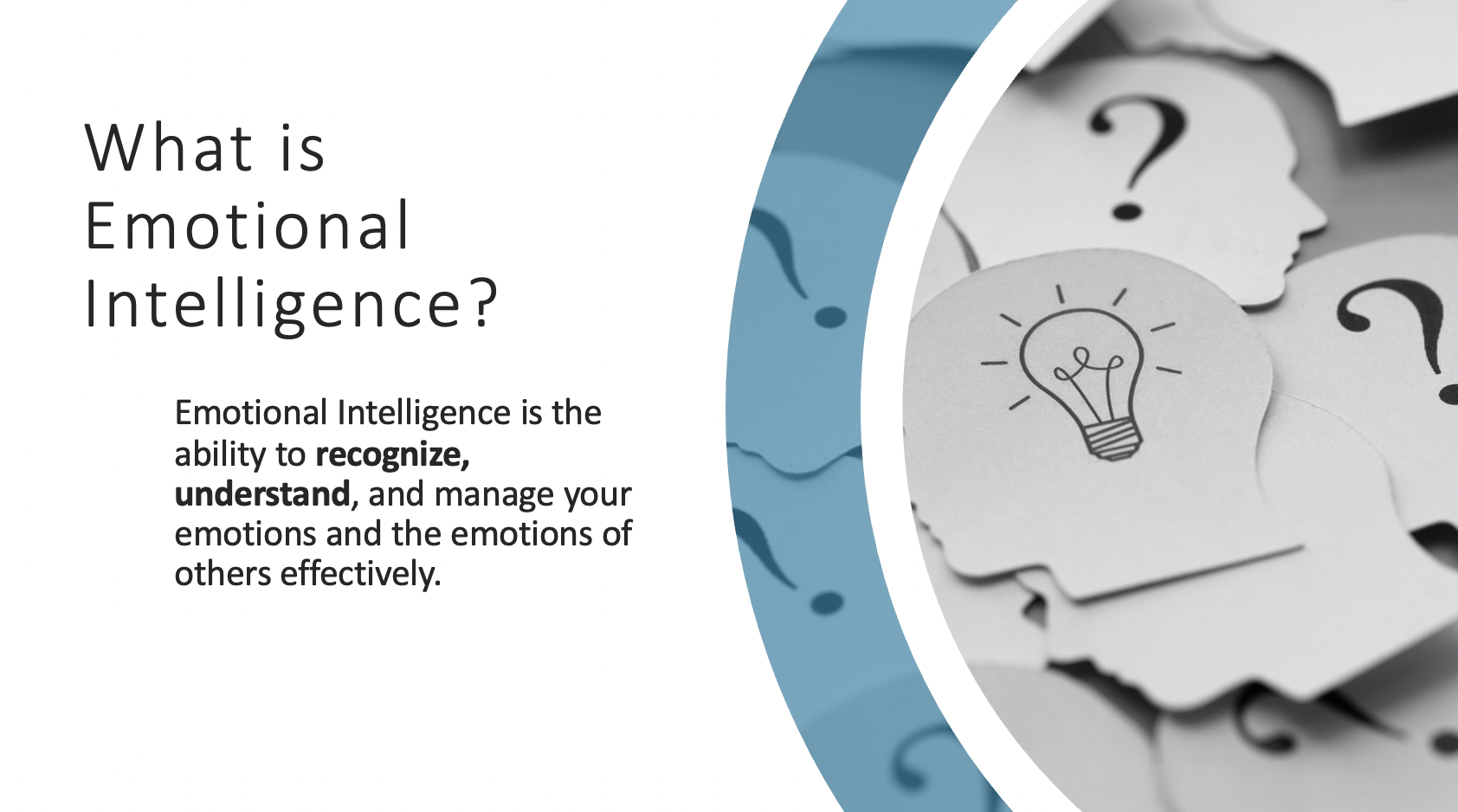
Define emotional intelligence and explore this definition with the group. This is an excellent opportunity to explore the meaning behind emotional intelligence and clarify any questions regarding emotional intelligence with the group.
After defining emotional intelligence, ask group members to share the emotions they experienced during the activity with the group. Ask the participants to refrain from group observations until later.
Explore the dynamic of emotions as they arise:
Did members experience multiple emotions? Were those emotions in harmony with one another? Did emotions contrast with each other?
Clarifying emotions (5-10 minutes):
Explore the six types of basic emotions with the group: happiness, sadness, fear, disgust, anger, and surprise. Then, explore emotions surrounding each category and how they can be clarified. For example: if a group member said they felt anxious during the activity, that emotion is rooted in fear. If a group member said they felt confused during the activity, that emotion is rooted in surprise. Provide examples for the group, then encourage them to clarify their shared emotions.
Many people, especially adults, will provide cognitive responses instead of emotions when asked how they feel. When asked what emotions they experienced during the activity, a cognitive response might sound like, “conversations about travel destinations made me want to explore the world more.” Encourage using the emotional wheel to assist participants in shifting from cognitive responses to emotional responses. Ask the participant which emotion is closest to their shared responses and explore the differences between emotion and cognition.
Phase 2: (20-30 minutes)
Social-emotional intelligence (5-10 minutes)
Ask the participants to return to their group observational notes from the simulation. Consider what cues clued participants in on how others might have been feeling.Provide an example of clarifying social emotions for the group:
“I noticed that you were quiet after being interrupted. Did you feel sad after that interaction?” Remind the group to use core emotion vocabulary (i.e., happiness, sadness, fear, disgust, anger, surprise).
Allow group members to share their observations.
Open a conversation to ask how accurate their observations were.
Why were my observations accurate/inaccurate? How can I better observe the emotions in groups moving forward?
Further discussion: (15-20 minutes)
Allow the group to discuss their experience with the activity in depth. Some guiding questions might include the following:
How aware were you in the moment of your emotions? Others?
Did you feel that other people’s emotions influenced yours? How?
What were your reactions to emotions in the space? How/did you respond?
How might you manage your reactions to emotions in the future?
How difficult was it to clarify your emotions?
Ways to further curate this resource:
Pedagogies that may strengthen this resource involve increased participant freedom and involvement. The facilitator of this exercise might increase participant freedom by:
Encouraging group members to create their own activities to stimulate everyday emotions.
Allowing group members to redefine emotional intelligence for themselves based on shared interests.
Involving artistic approaches to exploring emotions such as paintings, photographs, and music. This might involve emotional responses to the creation of artwork or the observation of artwork.
Goal
This activity focuses on individual and social-emotional intelligence. As an introduction to emotional intelligence, this activity seeks to help group members identify their emotions and clarify the origin of their emotions. At the group level, this activity seeks to increase awareness of group dynamics through observations and clarification of emotion. This activity aims to foster empathy and connection within a group by discussing the relationship between individual and social emotions.
After this activity, participants should be able to:
Understand the meaning and importance of emotional intelligence.
Clarify everyday emotions into the six core emotions.
Have increased awareness of the connection between individual and social emotions.
Resources
Further reading on emotions and insight into social-emotional intelligence:
Schwarz, R. (2002). Ch 12: Dealing With Emotions. In The skilled facilitator: A comprehensive resource for consultants, facilitators, managers, trainers, and coaches. essay, Jossey-Bass.
This is an activity designed and can be utilized effectively at the end of a series of training, seminar, course, etc. that is conducted based on the principles of experiential learning which facilitates participants learning through their experiences.
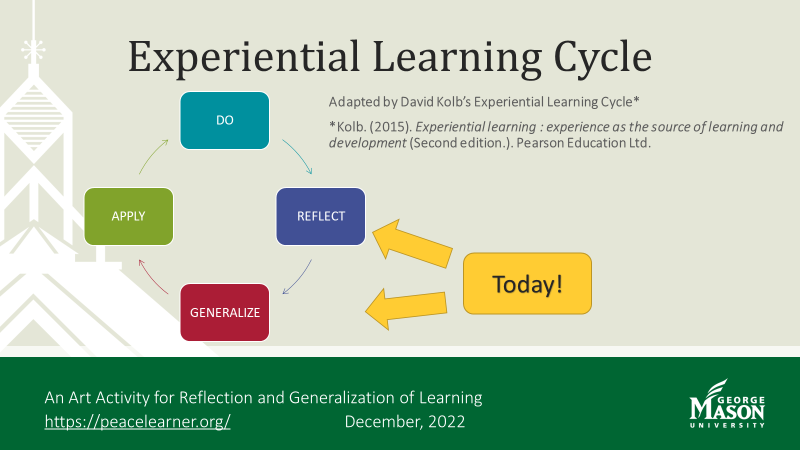
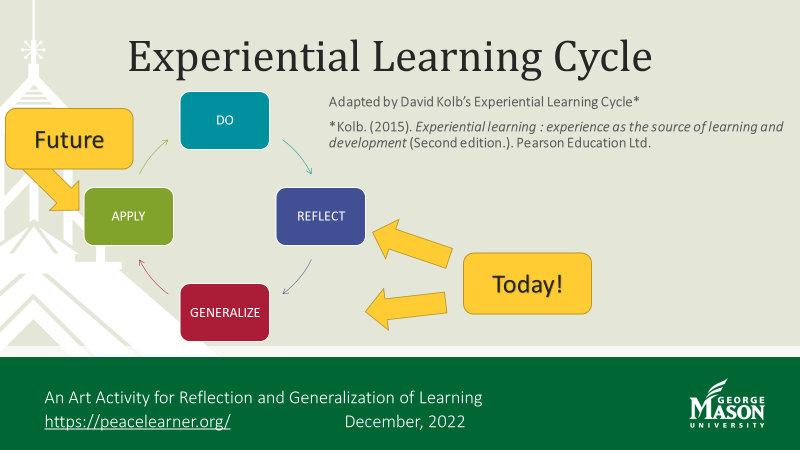
Based on the experiential learning cycle adapted from Kolb (2015), it is argued that people can learn from experiences, but just experiencing something is not enough to actually learn from it. For the effective experiential learning, the process of “Reflection” and “Generalization” are important in order to be able to “Apply” the learning in the future. Therefore, this activity is designed to be helpful for participants to reflect and generalize their learning from their experiences.
Outline of the activity:
Overview: The participants take time to work on their own to reflect their series of experiences, make a short story about it, and put it into an art piece. After that, the participants present it to the group, and the facilitator lead a short discussion about each presentation with the group, as well as a short reflection about this entire activity.
Time: 45-60 minutes
Number of participants: Any number more than 3
Age group: Any age, depending on the expected depth of the reflections, generalizations, and discussions
Settings: In-person or online.
For in-person settings, a variety of materials need to be prepared.
For online settings, it’s helpful to notify the participants in advance so that they can bring their own materials ready.
Goals: By the end of this activity, the participants would be able to
Become more aware of their biggest learning from the series of experiences
Express and present their biggest learning from the series of experiences
Have ideas how to apply their biggest learning from the series of experiences in their future
Remember their biggest learning from the series of experiences even after the completion
Pre-Work:
This 45–60-minutes activity is designed to be conducted after each participant taking time to reflect their series of experiences. So it is recommended to either give them heads-up to reflect the experiences on their own or set time for reflection together before this activity.
If it’s conducted online, it is also helpful to tell the participants briefly what we are going to do, and ask them to bring materials they may want to use (paper, pens, musical instruments, etc.).
Flow and instructions:
Introduction (1 min): Why we are doing this activity (purpose).
Presenting the learning cycle of DO – REFLECT – GENERALIZE – APPLY from the experiential learning, explain that this activity will help their reflection and generalization process of their learning and their preparation for application. DO part should have been done during the series of experiences.
Motivate them to try to grab the most important learning and express it in the form of art.
Instructions (4 min):
You will have 10 minutes to work on your piece of art by yourself. You are going to think and express the followings in a form of art, and present with the group after that (how to present, time to present depends on the number of the participants).
You can use any form of art. It could be a little one-man sketch or skit, making a song, rewriting lyrics of a famous song, drawing a picture, drawing a poster, making a sculpture using what you have at hand, write a poem, etc. But please try to avoid long sentences or wordy explanations. Using hands like handwriting is encouraged rather than typing or drawing on computer. Be creative!
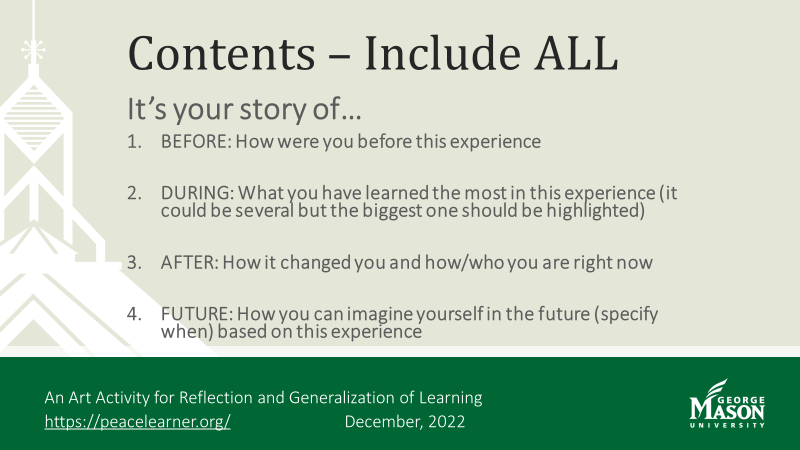
Contents of the art is like a story which should include ALL of the following:
BEFORE: How were you before this experience
DURING: What you have learned the most in this experience (it could be several but the biggest one should be highlighted)
AFTER: How it changed you and how/who you are right now
FUTURE: How you can imagine yourself in the future (specify when) based on this experience
Time to work by yourself is 10 minutes. Time for you to present is 2 minutes. The facilitator will give you reminders of time (5 minutes to go, 1 mininute to go).
Any questions?
Individual crafting time (10-15 min). Playing a nice music is a good option. Set a timer and facilitator will give reminders 5 minutes and 1 minute before the end.
Presentation and discussion (20 min):
We get together after the crafting time is over.
Some or all of the partiicpants present their art pieces.
After each person’s presentation, other participants are welcome to make short comments, if any.
Facilitator will also acknowledge and make a comment on the presentation.
Small reflection of this activity (5 min):
Open to the floor to share their reflections and learning (if any) of this activity.
Wrap up (5 min):
Show appreciation for their works and make a brief comment by the facilitator
Put up the learning cycle again to highlight that in the experiential learning, it starts with DO but through the process of REFLECT and GENERALIZE, the learners can bring their learning as transferable or applicable knowledge, skills or attitudes. That’s why we did this activity and hope it will be helpful for you to utilize or apply your learning (not only the biggest one but other small ones, too) in your life in the future in different contexts
Resource: Kolb. (2015). Experiential learning : experience as the source of learning and development (Second edition.). Pearson Education Ltd.
*This activity was designed by Yuriko Noda, a PhD stuent at from Jimmy and Rosalynn Carter School for Peace and Conflict Resolution, George Mason University
Art is a powerful medium to de-escalate the tension of conflict when it is utilized at an appropriate time. Especially, music could bring strong emotional connectivity among people worldwide; it has been constantly used as a simple but strong tool to overcome social oppression and to strengthen the voice of the public with a nonviolent approach. This activity, Music and the Mobilization of Nonviolence, aims to teach how music could greatly impact emotional connectivity and de-escalation of conflict and contribute to a significant nonviolent movement against conflicts we face in our society. The activity was fully conducted online; due to this condition, the online meeting software Zoom was the main tool to proceed with the activity. Since Zoom provided an interactive whiteboard and screen-sharing option which enable the participants to be simultaneously engaged throughout the activity, it was sufficient to facilitate the exchange of emotions and ideas that are stimulated from the session. The resources for this activity are gathered based on self-research; one song deeply connected to social conflicts is selected per genre: Blues, Gospel, Rock, Hip-hop, Classic, Grassroot music, etc.
This type of education could be effectively utilized in any group regardless of age or community level when it is conducted in an informal setting since it is based on experiential learning; however, it could be especially practical for students at the K-12 level. As music itself contains entertaining elements, it could help the students maintain their focus and be fully engaged by actively listening and watching music videos during the activity. The debriefing questions are also based on their emotions and feelings that are directly reflected by the musical contents; this simple discussion could make them feel comfortable and safe to learn the key points of this activity that music itself could connect people and contribute to peacebuilding processes in the long term perspective. Furthermore, they will have the opportunity to have a deeper understanding of the backgrounds of musical genres and pieces that they are used to listen but are not actually aware of the hidden stories they embody.
Implementation
Activity Time Duration: 45-60 minutes, depending on the number of songs an educator would like to use.
3 min: Brief introduction and learning objectives
10 min: introduction of a particular genre (it would be helpful to go through research or ask for support from those who have musical expertise during the preparation.)
10 min: Music introduction, listening (4-5 min) and debriefing (5 min) activities #1
10 min: Music introduction, listening (4-5 min) and debriefing (5 min) activities #2
10 min: Music introduction, listening (4-5 min) and debriefing (5 min) activities #3
10-15 min: Review of the activity, simple quiz activities about the music based on debriefing
Orientation of the Session: The educator may have multiple sessions, introducing one genre for each session. The first session, however, needs to introduce the overall learning point, which is the music’s impact on peacebuilding and the mobilization of the nonviolence movement in society. Guiding the main theme at the beginning session will help both educators and students to be consistent with understanding the music’s role in the strategic peacebuilding process while engaging in the activity throughout the sessions. For example, sessions could be categorized like the example below:
Session 1:Introduction_How Music Helps Strategic Peacebuilding?
Session 2: Understanding the Origin of Blues Through Learning the Black History
Session 3: Learning Gospel through Analyzing Amazing Grace
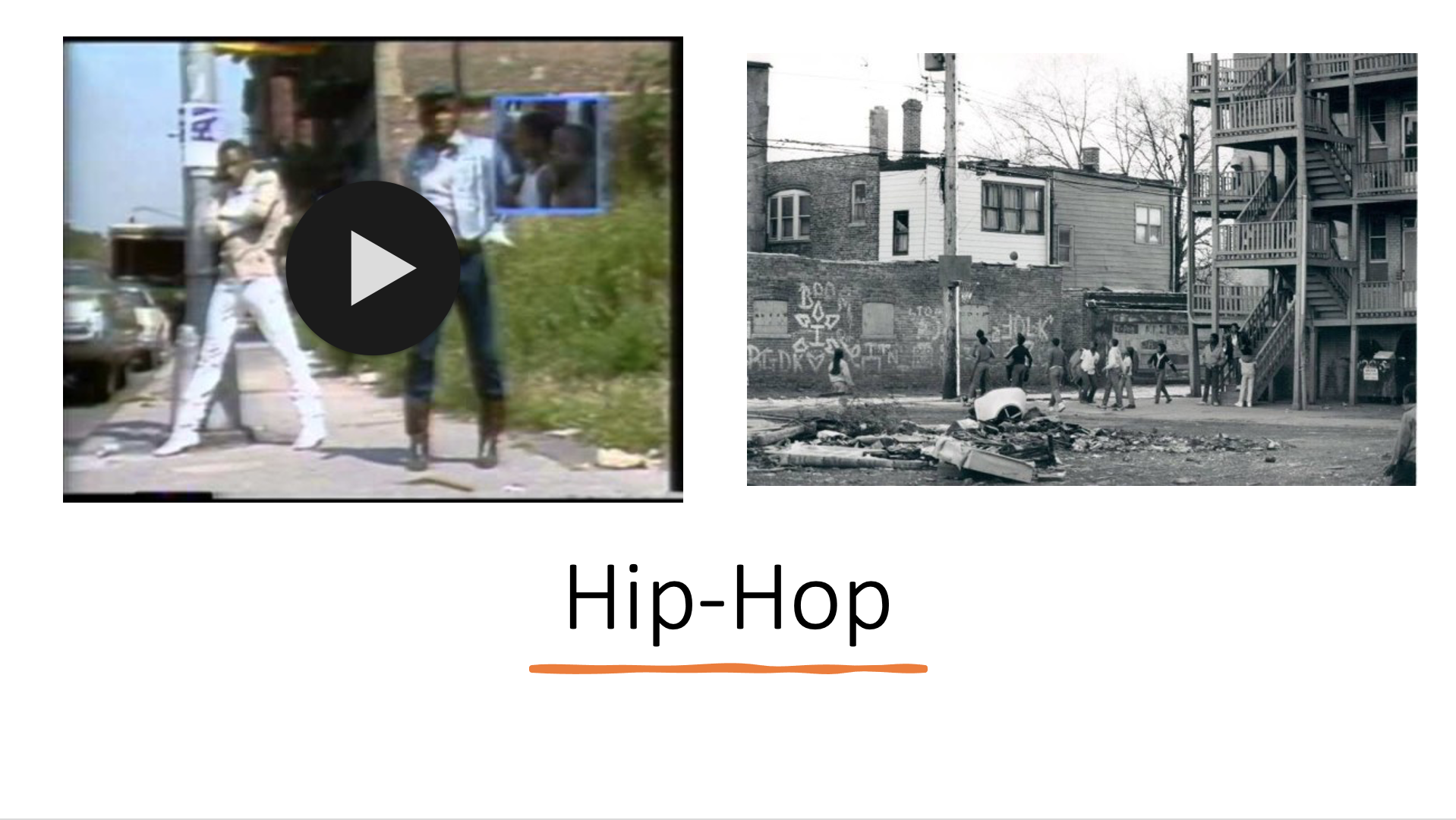
Session 4: How did Hip-hop Become a Powerful Medium for Raising Voices for Social Issues
Session 5: Rock for Peace
Each session will start by introducing two to three songs that are relevant to the genre. The educator may briefly introduce the background of the songs and share the lyrics with the participants to help them have a better understanding of the contexts. The facilitator could also have a simple quiz about the music so that the participants can guess the information about the music, providing much more interaction during the session.
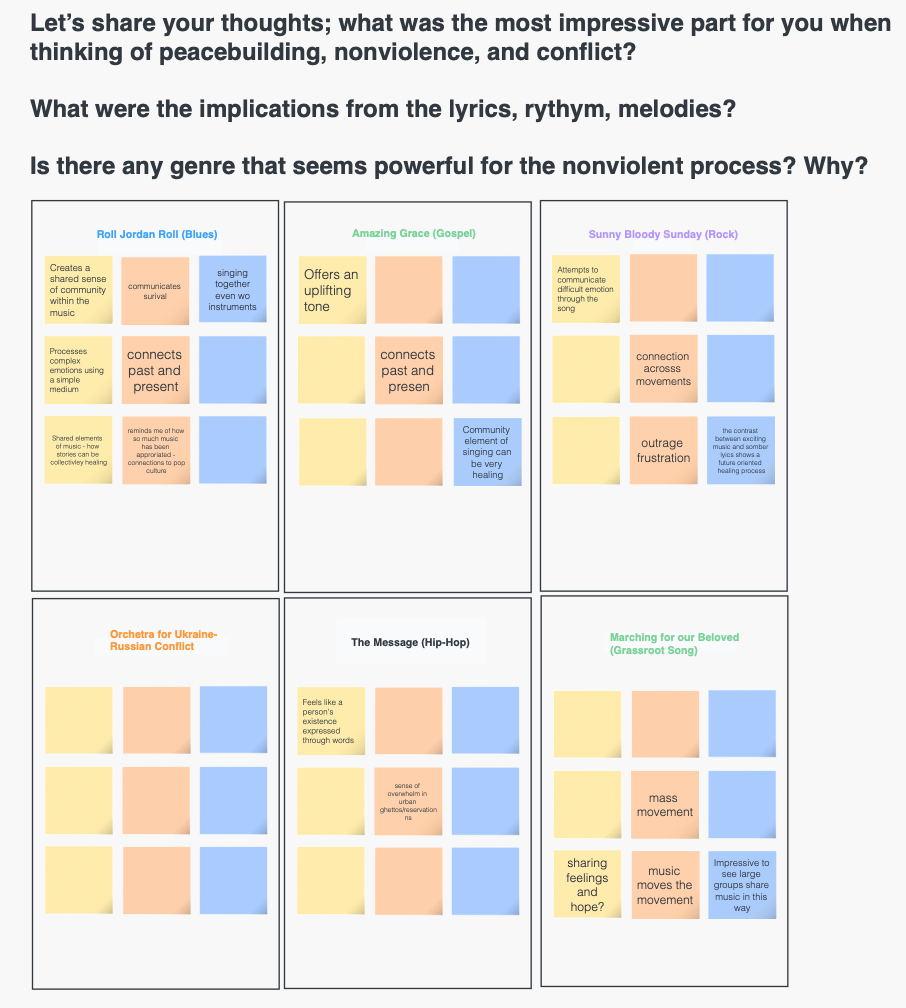
After appreciating those musical pieces, the educator can move into a debriefing session. When it is conducted online, shared whiteboard and brainstorming programs through Zoom or Mural could be utilized to have students engaged in the activity. When it is conducted in person, however, the educator may use a large size of paper so that the participants could simultaneously add their thoughts of impression and engaged emotions to the paper. The Questions after listening to the musical pieces could be like below:
Let’s share your thoughts; what was the most impressive part for you when thinking of peacebuilding, nonviolence, and conflict?
What were the implications of the lyrics, rhythms, melodies?
Are there any other elements that seem powerful for the nonviolent process? Why?
If you want to introduce other songs you particularly find relevant, please share and explain why it is connected to the topic.
Goal
The objective is to connect music with peacebuilding and the nonviolence movement by emphasizing its contribution to emotional connectivity between groups, individuals, and communities. Through such experiential learning processes utilizing basic senses that are based on auditory, visionary, and somatic senses, it aims to help students to maintain their interest in learning in non-academic approaches. Also, this activity could help the students have better accessibility to understanding past and current major conflicts that are occurring worldwide by appreciating the musical pieces that directly reflect them. By doing so, it could facilitate the process of conscientization (Freire, 1970), which enables the participants to understand the social issues that could be directly related to themselves in a critical manner. The contents illustrated below could be the main learning objectives:
Resources Used for the Activity
Musical pieces that are used for the activity could various depending on the educator’s preferences or participants’ suggestions through discussion at the beginning of the session:
Freire, P. (1970). Pedagogy of the Oppressed. Seabury Press.
*This activity was designed by Yong June Kim, an undergraduate student at George Mason University’s Carter School for Peace and Conflict Resolution, based on Dr. Arthur Romano’s Graduate Course (CONF 695) “Peace and Conflict Resolution Pedagogy” in Fall 2022.
Although the incorporation of peace education and critical pedagogical approaches are visible in certain spheres of elementary and higher-level education, entertaining the possibilities of implementing these in early childhood education is commonly absent from ECE spaces. Research on the human brain indicates that it is during the first five to six years of life that the vast majority of active brain growth and development occurs, with neural pathways forming and the brain essentially wiring itself as to how to know, relate to, and be in this world (Gramling, 2015). Further, evidence that children are aware of differences and begin to develop biases and prejudice during these early years (Pelo, 2008), including an awareness of structures of social dominance by as early as ten months (Christakis, 2016), suggest that the inclusion of peace education and pedagogical practices that foster critical thinking and a sense of ethnorelativism present as valuable concepts to bring to early childhood education. Ann Pelo, educational consultant and author, emphasizes the importance of rethinking early childhood education through the use of reflective pedagogical practice and social justice and ecological teaching. She asks, “What kind of people do we want to be? What kind of a world do we want to live in?” (pg. 37, Pelo, A., & Carter, M., 2019) and seeks to answer these questions through examining and reframing the purpose of education. Perhaps one of the most prominent examples of how critical pedagogy and education for peace may be translated to early childhood (and the pedagogical inspiration for Pelo’s work) exists in the infant toddler centers and preschools of Reggio Emilia, Italy, out of which the now globalized Reggio Emilia Approach to education emerged.
“This was the community’s response to the danger of totalitarianism and tyranny: create a school for the youngest of children.”-Anne Pelo
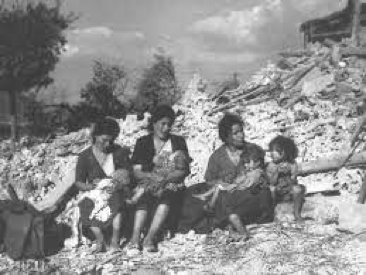
Following the devastation of WWII, the citizens of Reggio Emilia (specifically feminists active in the Italian Resistance and belonging to the Italian Women’s Union) sought to establish a school that recognized the right of every child to high quality care and education that imbued a sense of participatory civic consciousness so as to prevent any resurgence of fascist reign, war, and genocide as a consequence of societal conflict. With the guidance of Loris Malaguzzi, an educational practitioner who was instrumental in consulting a global network of educational theorists, philosophers, and social psychologists, the Reggio Emilia philosophy was developed as a new and comprehensive approach to early childhood education that sought to teach a sense of moral citizenship to the youngest members of society (Timeline | Reggio Children, 2020). Unlike other ECE approaches and curriculums that can be certified and implemented as is, the Reggio Emilia philosophy rests on a set of core values/tenets that are intended to be translated to work within the specific context of any given communal educational space. These foundational values mirror many of the pillars of peace education while also aligning with conceptual elements of critical pedagogical practice, and thereby serve as an example of the application of peace education and critical pedagogy to early childhood.
At the heart of the Reggio Emilia philosophy is what Malaguzzi coined “the Image of the Child,” the belief that each and every child represent a whole human and citizen, capable, competent, and deserving of inherent rights, freedoms, and responsibilities. (Edwards, C., Gandini, L., & Forman, G., 2011). Understanding the Image of the Child requires one to acknowledge their personal subjectivity in how they have come to view children and others through their own life experiences and epistemological lens. It informs the daily practices and interactions of adults as they work collaboratively with the children and each other to create a learning environment that is relationship-based. The task of observing and honoring the essential worth and value in each and every child connects directly to many of the other foundational tenets of the approach. These include:
The establishment of democratic classrooms, whereby all stakeholder voices of the educational process (the children, families, educators, and greater community) are held as equally valued and heard.
The concept that children are active protagonists of their learning, which occurs largely through processes of negotiated learning and social constructivism.
A practice of teaching and learning that is founded on a Pedagogy of Listening, whereby the capacity for reciprocal listening and dialog enables meaning making processes that are collaborative, collective, and democratic.
The idea that children (and all people) learn and communicate through “One hundred languages” of expression and understanding, and that it is imperative to acknowledge and listen to these various forms and ways of “being” in the world.
Embracing an openness to difference, doubt, uncertainty, and diverse perspectives as a point of learning and recognition of the value in another’s point of view and interpretation.
The environment’s role as the third teacher, supporting the development of curriculum that is contextual and emergent. (Edwards, C., Gandini, L., & Forman, G., 2011)
The pedagogical approach, which is constructivist in nature, pivots the role of the teacher from all-knowing keeper of information to co-discoverer, co-researcher, and co-learner alongside the children. This framing of the meaning-making process and role of the educator embodies a rejection of what Freire termed the “Banking Method” of education (whereby teachers deposit knowledge into students who are viewed as empty vessels) and assumes student-teacher, teacher-student relations that reconstruct traditional hierarchal structures of the educational process (Freire, 2000). Dedicated and astute observations of the children’s engagements and interactions inform the creation of documentation and reflective processes through which educators facilitate further learning that is responsive, relational, and centered on the children’s theories, inquiries, and quest for knowledge.
“…a willingness to question all your own abilities, your knowledge, to become humble. Only then will you be able to listen to the child, to set off on a common search, to ‘educate each other together.'” -Loris Malaguzzi
While the Reggio Emilia philosophy embodies values that parallel many of the pillars of peace education (enabling multiple intelligences, community building, nurturing emotional intelligence, skill building, and serving as a nonviolent means of transformative societal change by fostering ethnorelativism and valuing difference and diverse perspectives), when translated to the context of the United States the approach may be coupled with an anti-bias curriculum to more explicitly address racial hierarchy, structural violence, and societal injustice, thereby providing a nonviolent means of actualizing a more equitable society based on the pursuit of positive peace.
“The relationship between peace and prejudice concerns the ability or inability to be good listeners. This is where education for peace begins.” –Carlina Rinaldi
Although this post barely scratches the surface of the Reggio Emilia approach and what peace pedagogy may look like as translated to early childhood education, stakeholders in the fields of both of early childhood education and that of peace building may find it useful to begin to examine the possibilities of reframing the purpose and potential of early childhood education towards transformative societal change. A more detailed lesson plan could be developed centering on any or all of the foundational tenants of the Reggio Emilia approach and how they correspond to peace education and the implementation of critical pedagogy in early childhood, to then be used as inspiration for teaching practices in any given early childhood education center.
References/ Resources:
Christakis, E. (2016). The Importance of Being Little. Van Haren Publishing.
Edwards, C., Gandini, L., & Forman, G. (2011). The Hundred Languages of Children: The Reggio Emilia Experience in Transformation, 3rd Edition (3rd ed.). Praeger.
Freire, P., Ramos, M. B., & Macedo, D. (2000). Pedagogy of the Oppressed, 30th Anniversary Edition (30th Anniversary ed.). Continuum.
Gramling, M., & Jones, E. (2015). The Great Disconnect in Early Childhood Education: What We Know vs. What We Do. Redleaf Press.
Pelo, A. (2008). Rethinking Early Childhood Education (First ed.). Rethinking Schools.
Pelo, A., & Carter, M. (2019). From Teaching to Thinking: A Pedagogy for Reimagining Our Work. Exchange Press.
Background: In researching for my conflict resolution skills session assignment, I stumbled across a book, Making Peace Last, that takes the concept of systems thinking – one I originally grappled with during my master’s program in city and regional planning – and meshes it with peacebuilding. In the book, author Robert Ricigliano explains the paradox of macro-micro conflict, which is best summed up in this quotation he highlights:
“All the good peace work being done should be adding up to more than it is. The potential of all these efforts is not being realized.” – Mary Anderson and Lara Olson
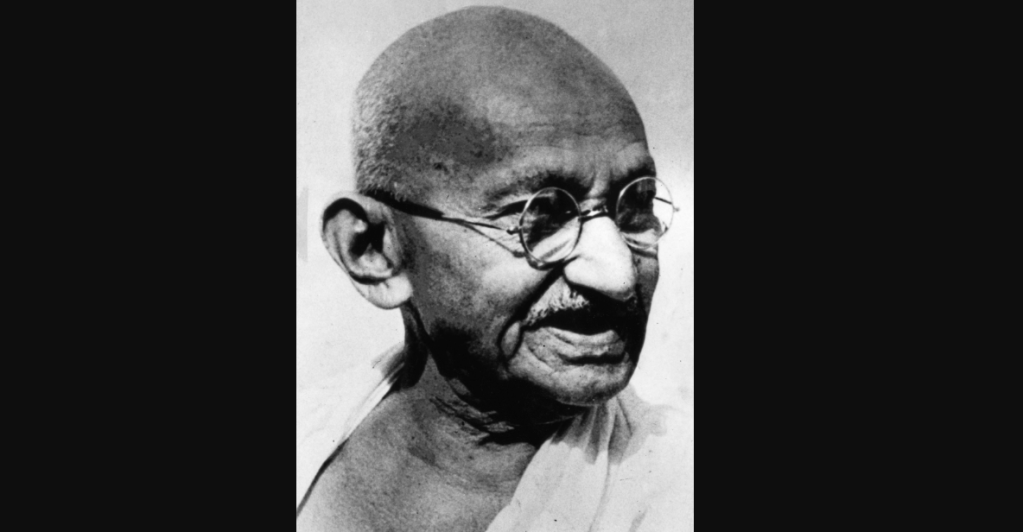
Gandhi’s
message of peace, love, forgiveness, and nonviolence is being ignored in some people,
although it is still in all over the world. Gandhi was untiring and indomitable
beloved idol for isolated weak class of people in India.
As
violation is from people’s avarice, teaching of Gandhi should be in the education
philosophy. Gandhi wanted to colonized people to be free from colonialism. Gandhi
wanted to Asia and Africa to be free from colonialism. Leaders in United States
and South Africa and several countries was successfully adopted Gandhi’s nonviolent
values, but not in Asia.
The ideas of religious of Gandhi could de-escalate the conflict
between different religions. According to Gandhi, “a curriculum of religious
instruction should include a study of the tenets of faiths other than one’s
own. For this purpose, the students should be trained to cultivate the habit of
understanding and appreciating the doctrines of various great religions of the
world in a spirit of reverence and broad-minded tolerance. This, if properly
done, would help to give them a spiritual assurance and a better appreciation
of their own religion. This study of other religions besides one’s own will
give one a grasp of the rock-bottom unity of all religions, and afford a
glimpse also of that universal and absolute Truth which lies beyond the ‘dust
of creeds and faiths.’”
There was war between India and Pakistan, Iran and Iraq war. These
wars destroy livelihood and made casualties. ASEAN region was the region where is
the most peaceful region, except for the Rohingya community in Myanmar. They
failed to assimilate and accept Rohingya community people.
For this article, stakeholders can be any countries which still in conflict such as Myanmar. Myanmar has conflict with Rohingya community, they do not consider Rohingya community people with Myanmar nationalities. I think the Myanmar government should embrace Rohingya community as a minority. People who are interested in peace education could get benefit from this article. This resource is well suited for all age of people and both gender who is interested in peace, and some countries which is still in conflict. Gandhi is a symbol of peace in the whole world, and his teaching of non-violence and peace is the best sources.
“A picture is worth a thousand words but a video is worth a million.”
In the realm of visual art, medium of photography has given an immense impact contributing in peace building throughout the history due to its unique traits of grabbing, maintaining, and retaining viewer’s attention. A new medium of Video has emerged that exceeds far beyond the limited capacity of photography. Video with its distinct feature that allows audience to “experience” the depicted stories which creates a subconscious space to delve into the core morals and messages of the content. Such transcended contemplation and emotional shifts may bring opportunities to alter traditional ideas, rules, patterns, and relationships.
Video in the form of art has not only the ability to deliver often isolated stories from the marginalized part of world but also used as a tool to emotionally connect with the audience with visual aesthetic, sound design, and convincing acting. Emotional connections are crucial that allows drastic, often radical, conversion in human cognitions and behaviors. Peace building, which harshly requires creativity and transcendence, needs such conversion to bring about possible solutions. Emotional connection can bridge as an opportunity for therapeutic strategies for traumatized groups and individuals. It can also be used for an attempts of convincing pursuing a space for reconciliation or resilience depending on the situation of the conflicts. Video art can come in many shapes each with different trajectories. These are few of the examples:
Non-FictionalDocumentary
Non-FictionalDocumentary videos can create strong narratives about causes and dynamics of conflicts. In real documentaries live actions and narrations are recorded that excludes the acting part of the filming. Keeping the fact is the most essential part of this form of video.
Recreated Documentary
Real person recreating the story.
Short Film
Professional actors re-creating the historical characters and events.
Therapeutic Video
Very subjective part of video art due to different perceptive points of healing of every individual. However, majority of people share universal axioms from the tiniest form. Possibly film, music videos, and any kind of serene or sensitive videos are therapeutic.
Visual Poetry
Extremely artistic approach that brings about human emotion which also covertly underlies creator’s desired messages.
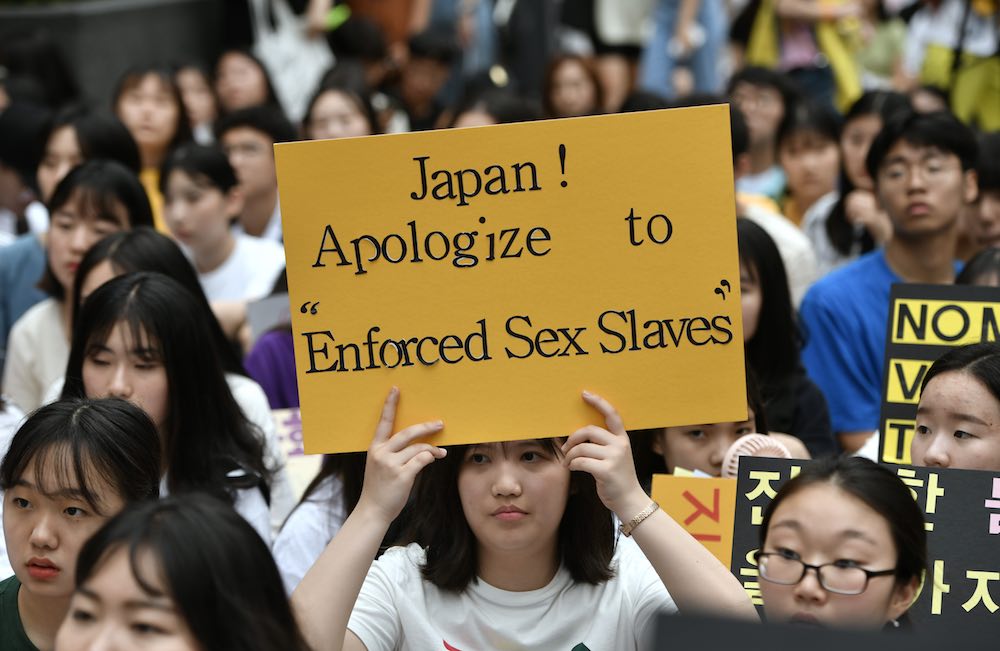
The current Korea-Japan relationship is so bad that it seems like there is no breakthrough. Issues of Japanese military sexual slavery, Dokdo, and the Yasukuni shrine which are the sensitive topics between Korea and Japan are unfolding all at once. The root cause of these problems is the distortion of the Japanese government’s perception of history, and the Japanese Military Sexual Slavery issue best illustrates this cause. The conflict over the Japanese Military Sexual Slavery issue has not ended, even at this point in the 21st century.
Japanese Military Sexual Slavery System
The Japanese Military Sexual Slavery system refers to crimes that the Japanese military committed from the 1930s to 1945 when Japan was in World War II. During that period, the Japanese military systematically set up ‘military comfort stations’ by recruiting women from colonized and occupied countries and forcing them to serve as sex slaves.
During the Shanghai Incident in 1932, rape by Japanese soldiers got more and more severe, and this led to an extreme anti-Japanese sentiment in occupied regions. Also, Japanese soldiers started to get a venereal infection, which interfered with the progress of the war. As a result, the ‘military comfort station’ system was established, and women from colonized regions were drafted against their will. According to the reports on the victims registered with the Korean government, the age of victims ranged from 11 to 27. Most of them were drafted by abduction and job fraud.
The conflict between Korea and Japan over the issue of “Japanese Military Sexual Slavery”
The Korean and Japanese government failed to solve the sexual slavery problem even though prolonged effort over two decades. Postwar compensation has been a diplomatic hot potato among Northeast Asian countries. Specifically, in the negotiation of the Korean-Japanese naturalization of 1965, several problems such as forced laborer, victims of the atomic bomb, sex slavery were unsolved. After sex slave victims testified Japan’s wartime atrocities in 1991, civic groups, journalists, the ministry of foreign affairs, and the public engaged to argue on those complex issues. Due to the failure of solving those complex issues by government and judiciary sectors, the Korean civic groups and sex slave victims appeal to the international court and arena.
The importance of resolving this conflict
The Japanese Military Sexual Slavery is concerned with the largest human rights matter because Military sexual slavery is a war crime and a crime against humanity according to International Law. Also, solving this problem is important for the peace order in Northeast Asia because South Korea and Japan should not only work closely together over the North Korean nuclear and missile issues but also play a central role in establishing peace order in Northeast Asia. Therefore, the restoration of Korea-Japan relations can bring peace to the international community. To resolve this conflict, the two countries should pursue mutual understanding and historical reconciliation based on a clear perception of historical facts. Therefore, educating future generations about the right history can be one important way to resolve this conflict. To restore the honor of the victims and enhance the people’s awareness of history and human rights, the Ministry of Gender Equality and Family opened the ‘e-Museum of the Victims of Japanese Military Sexual Slavery.’ This website can be effectively utilized for history education and peace-building services.
E-Museum of ‘the Victims of Japanese Military Sexual Slavery’
The resource provides various related materials and educational content, including general information to help understand Japanese Military Sexual Slavery. The resource is structured to expand understanding to the international community on the issue without being limited to South Korea by providing materials serviced in English, Japanese and Chinese. Also, this resource can be adapted for all age groups in various countries, but is especially suitable for primary and secondary school students in Korea, as it is designed to be used as a history textbook for them.
*Ways to use this resource: Educating the next generation
One of the ideal ways to integrate this e-Museum into the educational context is through formal education of school institutions. Educational institutions can systematically use this resource for educational purposes. More sophisticated planning will be needed to educate students and people outside of Korea.
To educate Korean students
The resource can be effectively used in strengthening education for elementary, middle and high school students in response to Japan’s distortion of history. Korean website offers educational materials and videos for each age range from elementary school students to high school students.
[To know exactly what Japanese military sexual slavery (is)] is an educational textbook developed by the Ministry of Gender Equality and Family. The textbook, “to know exactly what Japanese military sexual slavery” is a free one that can be downloaded from the online site. The textbook contains major issues to help us understand the whole issue. It consists of six types of powerpoint materials that could conduct in classes according to the level of elementary, middle and high school students, and workbooks that are used for students’ study and activities. The government needs to provide support for the classes and teacher training so that related history education can be actively conducted in front of education sites by utilizing such materials.
1-2 A group special lecture
This resource supports special group lectures related to the issue of ” Japanese Military Sexual Slavery”. Educational institutions can apply for these group special classes to educate students. It is only supported in Korea, and the organization should pay for the preparation of educational venues and the fees for instructors. Educational applications/question can be made by e-mail or phone.
To use this resource to educate international students, a variety of language support and content supplementation are first required. Although English-language sites exist, English-language websites do not have the same educational materials and contents posted on Korean online sites, and there are many services such as group special lectures only supported in Korea. So far, for example, only 10 victims’ testimonies have been translated into the English-language website of the e-history. In addition to Chinese and English, there should be a variety of language support and sufficient and diverse content delivery as much as Korea so that people around the world can view the resources and refer to them in education. It is also necessary to provide appropriate educational materials for international students.
*The following resources can also be used as educational material for international students to understand the problem more easily.
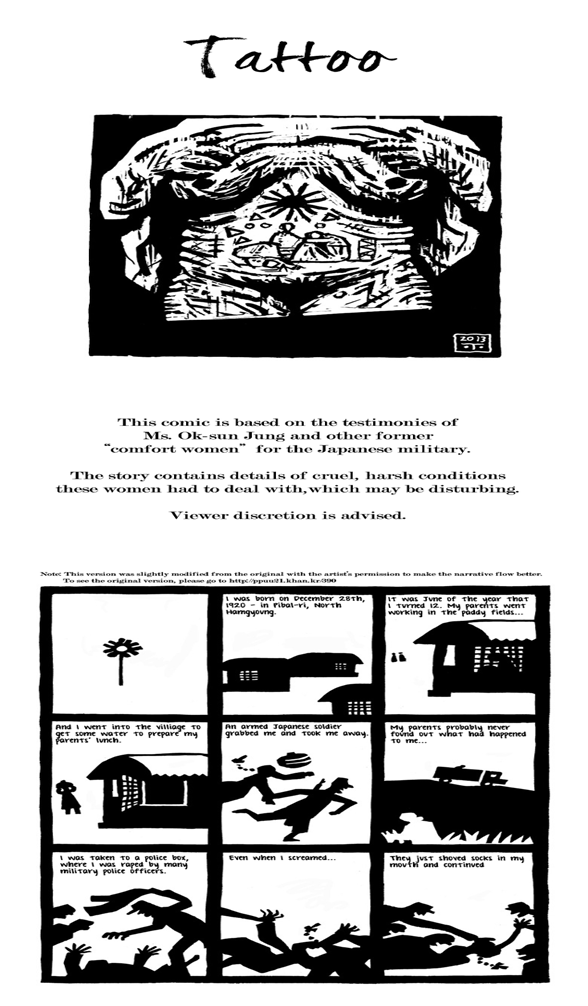
Subtitle support services are needed to target the international community. This image is a scene from a webtoon called ‘A Story of A Comfort Woman – Tattoo.’ This link allows you to view the English translation of the entire webtoon . https://foxtalk.tistory.com/98
An effective way for educators to use this resource for international students is to suggest a link between the ‘Japanese military sexual slavery ‘ with a country’s current issues. Japanese military sexual slavery issue has many connected themes such as patriarchal system, colonization, imperialism, and misogyny. Also, unfortunately, these problems are still ongoing in so many countries. Therefore, linking ‘Japanese military sexual slavery to the country’s problems will be a good foundation for international students to understand.
For example, in Uganda and Congo, the Japanese military sexual slavery issue can be incorporated into the issue of wartime sexual violence. Also, the State of California proposes to teach Japanese military sexual slavery issue for women’s rights issues, while the San Francisco Board of Education proposes to teach it concerning the issue of women’s rights. Through the correlation between ‘Japanese military sexual slavery ‘ and facing problems, educators can make this resource a very effective educational tool.











 Peace Learner