Radical Math

POSTED ON BEHALF OF MONICA SHAH

It is a myth that peace and social justice issues can only be taught in a peace studies course. It is an even greater myth that there is no place for peace and social justice in mathematics, science, engineering or technology curricula. This post aims to bring attention to a resource for math and economics teachers of all levels who want their students to study issues of social and economic justice.  Radical Math is a site that contains more than 700 lesson plans, articles, books, charts, graphs, data sets, maps, and websites that will help lead students to not only understand issues of social, political and economic injustices through a mathematical framework, but also to learn how to develop just, realistic and mathematically-sound solutions.

Far too often students have complained about their required math courses and asked, “When will I ever use this?” Fusing social justice and math education allows students to be able to do more than memorize formulas and solve equations; they can use math as a tool to understand and change their society. Social Justice Math has two main purposes: 1) to use mathematics to teach and learn about social and economic justice and 2) to develop mathematical literacy and learn math through the study of social justice issues.  Radical Math resources can be utilized in upper elementary, middle, high school, and college classes. Such curriculum can also be integrated in community programs and classes geared to teach math, financial or computer literacy to citizens, immigrants or ESOL students.

Check out this guide created by Jonathan Osler:

A Guide for Integrating Issues of Social and Economic Justice in Mathematics Curriculum

http://www.radicalmath.org/docs/SJMathGuide.pdf

One relevant (and very current) topic that can be introduced and discussed in a math or economics classroom is the Occupy Wall Street and other “occupy” demonstrations around the nation protesting economic and social inequalities, corporate greed and injustices, and corruption. For example, students can learn about the Gini coefficient and how that is calculated, evaluate the disparities in income and wealth distribution, and calculate corporate taxes and profits.

On the site, students and teachers can search by math topic, social justice issue or resource type. Below are all of the searchable topics and themes:

By Math Topic: Algebra,  Annual Percent Rate (APR), Area, Averages, Bar Graph, Basic Math Concepts, Budgeting Money, Budgets, Cartesian, Chance, Charts, Compound Interest, Correlation, Currency Conversion, Data, Data Analysis, Equivalent Fractions, Extrapolation, Geometry, Graphs, Graphing, Fractals, Fractions, Histograms, Interest, Least Common Denominators, Line Graphs, Mapping, Maps, Mean-Median-Mode, Measurement, Net Worth, Patterns, Percent Growth, Percents, Polar, Polls, Probability, Proportions, Rates, Ratios, Real Dollars, Numbers, Sampling, Scatter plots, Statistics, Survey, Symmetry, Tessellations.

By Social Justice Issue: Achievement Gaps, African Americans, Banking, Criminal Justice System, Death Penalty, Defense Budgets,  Economic Development, Ethnomathematics, Environment (pollution, hunger, food and water resources), Financial Literacy/Education (saving, managing debt, paying for college, credit cards, loans, taxes), Gentrification, Globalization, GLTBQ, Health Care, Higher Education, Homeownership, Housing, Hurricane Katrina, Immigration, Juvenile Justice, Latino/Hispanic, Minimum/Living Wage, Lottery, Military Recruitment, New York, Poverty, Poverty Line, Predatory Lending, Prisons, Public Education, Public Health, Racial Profiling, Racism, Single Mothers, Standardized Testing, Sweatshops, Taxes, Teaching, Unemployment, Voting, Wars, Wealth, Welfare, Women

By Resource Type: Article, Book, Chart, Curriculum, Film, Graph, Map, Syllabus, Table, Website

If you have any ideas or have created a lesson plan or projects on a math topic related to a social justice issue that you would like to share with others, you can e-mail info@radicalmath.org.
Operation Ceasefire

Operation Ceasefire is a project that was developed by David Kennedy, a self-taught criminologist and director at the Center for Crime Prevention and Control at John Jay College of Criminal Justice in New York City. Kennedy developed the idea for Operation Ceasefire after visiting a public housing complex in south-central Los Angeles in 1985. Kennedy’s visit had a powerful impact on him as he witnessed the impact of drugs, gangs, and violence on this community. Kennedy dedicated his career to reducing gang and drug-related inner-city violence. He traveled around the United States, meeting with police officials and attorney generals in areas with significant drug markets, and first developed a program in Boston which has now been applied in 70 other cities. The program has been effective in reducing youth homicide rates by as much as sixty percent. “It is incredibly dangerous,” says Kennedy. “If you talk to these guys, what they say is, ‘I’m terrified … I got shot … My brother’s dead … I’ve been shot at … And they are trying to shoot me …’ That [is] their everyday world.” Kennedy’s homicide-reduction program, Operation Ceasefire, established meetings involving gang members, community members that the gang members respected, social services representatives, and law enforcement. Part of the strategy involved making it known to gang members that the police did not want to arrest them, but wanted them to stay alive and out of the criminal justice system. The police did intend to aggressively target people engaged in violent retaliation against one another. Involving the mothers of drug dealers in these meetings was also a crucial factor in reducing community violence. “We said, ‘Your son is at a turning point. He could be arrested right this minute, but we don’t want to do that. We understand how much that damages him and his community. There’s going to be a meeting in a week. Please come with your son to the meeting”. Nearly all invitees to these meetings came. This has been shown to have a significant effect on closing down open-air drug markets.

Kennedy developed this program to be implemented in informal educational settings, bringing together a diverse array of participants. Gang members, their families – especially the mothers, members of the community at large, and law enforcement officials must be involved in order for the program to be successful. Because this program is intergenerational, it does not work without involving both the older and younger generations. In a way, the older generation becomes part of the educational process by speaking with the young generation both about how much they care about them and about how much they are being hurt by these dangerous activities such as drug dealing and violence.

Community building is thoroughly upheld by this program by strengthening the relationships between generations and between gang members and the rest of society. Additionally, this project explores approaches to peace by bringing together unlikely partners aimed at achieving the same ends – eradicating violence in affected communities.

While the program itself is a peace education activity targeted at the affected communities, it would be very beneficial for students, particularly in high school to learn about this project. High school students are at the age where they are most likely to join a gang, and also most likely to suffer from gang violence. A part of the cycle of violence is that many of the gang members themselves are afraid, which leads to retaliation as a product of fear. Perhaps bringing this program directly into high schools could curb this fear and change detrimental behaviors before they start.

Let’s talk about peace and possibly get rewarded for it: National Peace Essay Contest for High School Students

The National Peace Essay Contest for high school students sponsored by the The Academy for International Conflict Management and Peacebuilding, the education and training sector of the United States Institute of Peace, is a way to incentivize high school educators and students to include peace talks as part of curriculum especially for history, government and social studies content areas. According to the institute the goal of the contest is to “promote serious discussion among high school students, teachers, and national leaders about international peace and conflict resolution today and in the future.”

The incentives for educators include the fact that the activity complements existing curricula and other scholastic activities and meets National Contents Standards, which is the direction that most school districts, including the District of Columbia is heading in. Students’ incentives include skill building in the areas of research, writing, and reasoning skills. Additionally, first place state winners receive scholarships and are invited to Washington for a five-day awards program. The Institute pays for expenses related to the program, including travel, lodging, meals and entertainment. This unique five-day program promotes an understanding of the nature and process of international peacemaking by focusing on a region and/or theme related to the current essay contest.

Educators can incorporate this contest as part of a reframing history activity by having students analyze past national or world conflicts and reevaluate outcomes applying the concepts of peace studies such as exploring approaches to peace and how those past violent conflicts could have been transformed non-violently. Students will be exposed to a different way to view conflict in the world and begin to generate ideas about how to resolve those conflicts while maintaining peace, justice, human rights and security in the world, as well as begin to examine what their personal roles are as global citizens in the effort for peace.

Check out contest information at: http://www.usip.org/npec

Happy United Nations Day!

Tomorrow marks United Nations Day, the anniversary of the creation of the United Nations, and a day that we take time to look at the work of this important organization and talk about its impact on the world.

“Secretary-General Ban Ki-moon stated in 2010: “UN Day is a day on which we resolve to do more. More to protect those caught up in armed conflict, to fight climate change and avert nuclear catastrophe; more to expand opportunities for women and girls, and to combat injustice and impunity; more to meet the Millennium Development Goals.””

No matter what age group, or what subject matter, a discussion of one of the Millennium Development Goals, can be integrated into class today. Younger grades may enjoy learning about what education looks like in other parts of the world for kids like them. Science and health classes can tackle child health, maternal health and HIV/AIDS. Economics, government/civics classes, and other social sciences may find global partnership and gender equity fitting themes for discussion. Some groups may want to find ways to live more sustainable lives or help end hunger. Find out how close we are to reaching these goals and what you/your students can do to help. Use a video/interactive media resource to add a new twist to your lesson!

Check out tomorrow’s ongoing events at the UN and promotional materials on the live webcast.

See how the UN is participating in New York City Public Schools and find examples of resources to use with high school students.

For a holiday themed addition, transform Halloween into a time to give back: check out Trick or Treat for UNICEF to learn about the campaign and see how you can incorporate donation boxes into your school or neighborhood’s celebration.

For other education resources from the UN to incorporate tomorrow and year-round check out the cyber school bus!

These resources and activities designed to recognize this day and this institution can help to build community by creating common goals for the class to work for and think about through class-wide, school-wide, or community-wide projects. A look at the UN can also help students explore approaches to peace by recognizing the physical, structural, and cultural violence that exists in the world, and highlighting the global community’s efforts to eradicate that violence.

A Peace of Art

Roger Shimomura

While field trips are not always accessible for every classroom, one of the many nice things about living in Washington, DC is the plethora of free museums and art galleries around the city. One of those free venues is the National Portrait Gallery (NPG), a museum which, “through the visual arts, performing arts and new media…portrays poets and presidents, visionaries and villains, actors and activists whose lives tell the American story.”

NPG offers guided, interactive themed tours for school groups, several of which address marginalized societies in America. These tours are standards-based and fit into many art, history, social studies and language arts curricula. For instance, teachers can select “The Struggle for Justice” tour, which “showcases major cultural and political figures—from key nineteenth-century historical figures to contemporary leaders—who struggled to achieve civil rights for disenfranchised or marginalized groups.” Students can view portraits of Susan B. Anthony, César Chávez, Leonard Crow Dog, Ellen DeGeneres, Frederick Douglass, Martin Luther King Jr., Larry Kramer, Rosa Parks, Eunice Kennedy Shriver, and others. Seeing these portraits up close offers students the opportunity to make visual and artistic connections with the historical and literary figures they have learned about in the classroom and in texts.

Currently, there is also a temporary exhibit at the NPG dedicated to contemporary portraiture entitled “Portraiture Now: Asian American Portraits of Encounter.” The exhibit features seven artists showcasing Asian American portraiture and helps to enlighten viewers to the Asian American experience, offering “representations against and beyond the stereotypes that have long obscured the complexity of being Asian in America.” Teachers can also arrange for a guided tour of this and other contemporary portraiture exhibits at the gallery. This exhibit gives students a visual tool for relating to and understanding the Asian American culture and experience, helping them identify and break down stereotypes of a marginalized group in our society.

While seeing these portraits and exhibits up close can be a powerful experience for students, the great thing about these tours is that they are also offered online, along with lesson plans and materials for teachers to use if they are not able to take a field trip to the gallery. The tours mentioned above are suggested as suitable for grades 6-12. And even if you are not in the classroom, these are terrific exhibits to explore on your own or with a family, some friends, or a community group.

One other exhibit worth mentioning is “30 Americans,” a showcase of works by many of the most important African American artists of the past 30 years. The exhibition is at the Corcoran Gallery of Art and “focuses on issues of racial, sexual, and historical identity in contemporary culture while exploring the powerful influence of artistic legacy and community across generations.” The Corcoran does charge for admission of visitors over the age of 12, however – tickets are $8 for students and seniors, and $10 for adults. Nonetheless, the exhibition has already garnered praise; The Root calls it “massively ambitious” and says “the artists featured in the exhibit provoke, disturb, enlighten, inspire.”

These various exhibitions seek to give a voice to marginalized groups and bring attention to justice and peace in our society. Anyone viewing these collections, whether a student or an adult, is afforded the opportunity to practice community building by taking into account others’ experiences and noticing and appreciating their differences. The powerful nature of the exhibits and tours might also channel empathy and compassion, allowing viewers to nurture emotional intelligence. Viewers are given the opportunity to utilize other intelligences as well by combining what they have learned in the classroom or in texts with visual and verbal information about the subjects in the artwork, obtaining new knowledge along the way as well.

Important Info and Dates:

Portraiture Now: Asian American Portraits of Encounter
August 12, 2011 – October 14, 2012
http://www.npg.si.edu/exhibit/encounter/index.html

30 Americans
October 1, 2011 – February 12, 2012
http://www2.corcoran.org/30americans/

National Portrait Gallery Resources

Info about school programs: http://www.npg.si.edu/education/schoolteach.html

Online exhibitions and lesson plans: http://www.npg.si.edu/education/resource2.html

Professional Development Programs for teachers: http://www.npg.si.edu/education/teachprog.html

Yoga in Schools

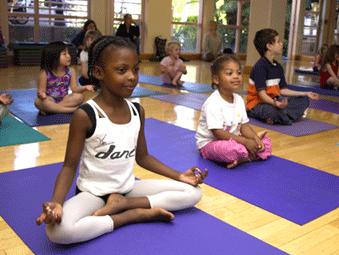
The popularity of yoga practice has skyrocketed over the past few years. This added interest has made yoga much more widely accepted—no longer are hippies and new agers the only ones going to ashrams. As the popularity of yoga has expanded, new outlets of practice have emerged—from public museums to city jails to public schools.

The most interesting outcome of the new attention is the use of yoga and meditation in public schools. City public schools can be some of the most depressing and dangerous places to be in America. Be it decrepit buildings, harassment and bullying, physical fighting, or drugs, many of our schools do not create a peaceful learning environment for our children. How can some of our most struggling students be expected to succeed in an environment where they feel unsafe?

The use of yoga in public schools not only serves as exercise, it also alleviates stress, creates more peaceful interactions with others, decreases discipline problems, and can even lead to an increase in grades. Some schools go so far as offering yoga as an alternative to regular P.E. classes. Other programs are implemented in a regular classroom setting and involve more meditation and focus than physical yoga practice.

Yoga Ed is one of the frontrunners in the push for yoga in public schools. Their program started in the state of California but has become nationwide, offering instructors to teach yoga in schools and seminars to train current teachers on implementing classroom yoga. Yoga Ed even offers lists of resources on their website.  They have recommended music, children’s books, and have tips on practicing yoga in schools.

Yoga can be used in any school setting from Pre-K to 12th grade (or even into college). It seems just as effective in the lower grades (increased concentration, less fighting) as in middle and high schools (less stress). The two pillars most supported by yoga in schools are Skill Building and Community Building. Yoga is a resource that kids can carry with them throughout their lives to handle conflicts and daily problems in a non-violent way. It also creates a more cohesive, peaceful group dynamic in the school setting.

If a principal seems unwilling to set up a school-wide yoga program, individual teachers can take trainings or find meditation techniques online to use in their classrooms. Yoga is a very accessible (and often free) resource for teachers to build their classrooms into communities and alleviate discipline problems.

Also, for reference (and cuteness), here is a video of classroom yoga in Los Angeles by Sat Naam’s “Yoga in Schools” program.

Here are two other great resources for those who want to learn more about yoga in schools!

http://www.yogaed.com/resources/Non-Violence_in_School_through_Yoga.pdf

http://www.nytimes.com/2011/10/09/nyregion/in-yoga-classes-at-schools-teachers-avoid-the-spiritual.html


A Force More Powerful

What started as a book and documentary project about non-violent protest in the 20th century has evolved into a series of films, lesson plans, and interactive computer games that help teach students about nonviolence and practice the skills to achieve it. The initial book and documentary project, A Force More Powerful, highlights some of the most influential nonviolent leaders and movements in the past century and the subsequent films, Bringing Down a Dictator, Confronting the Truth, and Orange Revolution, focus further on specific incidents where citizens used nonviolent action to enact change and restore justice after disaster. The computer game, People Power, sets participants in the shoes of a nonviolent leader and inspires them to change the status quo through nonviolent methods:

People Power is built on nonviolent strategies and tactics used successfully in conflicts around the world. The game simulates nonviolent struggles to win freedom and secure human rights against a variety of adversaries, including dictators, occupiers, corrupt regimes, and to achieve political and human rights for minorities and women. The game models real-world experience, allowing players to devise strategies, apply tactics and see the results.”

These resources are best used with students in High School/University settings. Between the difficult stories covered and the complex legal issues discussed, the subject matter is trickier to approach with younger students; however, it may be possible to adapt some of the stories about nonviolent activists to approach with younger grades. In my mind, there are two ways that this resource could be effective: either as an integrated part of a formal social science class (i.e. history, government, ethics, etc.), or as part of a workshop/training in a non-classroom setting. The videos could be used to make a “movie series” focusing on non-violence, which could be presented in classrooms or in a workshop setting, but in either situations, it would important to leave some time to discuss the movies after the viewing, both to make sure students understand the film, and to give them time to process what they’ve seen. In the event that there is the time/desire to do a more formal and long-term unit on nonviolence, the movies can be combined with the lesson plans provided, and students can play People Power. Incorporating these different multimedia approaches and adding an interactive element can help give students a deeper look into the lives of nonviolent activists and consider what nonviolence really means to them.

These resources embody two pillars of peace education: Reframing History and Transforming Conflict Nonviolently by teaching students about some of the most inspirational parts of modern world history, ones that are not often covered in traditional classes, and providing real-world examples of nonviolence in action that can be discussed, dissected, and followed.

Want to learn more about A Force More Powerful? Short on class time but still want to know what the movie is about? Check out the free study guide for an overview and ideas.

Sojourn to the Past

One of my father’s former students became a high-school history teacher and actively fundraises every year to take her students on a phenomenal trip that helps to reframe the history of the United States Civil Rights Movement. Sojourn to the Past is a “ten-day moving classroom” academic immersion program that takes 11th and 12th graders along the path of the United States Civil Rights Movement. This program brings together youth from diverse social, academic, ethnic, and socio-economic backgrounds in an effort to empower students and educators alike with the historical knowledge and motivation to take responsibility for fostering a society without violence and discrimination.

The trip for students and teachers begins in Atlanta, Georgia and continues through major sites of the Civil Rights struggle including Montgomery, Selma, and Birmingham, Alabama, Hattiesburg and Jackson, Mississippi, Little Rock, Arkansas, and Memphis, Tennessee. Participants meet with surviving activists of the period including US Congressman John Lewis, a veteran of Dr. King’s Selma march, and Minnijean Brown Trickey who was one of the Little Rock Nine. Through the combination of historic site visits, oral history and the study of written documents, students and teachers who participate in Sojourn to the Past learn “tolerance, justice, compassion, hope, and non-violence.”

While the Sojourn to the Past trip is currently being offered to 11th and 12th grade students, I believe that this experience would be valuable for students from 5th grade onward. Often, and especially in our public school system, history is taught with heavy reliance on text books, many of which are one-sided and fail to illuminate the rich and diverse experiences that have shaped the world we live in today. Sojourn to the Past is a wonderful way to supplement a standard history curriculum, allowing students and educators to gain a deeper, more hands-on understanding of the Civil Rights Movement. Besides its current use, this is a program that could benefit anyone. It could easily be adapted to community and faith-based groups through institutions like charitable and civic organizations, community centers, churches, synagogues, and mosques.

The Sojourn to the Past trip is a free-standing peace education activity that is already well-designed and fully packaged to promote the historical knowledge and attitudes that are desirable for those interested in non-violent social change. The explicit values to which Sojourn is committed are humanity, diversity, respect and compassion, education, empowerment, social-justice through non-violence, courage and civic responsibility, integrity and accountability, and the creation of an inclusive environment.

Three pillars of peace education are exceptionally upheld through the Sojourn to the Past program. Through the act of bringing together students from diverse backgrounds and exposing them to a common experience, Sojourn helps to build community. By exposing participants to the ways that significant change was accomplished in the past through non-violence and solidarity, Sojourn allows its participants to explore different approaches to peace. Finally, and perhaps most explicitly, Sojourn reframes history by clarifying the relationship between today’s anti-discrimination laws and the struggles of real people a half a century ago.

Check out their website!!

http://www.sojournproject.com/

Peace Week 2011

Peace Week 2011 is a free global telesummit that involves “an extraordinary week of presentations, forums, music, art and reflection on the prospects of creating a sustainable culture of peace.”  There are 52 peacebuilders who will be speaking throughout the week.  I learned about this event from one of the people I follow on Twitter.  Upon opening up the website and learning more about the program, I immediately signed up to participate.

I find this to be a great peace education resource to bring into classrooms because its an opportunity to expose students to a global network of peacebuilders working in a variety of fields.  I think its most appropriate for high school, under grad, or graduate students, as I assume from the topics being covered, that the different sessions are somewhat advanced and would require some background in peace studies to fully appreciate or grasp the subject matter.  Given the large amount of presentations and the week-long schedule, I think this program could be incorporated into either formal or nonformal educational settings.

Continue reading

The Happy Planet Index

What a great presentation by Nic Marks of the Happy Planet Index.  There is so much learning to be gleaned from this work.

First, the presentation does a great job taking statistical rankings and measurements that have guided so many economic, social, and development initiatives for the past 70 years and challenging their most basic assumptions – that being, economic growth and levels of production are appropriate ways to measure a country’s well-being.  In so doing, this challenge forces humans to recognize what it is that we might actually measure that will allow us to set goals that actually lead to healthier, happier lives and a healthier, happier planet.

Continue reading