The Fower of Identity activity is adapted and sourced by the Council of Europe. Founded on May 5, 1949, the Council of Europe is an organization that values human rights, democracy, and the rule of law. Today, 46 states are members of the Council of Europe, and of these 46 states, 26 make up the European Union.
The Flower of Identity activity is best suited for college-age students and adults. This activity can be achieved in 30 – 45 minutes and is usually conducted as an informal icebreaker and/or teambuilder. The Flower of Identity activity explores DEI initiatives: diversity, equity, and inclusivity. Although this activity can be done with youth groups, it is recommended for a more mature audience as it requires vulnerability and a deep dive into one’s identity.
Implementation
Set Up: Activity should be set up in advance. Cut construction paper sheets (the colorful kind) in the form of petals. You will need to cut one petal per group. Split participants into groups of 4-6. Each group will get one petal and numerous markers. Each individual participant will be handed a piece of scrap paper. This activity can be done on desks or on the floor, but preferably it should be conducted on a flat surface.
Introduction (5 minutes): The facilitator should define identity. Explain to participants that identity can be thought of in terms of a flower. During this activity, each group will make up a petal, which is a part of the flower. At the end of this activity, all of the petals will be combined to form our flower. The flower at the end will represent the larger group and/or community. Before we get started, ask participants to take a minute to brainstorm elements of identity.
Individual Draw (5 minutes): The next part of this activity asks that each participant take out their scrap piece of paper. Using the markers provided, participants will individually draw a flower – participants will just need to draw the center of the flower and the petals attached to the center. Once they have drawn a flower, they will now write elements of their own identity in the petals. Note for the facilitator(s): the participants can use region, gender, education, values, family, jobs, etc to represent elements of their identity.
Fill in group petal (15 minutes): Ask each participant to share their flower with their group members. Once each participant has shared, the group will decide on a common element(s) of identity. The group will then write the element(s) in their group’s petal.
Present the petals (5 minutes): Bring all the groups together and have one member from each group present their petals to the larger group.
Creating a flower (5 minutes): The facilitator will collect the petals from each group to create a flower. The facilitator will then close the activity by asking the larger group what elements of identity they all share.
Debrief (10 minutes): Below are debrief questions that could be asked following the Flower of Identity activity.
How did you choose what went into your flower (the flower drawn individually on the scrap paper)?
Did anyone learn anything new about your groupmates?
Were any of you surprised to find common elements of identity amongst group members?
What does it mean to be a part of a group? Why is being a part of a group important?
Goals
To think about the different components that shape identity.
To explore one’s own identity.
To find commonalities in the identities of a group.
This lesson plan has been designed to be taught in high school and college classes and community arts centers.
Implementation:
The format is flexible and can fit into a three-hour class, two one-and-a-half hour sessions, or the exercise can be broken down into four parts: the erasure and discussion, making the collage, the public component, and the class discussion.
Materials Needed:
Sharpies + red pens (1 per each student)
Paper (+ access to a printer)
2 poster-boards
Glue sticks or tape
1 pair of scissors
Goals: This is a demonstrative lesson that draws on the conceptual framework of Freire’s Theater of the Oppressed. The class is designed to let participants reclaim their own stories by creating a collaborative story.
Lesson/Facilitation Plan:
One week before class: participants will be provided with the following resources: PBS Storied, Harvard Library Guide to Banned Books, History, and Censored Texts (and the pages within it) and the Library of Congress digital collection of governmental/historical texts. Participants choose and email the instructor/s a 3-page extract from a banned book or story that they feel is important or relevant to themes or issues they have special investment in. The instructor/s will print out two copies of the selections ahead of class.
The class is designed engage with oppression and erasure in two ways: by using redaction to reclaim and subvert censorship by reconstructing redacted work to make a new narrative, and By recreating oppression through redacting all non-challenged elements of a story and creating a new narrative using only the censored text.
Session 1:
The class will begin with a conversation on Benjamin Graves definition of Derrida’s Deconstruction.
Students will discuss examples of poetic work that address oppression and erasure through varied processes by reading extracts and reviews of Layli Long Soldier’sWhereas, Nicole Sealey’s The Ferguson Report: An Erasure, Zong! As Told to the Author by Setaey Adamu Boateng by M. NourbeSe Philip, and Travis Macdonald’s The O Mission Repo (free download of the full book here).
30 minutes: Using the sharpies provided, the participants will make an erasure by blocking out all the challenged speech and content (overview of what is challenged most frequently here: https://libguides.butler.edu/c.php?g=34189&p=217686).
On their second copy of their texts, students can erase everything but the challenged text, using the red pen to underline the text that is personally significant to them or that represents contested topics.
15-20 minute debrief: The class will then turn in the texts to be laid out altogether. The class will look at the erasures as a group: each person’s chosen text will remain anonymous unless they otherwise expressly state that they don’t want it to be. There will then be a group discussion on the nature of inequality.
Questions to ask the participants include:
Looking at the pages, is it clear that some stories have had more taken away than others?
What stories, if any, were left unchallenged, and which narratives were taken away almost completely?
Do you think differently about your intersecting identities, relationships, experiences, and right to tell your own stories after this?
Looking at the pages where only the unchallenged text was erased, what remains? What does what remains say?
This conversation will be intended to provide an opportunity for participants to reflect on privilege, narrative, and whose stories are told. The exercise is designed to show the experience of oppression and who gets their narrative erased.
After the discussion concludes, the lesson will pivot to considering ways to counteract oppression. Drawing from Theater of the Oppressed, the class will focus on ways to reconstruct narrative and divert/reenact the experience of oppression. Two options will be provided (option two is geared to a smaller class, though both could fit depending on the size of the group and dynamic present).
Option 1:
Participants will be instructed to take the censored text and use the words left uncensored (or even the censored text cut into shapes or repurposed any way they like) and work in a group to reclaim their voices by making a new story through collaging the found texts on a piece of poster-board.
Option 2:
The other option is that all participants will choose a line from the texts provided and place the lines in envelopes to be shuffled then drawn randomly like an Exquisite Corpse to create a story.
Option 3:
Participants can construct a collage piece using only the censored work.
After making the story, the participants will debrief with a 15-minute conversation.
Questions to ask participants include:
Did you feel like you got to reclaim what was taken from your narrative and make a new story?
Why, or why not?
Was the experience of having to make a new piece with the remaining words and texts from the erasure empowering or disempowering?
How, why?
Looking at the poster now, how do you feel?
Session 2:
Sharing their work: It is important for the class to have a choice about who they approach to discuss their project with. Depending on the class size and environment, the class will have two options:
Option 1:
Present their narrative reconstruction and initiate a conversation with 1 or 2 people outside of school (there is no specification for who, how, or where) and take notes on the differing reactions and responses to their project. Participants will take a photo of the text, and be instructed to ask the conversation partner of their choosing about the piece (here, participants are strongly encouraged to come up with their own questions and framing for how they approach this conversation). For a 1-session class, the notes and takeaways from the conversation can be emailed to the group, uploaded on Blackboard, or sent to the instructor/s, depending on format.
Option 2:
This option works best in schools or an arts center, and fits well with either a multi-session class or one longer session.
Participants will put the poster board up next to a blank poster board with sharpies and pens in a public educational space (in a study lounge, school library, hall outside the classroom) for people to anonymously respond to. The class chooses how they want to display their piece and for how long (for example: displaying it in a study room during lunch hour, or leaving it up for one day and then returning to gather the materials).
The participants will engage in public pedagogy by taking note of the reactions—positive, negative, or lack thereof—that the piece elicited and have a final 15-minute conversation on their findings before the session ends.
This exercise helps participants to understand and appreciate the power of eye contact and how it can affect emotional connection and emotional states. It is ideal in teaching emotional intelligence, body language and communication skills.
Context
Since this exercise can be used to teach emotional intelligence, body language, and communication skills, it is best placed in any educational setting and can be tailored to appeal to both a younger and older audience. Emotional intelligence is an important life skill, and everyone, regardless of age, education, and background, can benefit from this activity.
Implementation
This resource can be incorporated in many ways, but it is best used as an icebreaker and/or at the start of the class, workshop, meeting, etc… This resource is also good to incorporate in the middle of said class, workshop, meeting, etc… because it requires participants to get up and move around which increases engagement and active listening. It also provides a good opportunity for participants to get up and stretch, especially if they have been sitting for too long.
A good amount of space is required for participants to be able to freely walk around, therefore it is important to consider the number of participants that will be doing this exercise in addition to the space that you will be utilizing. It is recommended that participants are either given or use their own piece of paper and a writing utensil, for it will be helpful to give them the opportunity to take down notes during appropriate times throughout the activity in order to remember details for the debrief afterwards. The debrief is not necessary, but it would help participants get more from the exercise and is highly recommended.
This exercise can take anywhere between 10-30 minutes depending on how much time you allocate to your participants for note-taking after each round as well as how much time you spend on the debrief afterwards. The actual exercise itself could take 10-15 minutes.
Exercise Instructions for Facilitator(s)
This activity will have 3 rounds. Make sure to provide participants with a notecard/piece of paper and a writing utensil.
Round 1
Once we say so, everyone will start walking around the room as if you all are in a public space while NOT making eye contact with anyone else.
We will be setting a timer and doing this for 1 minute, once the minute is over, we will tell you all to stop and give you further instructions.
*Do the activity for 1 minute*
STOP
Using the card we handed you, please write down how this round made you feel and/or what you are feeling now; you can write whatever you want, just make sure to put a *1* next to what you wrote to indicate that it’s for the first round.
We will be doing this 2 more times.
Round 2
Once we say so, everyone will start walking around the room again, and this time we ask that you seek out eye contact. However, as soon as you and someone else make eye contact, you both should break it and look away.
We will be setting a timer and doing this for 1 minute. Once the minute is over, we will tell you all to stop and give you further instructions.
*Do the activity for 1 minute*
STOP
Using the card we handed you, please write down how this round made you feel and/or what you are feeling now; you can write whatever you want, just make sure to put a *2* next to what you wrote to indicate that it’s for the second round.
We will be doing this one last time.
Round 3
Once we say so, everyone will start walking around the room again. Just like Round 2, we ask that you seek out eye contact. This time, however, you will pair up with the first person you make eye contact with. Once you pair up, you and your partner should stand side by side and make sure that you do not establish eye contact with anyone else.
We will be setting a timer and doing this for 1 minute. Once the minute is over, we will tell you all to stop and give you further instructions.
*Do the activity for 1 minute*
STOP
Using the card we handed you, please write down how this round made you feel and/or what you are feeling now; you can write whatever you want, just make sure to put a *3* next to what you wrote to indicate that it’s for the third round.
Once you have written on your card, go back to your seat with your card, and we will follow up with a discussion.
Debrief
Before we get started with our discussion, please note that you are not required to share if you do not want to. You are allowed to share as much as you would like, and we hope that we have enough people willing to share for us to be able to have this discussion.
While you were going through the different rounds of exercise, how did you feel?
How did it feel when you were making eye contact and you had to break it straight away?
How did it feel when you made eye contact and you could approach the person to pair up with
If you had a difficult time pairing up with someone, how did it feel to go about finding someone you could make eye contact with?
How easy was it to make eye contact with someone?
How close do you feel with people that you maintained eye contact with?
What pre-conditioning dictates our behavior in making eye contact or maintaining eye contact, and how does this compare between different societies?
Learn about open-ended questions and the difference between open-ended questions and close-ended/leading questions
Develop confidence with asking open-ended questions
Practice listening to understand and respond
Consider the value of open-ended questions in conflict resolution facilitation
Context
This lesson/facilitation plan is appropriate for formal and informal settings, from middle- and high-school peer mediation workshops/clubs/classes to college and graduate courses to adult workplaces or community groups. It may be useful in any group setting in which instructors/facilitators are seeking to help participants learn to ask better questions, listen more closely to others, and/or prepare to serve as facilitators or mediators of some kind. As described below, this activity will work best when there are at least two instructors/facilitators. A single instructor/facilitator may modify the activity if needed, and there are suggestions below for that modification.
Materials
Paper/notecard and writing utensil for each participant
Timer
Optional:
Slides, poster, and/or handout with information about open-ended questions
Slides, poster, and/or handout with a list of potential fun facts for participants to choose from and instructions for the activity
Slides, poster, and/or handout with a written example of the activity (such as the one supplied below)
Time
Expect to spend at least 30 to 45 minutes on this activity, depending on the size of the group.
Room Set-Up
Place (or ask the participants to help place) 6 to 12 chairs (with or without desks/tables) in a semicircle, all facing towards the inside. Place one chair (with or without a desk/table) in front of the opening of the semicircle and make sure that it is facing the semicircle. If the class/group is too large to fit in the semicircle, have other chairs outside of the semicircle and explain that everyone will get a turn in the semicircle.
Background and Preparation
Invite the participants (or the first group of participants) to sit in the semicircle.
If there are people who do not fit in the semicircle, explain that those who are not in the semicircle are responsible for observing the action in the semicircle.
Tell the group that they will be practicing the facilitation tool of asking open-ended questions, which is a really important skill when you are trying to understand someone else’s experiences and perspective.
Explain that open-ended questions are questions that do not have yes-or-no answers and that are not leading or loaded. They often begin with “who,” “what,” “when,” “where,” “why,” or “how.” Using “why” can be tricky because the other person may see the question as judgmental, but “why” questions can also be valuable, when asked in the right situation and with the right tone.
Share examples of open-ended questions and close-ended/leading questions and discuss the difference and the value of open-ended questions. One example pair of questions is “How did that make you feel?” (open-ended) vs. “Were you scared?” (close-ended/leading).
Ask the group for their thoughts on the value of open-ended questions.
The Activity
The following lesson/facilitation plan refers to the co-teacher/assistant/co-facilitator as “Ms. Terry.” The name “Ms. Terry” is just a placeholder for personalization and ease of reference in this lesson/facilitation plan. If you have a co-teacher/assistant/co-facilitator, replace “Ms. Terry” and her pronouns with your co-teacher/assistant/co-facilitator’s name and pronouns throughout the instructions. If you are leading this activity without a co-teacher/assistant/co-facilitator, replace “Ms. Terry” and her pronouns with “a/the volunteer” (or something similar) and explain that the volunteer will change with each round.
The following script explains the activity. Feel free to personalize it and modify it as you see fit.
Ms. Terry will leave the room shortly and, while Ms. Terry is outside, the class/group will collectively decide on one fact that they would like to know about her.
I will provide you with a list of fun fact questions to choose from, and I hope to achieve a quick consensus or do a little vote (if needed). Remember that there will be multiple rounds, so there will be a chance to use several different questions.
Note to the instructor/facilitator: See the next section for some fun fact question ideas.
Once the class has decided on a fun fact, Ms. Terry will return and sit in the chair in front of the semicircle. She will start off the activity by making a random statement. She might share something she did earlier in the day, something she recently saw, or some other observation.
Next, the first person in the semicircle will ask Ms. Terry an open-ended question based on her initial statement.
Ms. Terry will answer the question, and then the next person will ask a new open-ended question based on Ms. Terry’s answer to the previous question.
This question-and-answer session will continue until the group is able to steer the conversation to the point at which someone is able to ask the original question of interest or the round reaches the 10-minute mark, whichever comes first. If the round reaches the 10-minute mark without getting to the question of interest, the group will share the question they were trying to get to, and the class/group will start a new round.
There will be no random participation in the semicircle. You will have a turn to ask a question based on the order in which you are sitting. If we make it all the way around the semicircle, we’ll go back to the first person in the semicircle.
If one of you asks Ms. Terry a closed or leading question, I will speak up and ask you to reframe your question so that it is open-ended. I will also step in if someone asks a question that is not based on Ms. Terry’s last statement.
Ms. Terry will leave the room again at the end of each round to give the group the chance to decide on another fun fact question, and then we’ll start a new round.
Notes for the Instructor/Facilitator
If there are observers, you can keep them engaged and provide them with another way to learn by tasking them with raising their hand if they notice that someone in the semicircle has asked a close-ended or leading question or if someone has asked a question that does not relate to the answer Ms. Terry provided for the previous question.
For the list of fun facts, favorites are often popular and can be appropriate for all ages, but you are not limited to posing questions related to favorites. Other questions are also appropriate and interesting. Example questions include the following:
What is your favorite animal?
What is your favorite candy/food?
What is your favorite holiday?
What is your favorite color?
What is your favorite TV show/book/movie?
What is a place you really want to visit?
If you could go back in time, which historical era would you choose to visit?
What is your biggest (non-serious) fear/superstition/pet peeve?
What is the first job you ever wanted/dreamed of as a little kid?
Who is a famous person you admire?
If you are leading this activity without a co-teacher/assistant/co-facilitator, you may choose not to provide the group with a list of fun fact questions (instead just having the class/group come up with options themselves) so that the potential volunteers to serve in the Ms. Terry role, who should change with every round, will not see the list of options.
Set a timer for 10 minutes at the beginning of each round and intervene as necessary (as described above) throughout the round.
Once Ms. Terry answers the participants’ original question or a round reaches the 10-minute mark, congratulate all involved and pass out paper and writing utensils so that participants can take a moment to record their thoughts and feelings.
If the class/group was too large to fit into the semicircle, have the participants who asked at least one question in the previous round swap places with observers and start a new round, sending Ms. Terry out of the room again while the participants decide on a new fun fact to learn about her.
If you are leading this activity without a co-teacher/assistant/co-facilitator, you may ask for a new volunteer to take the place of the previous round’s volunteer at this time.
In each round, start from a different place in the semicircle.
It may be helpful to provide the participants with an example, whether by reading aloud and/or by passing around a handout with a written example. One potential example is below. If you share the example below with the participants, it may be helpful to note that a real round may be longer or shorter than this example. Additionally, if you share the example below, feel free to replace Ms. Terry with the name of the person who will take on that role in your activity, or you can use the generic “Volunteer.”
Example
While Ms. Terry is outside the room, the participants decide that they would like to learn Ms. Terry’s favorite holiday. Now, Ms. Terry has returned and the question-and-answer activity begins.
Ms. Terry: Over the weekend, I played in a basketball tournament.
Participant 1: Where did the tournament take place?
Ms. Terry: It was in a community center in Somewhere, about a 30-minute drive away.
Participant 2: How did you get there?
Ms. Terry: My teammate picked me up, and then we picked up another teammate, so there were three of us in the car.
Participant 3: What did the three of you do in the car during the drive?
Ms. Terry: We talked to each other about our weeks, our jobs, our families, and the news. We had a nice time chatting and laughing.
Participant 4: What makes you laugh?
Ms. Terry: Oh, we’ve known each other for several years and we tease each other and joke about different things in our lives and in the news. I think it’s important to be able to laugh at yourself and with your friends.
Participant 5: Who do you like to laugh with the most?
Ms. Terry: I probably like to laugh the most with my family and my best friends. We’re all so comfortable with each other and we know how to really make each other laugh and how to laugh with and at each other and ourselves.
Participant 6: Who is in your family?
Ms. Terry: My family consists of my parents, my brother, my sister, my brother-in-law, my niece, my nephew, and a bunch of cousins and aunts and uncles.
Participant 7: Besides joking and laughing, what do you like to do with your family?
Ms. Terry: We like to cook and play games.
Participant 8: When do you like to cook and play games with your family?
Ms. Terry: We cook and play games pretty much anytime we are together at someone’s home.
Participant 1: When do you gather at someone’s home?
Ms. Terry: My closest family gathers together relatively frequently because we’re pretty close. More people join in for birthdays and holidays and other special occasions.
Participant 2: What is your favorite holiday?
Ms. Terry: My favorite holiday is Thanksgiving. I love how everyone comes and we talk about what we’re grateful for, plus there is a lot of time for cooking and playing games together.
Participant Debrief
After completing at least three rounds, shift to the debrief. Although appropriate debrief questions will vary depending on the age of the participants and the purpose of the activity, there are a few questions, identified below, that will likely be useful to all groups.
Was this easier or harder than you thought it would be?
To break up the activity, it may be helpful to ask participants to place themselves along a spectrum for this question, indicating that participants who thought that the activity was much easier than expected should go to one side of the room, those who thought that it was much harder than expected should go to another, and those who felt that it was about what they expected or somewhere else in the middle should place themselves in the room according to their experience. Then, you may choose to ask some people to explain why they chose to stand in the particular spot they picked.
After completing the activity and participating in the debrief up to this point, what do you think is the value of using open-ended questions when conflicts arise? How might you use open-ended questions to deal with rumors? How might you use open-ended questions when a group of people is trying to work together for the first time?
When you asked your questions, you were trying to steer Ms. Terry in a certain direction. Do you think this sort of questioning is okay in a real facilitation situation? If so, when and how would you decide to do this?
Additional Resources
For more information about open-ended questions, take a look at any of the following articles (presented in alphabetical order, not in order of preference).
Einstein’s parable perfectly expresses why we need to teach history in classrooms in the United States. Continuous teaching and reflection on our failures and successes as a country is the only way to prevent us from repeating the mistakes of the past and causing further harm. Furthermore, history provides us with some parameters within which we act and engage with others. For example, we know objectively that slavery was horrific, so we will never return to a time where slavery is normal or accepted.
History education also helps us to understand the context behind the current realities of different demographics within the U.S and what we could do to rectify certain inequalities. While slavery isn’t accepted in the United States, we can still see the remnants of slavery in different aspects of life. This is particularly true for wages for non-white people, the way school and electoral districts are drawn, access to education/education resources, incarceration rates etc. Understanding how history impacted all of these systemic issues will help us to cultivate long lasting solutions. Acknowledging the history is the only way to fully dismantle these avenues of systemic oppression.
Despite its importance, the teaching of history has been threatened by political agendas. Several lawmakers have put forth legislation in a number of states that would ban the teaching of critical race theory, which encompasses lessons on slavery, segregation, and systemic racism. Of course, this is not a new phenomenon. Even during the civil rights movements white people controlled what was able to be taught in schools. In Jarvis Givens seminar on the fugitive life of black teaching, he explains how teachers were being closely monitored in schools to ensure they were teaching only the approved materials. Teachers would rebel and carefully include material on slavery and segregation in their lesson plans.
The politicians that are raising the legislation claim that teaching this in schools creates more division and makes students feel uncomfortable. These politicians want to provide children with an incomplete education that only portrays white men and women as honorable. They don’t want to show how cruel some people were to other fellow humans. If we don’t teach students that, how can we expect them to be any better in the future especially as the world is increasingly globalized and interconnected. We have to continue to teach children that everyone is equal regardless of their skin color or race otherwise, we could very well find ourselves back in a slavery mindset.
This blog post contains some tips for talking about slavery, racism, and racial injustice within a classroom setting. The blog will also provide opening activities that teachers can do with their students prior to having these conversations to help prepare the students for having these difficult conversations. This activity would be most suited for students in the ninth-twelfth grades since they should have a bit more background on these topics and are a bit more emotionally and intellectually mature. It would make sense that these conversations and activity take place in history or social studies classes. While I am suggesting this activity and discussion be done in a classroom setting, the activity can be adapted for more informal community settings since most of the same principles will apply. A classroom setting is one of the best spaces for this because teachers will have had the opportunity to build trust and rapport with their students throughout the semester, which makes these conversations a little bit easier to have. When done in a more informal community setting, it will be harder to have the needed levels of trust within the group.
This blog post was inspired by some recent conversations about how the education system in the United States teaches about slavery and racism. I came to the conclusion that our system doesn’t do a great job. I think people are sometimes afraid to offend someone, say the wrong thing, or just don’t think this topic is appropriate for kids. I would argue, however, that we need to start teaching children at a young age about racism and racial injustices. Having this knowledge will affect how they interact with an increasingly globalized world.
Activities
Pre-activity: Establishing codes of ethics
This activity is prepared under the assumption that the teachers and students in the classroom have built up some trust. In order to reinforce the trust, the teacher should begin the class by collaborating with students to set some ground rules and codes of conduct for students and the teacher to adhere to while engaging in the discussions on race. Students should take the lead on suggesting ideas, but the teacher can help fill in gaps where they deem necessary. The objective of this activity is for students to share what is necessary for them to feel like they are in a safe space and to establish a mechanism whereby student can alert the teacher and other students if they are feeling too stretched by the conversation.
This activity could also be done at the beginning of the school year and then revisited prior to lessons on race, slavery, and racial injustice.
Time needed: 25 minutes
Materials needed: A marker and a large sheet of paper (a blackboard can also be used)
Instructions:
Teacher should facilitate the brainstorming session and act as note taker.
Ask students to provide ground rules and codes of conduct for the discussion (examples: not talking over each other, respect other students’ identities, keep an open mind, etc)
Ask students to brainstorm (aloud) how they can indicate when they feel that the code of conduct is being violated or if the conversation is triggering to them.
Have students come to a consensus on what to include and have everyone (including the teacher) agree to follow the rules.
The teacher should port these rules in a visible place.
Warm-up activity: Who am I?
This activity has been adapted from The Learning Network’s repository of lesson plans on race, racism, and injustice. This activity can be used as a way to get ease them into talking about issues of identity and race by starting with something they can relate to on a personal level.
The goal of this activity is to really get students thinking about their own identities and how they affect how people see them. Having this conversation is a good way to lead into a conversation about racism and how it affects all aspects of life. It will also be useful when explaining that although slavery and Jim Crow are over, we can still see remnants of that kind of thinking in our lives today.
Time needed: 30 minutes.
Materials needed: Pen and paper.
Instructions:
Ask students to take 5 minutes to think about their personal identities that are directly related to their race. Ask them to describe their identity in less than ten words.
Next, ask students to turn to their neighbor and do a pair and share for about 5 minutes. This should help students feel more comfortable sharing.
Next, ask for volunteers to share with the class if they are comfortable. This step is optional.
For the remaining time, the teacher can ask how the students identities affect how they see the world or how they think other people see them. It would be beneficial for the teacher to share about their own identities and experiences here as well to model to the students that this is a space to discuss.
Tips for Having Conversations About Racism and Racial Injustice in the Classroom
Start building trust between you and your students on the first day of class. Trust is absolutely necessary for having conversations about race and racial injustices. Students won’t be willing to be vulnerable or uncomfortable in a space where they don’t trust the teacher or other students. Do your best to establish your classroom as a safe space from day one.
Being uncomfortable is okay. Talking about slavery and segregation are never going to be comfortable for any race. However, we have to learn how to sit in uncomfortableness and recognize that it was far worse for people affected by slavery. We then need to take that uncomfortable feeling and use it to make the needed changes. We need to redeem uncomfortable for true equality and freedom.
Be knowledgeable on the subject. Make sure that you have done thorough research before discussing topics like this. It is important to go beyond base level knowledge that most school curriculums call for. Dig into other sources so that you can provide students with different perspectives. Part of this process is to acknowledge what you don’t know. Then, go and find out more. You should encourage your students to do this as well. Because the reality is that you won’t have the time to cover everything.
Know when to say you don’t know, especially when it comes to things that don’t relate to your identities. I think this is particularly important for white educators who are facilitating these conversations. Reach out to your colleagues for their perspectives and advice. The more perspectives that can be raised the better.
Prior to starting your lessons, remind students of the code of conduct they agreed to. You can use this time to make any needed amendments or additions.
End each class with a debrief. You can ask students how they are feeling after the lessons, what they found most interesting/impactful, things they might want to know more about, and any other thoughts they might have. The conversation can get heavy, so it is important to talk through some of things they might be thinking or feeling after each class.
Ask, “What do you do when working on ______ (the subject matter or challenge at hand)? Please make a short list of activities.” Then ask, “Why is that important to you?” Keep asking, “Why? Why? Why?” up to nine times or until participants can go no deeper because they have reached the fundamental purpose for this work.
How Space Is Arranged and Materials Needed
Unlimited number of groups
Chairs for people to sit comfortably face-to-face; no tables or equipment needed.
How Participation Is Distributed
Everyone has an equal opportunity to participate and contribute
How Groups Are Configured
First pairs, then groups of four, then the whole group (2-4-All)
Sequence of Steps and Time Allocation
Each person in a pair is interviewed by his or her partner for 5 minutes. Starting with “What do you do when working on ____?” the interviewer gently seeks a deeper answer by repeating the query: “Why is that important to you?” Switch roles after 5 minutes. – 10 min.
Each pair shares the experience and insights with another pair in a foursome. – 5 min.
Invite the whole group to reflect by asking, “How do our purposes influence the next steps we take?” – 5 min.
WHY? Purposes
Discover what is truly important for the group members
Lay the groundwork for the design that will be employed
Ignite organizational momentum through the stories that emerge
Generating a small number of clear answers can help you move forward together with more velocity
Provide a basis for progressive evaluation
Generate criteria for deciding who will be included
Tips and Traps
Create a safe and welcoming space; avoid judgments
Have fun with it: you can invite participants “to channel their inner toddler” while they ask why repeatedly
Keep going! Dig deep with compassion. Vary the ways of asking “why?” For example, ask, “If last night, while you slept, your dream came true, what would be different?”
Make sure the question asked is, “Why is it important to YOU?” (meaning not THE amorphous organization or system but you personally)
Share the variety of responses and reflect on differences among group members. What common purpose emerges?
If someone gets stuck ask, “Does a story come to mind?”
Maintain confidentiality when very personal stories are shared
Make clarifying purpose with Nine Whys a routine practice in your group
Riffs and Variations
Combine a short Appreciative Interview with Nine Whys. Start with the interview, then ask: “why is the success story you have shared important to you? Why, Why, Why?“
Ask the small groups whether “a fundamental justification for committing time and money to the work” emerged in the conversation. A clear personal purpose plus a community justification can quickly fuel the spread of an initiative. Work toward a single sentence that powerfully justifies the group’s work to others: “We exist to…! or We exist to stop…!”
In a business context, ask, “Why would people spend their money with you? Why would leaders want you to operate your business in their country?”
Add 10 how questions after you have clarity around why (it becomes MUCH easier).
A good purpose is never closed. Make it dynamically imcomplete by inviting everyone to make contributions and mutually shape understanding of the deepest need for your work.
Record answers on Post-it notes, number them, and stick on a flip chart. You can arrange the answers in a triangle: broad answers on the top and detailed answers on the bottom. Compare and debrief.
Ask, “Why is that important to your community?” “Why? Why? Why?…”
Use the chat function during a webinar to start formulating a purpose statement: participants reflect on the Nine Whys questions, sharing their ideas in the chat box.
Background
Attribution: Liberating Structure developed by Henri Lipmanowicz and Keith McCandless. Inspired by Geoff Bellman, author and consultant.
This simulation is originally adapted by Karen Ridd, Training for Change, in Thailand, 1995, from a game led by Pom, Thai student and grassroots environmental activist, 1994. The exercise was sourced from 350.org, a international grassroots movement advocating for dismantling the fossil fuel industry and building a world of community-centered renewable energy for all. 350.org provides trainings and resources for facilitators already involved in the climate change movement or those just starting out.
Context
This activity is best suited for high school students, college-age students, and adults. This activity can be conducted in 45 minutes, but more time is recommended to have a more robust discussion and debrief following the activity. This simulation can be delivered as a stand-alone activity, but it is best suited as an activity in supplement to discussion of nonviolent tactics, movements, or specific group goals.
This activity is best done with at least 2 facilitators, but if the activity is delivered in a shorter timeframe (>45 minutes) there should be one facilitator per group. Groups can be anywhere 3-10 but smaller groups are recommended.
Goals
The goal of this training are to provide an opportunity for participants to experience nonviolent action. This can be utilized in a variety of ways included:
Experiential learning for students studying nonviolent movements
Opportunity for budding activists to experience a situation where their community is threatened and action needs to be taken
Team building for existing or new activists groups to practice collective action
Scenario planning for real life situations participants may face
This activity also provides groups an opportunity to build their ideal community and share their experience and values. Please note that this might not be well suited for participant groups who have experience significant community destruction that has not address as it may be triggering.
Implementation
The below implementation is the adapted 45 minute delivery of the the village game. Village game run times are typically between 1-2 hours.
Set Up: Activity should be set up in advance. Set up tables with newspaper and numerous markers. This activity can also be done on the floor if desired. If you attackers will be using markers instead of tearing newspapers exclude red marker for your participants. Attackers will use red markers during their attack. Newspapers can be prepped with landmarks such as rivers, mountains, roads as needed to get the participants started.
Introduction (3 minutes): Prime the group by establishing that there are no rules besides physical violence/destruction of property in this activity. Expanded ground rules may need to be set given the location and context, but it is imperative to emphasis creativity for this exercise especially with unexperienced groups. Divide participants into groups consisting of at least three individuals and and assign a facilitator to each group (this will be referred to as village facilitator). If participants are known before the delivery time can be saved by making assignments in advance.
Building Villages (10 minutes): Prompt villagers to begin making their dream village. This can be done in the plenary or by the village facilitator. Encourage creativity and connection to the village by prompting questions as needed. Peaceful music can be turned on to create a more immersive simulation. It is critical during this portion of that participants get ideas onto their newspaper. Inform participants that they will be presenting their village to the other village groups.
Touring Villages (5 minutes): Have groups hold their newspaper village up and talk about the important features of their village for one minute. Groups can also walk around and “tour” the other villages.
Revising Villages (2 minutes): Invite participants to return to their village and add any remaining items as desired. Ask participants to remove chairs if tables are being used. Facilitators who who are playing the role of attackers should change their outfit in some way such as adding a tie or clipboard to denote their changed role. If there enough facilitators, attackers should be in addition to village facilitators.
Village Attack/Defense (10 minutes): Music should be changed to construction, destruction, or other appropriate sound track depending on the antagonist role. Attackers should introduce themselves to the whole group and explain who/what they are. Some antagonist examples are: Oil/Fracking company, Corporation, Government group, or another group with asymmetrical power.
Attackers will then begin destroying villages by scribbling out or ripping off different sections of the newspaper village. Keep the attacks minimal to avoiding overly-distressing villagers or causing them to give up. Attackers should move away from the village to give them time to plan/recover between attacks. Village facilitators can begin prompting participants that they can be creative in their reactions or asking them questions about the attack.
Attackers should return to the village as many times as needed to destroy more sections of the village. As time continues and if participants do not take action, village facilitators can prompt the participants with ideas to prevent further attacks. Potential ideas are: negotiating, sitting on the village (if on the floor), covering the village up, blocking the attackers from the village, picking the village up and hiding it from the attackers. Attacks should continue until villagers successful stop attackers or time finishes. If there is more time is available the activity should continue until attack is successful stopped.
Debrief (10 minutes): Depending on the purpose of the simulation debrief discussion should be adjusted. Below are some example debrief ideas depending on the goal of the simulation. Since debrief time is so short facilitators should provide participants with a resources or additional ideas to explore on their own. If time allows or additional activities are planned alongside this simulation the debrief can be more expansive.
Experiential learning for students studying nonviolent movements
Ask participants about barriers to action in saving their village. Connect barriers to nonviolence movement participants have studied.
Explore conversation about ideas that surfaced versus reading about nonviolence versus participating and nonviolence simulation.
Opportunity for budding activists to experience a situation where their community is threatened and action needs to be taken
Ask participants about their inital reactions or feelings that surfaced in this activity?
Explore how participants felt during the village destruction and what prompted them to act.
Provide resources to nonviolent tactics or action steps if participants wish to become involved in activist settings.
Team building for existing or new activists groups to practice collective action
Ask participant how it felt to collective build their ideal village and what they learned about their fellow participants.
Ask participants about the group dynamics while under stress in this activity. Have them explore how group actions effect nonviolent movements.
Scenario planning for real life situations participants may face
Discuss what worked and what didn’t work and apply to participants’ context. Provide resources or ideas about nonviolent tactics.
Explore the differences that might occur in the simulation versus real situation. Additional role playing may be utilized or participants can share learnings from their experiences.
Resources
These resources are not expansive, but rather a starting place for facilitators that will depend on context and participants.
In my work with a middle shool peer mediation course, I failed to explore their emotional vocabulary first. I backed up and took the time to explore emotion words more deeply -and was glad I did.
I introduced the concept of the red haze- the idea that when we are emotionally charged, we are unable to think clearly. Highly charged emotions create a brain fog that we imagine being red, meaning danger. I then defined remorse as deep regret for wrongdoing, students shared experiences of remorse. They realized that the regrettable behavior was almost always while in an emotional red haze. I then asked them what emotions tend to create this red haze. Their list included: mad, sad, bad, and, after a long pause, somebody added ‘pissed off’. This was the list with which they felt comfortable. They were, of course, familiar with feelings but they seemed either uncomfortable or ill-equipped to express emotions. So, how do we lift that red haze in order to talk about conflict constructively?
Students reflected on the phrase, “You can’t have the good without the bad.” They deduced that the conflict stories had to do with a shift from positive feelings to negative feelings, so we need to talk about all emotions, good and bad, in order to understand where things went off the rails.
We created our own exhaustive list of emotions. They shredded dictionaries, old school style, in their search for terms that they thought might be helpful in pinpointing emotions, both positive (enjoyable to experience because they meet our emotional needs) and negative (unpleasant to experience because they do not indicate that our emotional needs are getting met). They found some fun ones! Once our long list was compiled, we spent the next two weeks getting comfortable with these words. We played charades. We lumped synonymous words together and created spectrums of those synonyms, from high energy words to low energy words. We matched antonyms and explained how we understood them to mean opposite things, for example- is love the opposite of hate? or is apathy? They discussed this for days! We compared our satisfaction levels after listening to computer generated voices versus great storytellers and discussed the long history of storytelling. We read our favorite passages from books using voices that reflected an assigned emotion. These were all meant to be fun and playful as this exploration into emotions can leave some students feeling vulnerable.
Feeling better prepared to capture the meaning in the storytelling component of peer mediation, we went back to learning the peer mediation process. When they began peer mediation sessions, they found the process beyond storytelling went much faster than they expected. Disputants would say with relief “Yes! That is exactly how I feel!” and the processes of identifying needs, seeking options, and crafting an agreement were much easier than they imagined.
What was going on?
When the peer mediators were able to help the disputants move away from “you” messages and instead identify and own their specific emotions in a safe space, both parties felt heard and understood. Storytelling allowed them to clear the red haze. It was the storytelling that promoted compassion and sometimes renewed friendships. The peer mediation students were discovering how to open an emotional release valve in their disputants …and they felt a little magical in doing so. Perhaps they developed an unrealistic expectation of the ease of conflict resolution? Perhaps it was a shift to SEL that needed attention first?
These lessons align best with Social Emotional Learning strategies, the research tells us that more SEL (Social Emotional Learning) is critical for student success, learn more about the need for more SEL at: Impact of sel SEL: The Time Is Now
Further Conflict resolution plans like the ones I went back into after this exploration can be found at:
80% of this Peer Mediation class stayed with me for a second semester course called “Peer Helping”, I gave them the tools to effectively tutor other students and during those tutoring sessions, they were able to use their story capturing skills to help students work through the emotional blocks preventing them from achieving academic success. Partnered up with students who were failing across-the-board, by the end of that semester they saw changes, not just in academic scores, but in their attitudes toward their futures.
When reaching out to these peer mediation students years later, they expressed some frustration. On the positive side, they felt confident in expressing their needs and concerns constructively when in conflict. Their frustration was that conflict resolution felt rather one-sided; they had to do the heavy lifting when in conflict because they felt few people have the constructive conflict resolution skills that they had acquired.
Below are some more strategies we used in our exploration of emotions and some links for similar activities. They are appropriate for middle and high school classrooms and clubs which meet regularly. All of them require very little prep or materials and can be done in less than 30-40 minutes or over a period of time in pieces. Discussion of emotions requires a degree of trust building; sharing of personal feelings should be kept optional and minimal while laying the foundation of trust within the group.
Activity #1
The Wheel of Emotions
Time: 40 minutes
Tools: A copy of the Wheel of emotions (below).
Students will identify words useful in pinpointing emotions with more specificity.
Students will compare the feeling they associate with emotion vocabulary and compare it to their classmates feeling.
The emotions wheel gives us a chance to look at how emotional vocabulary can be helpful. Sad doesn’t mean a lot; but powerless tells much more, and yet, is the word alone enough to covey an understanding?
The “mild to spicy” continuum explained: A feeling word may be more or less charged (mild or spicy) for each of us, we might feel it differently in our bodies than others. Notice the words on the outside are more specific than the words on the inside of the wheel.
If annoyed is a ‘mild’ feeling for you (low charge, low energy), move toward that end of the room. If you think it’s ‘spicy’ go to this end (high energy/high charge)
*This example may be helpful: When exploring the word “Annoyed,” Angelo may feel as though he lives in a constant state of mild ‘annoyance’ (the alarm clock, a long assignment, etc) and typically dismisses that feeling (low charge) VS Isabelle, who may find being ‘annoyed’ by a particular person/situation a sensation that just makes her want to break things (high charge)!
Explore 10-12 words in this continuum style. “Annoyed, embarrassed, enraged, worried, overwhelmed, anxious, concerned, sad, depressed, lonely, isolated, nervous, afraid.”
Debrief:
We all have a unique sense of any emotionally charged term, it may be very similar or different for each of us. Does our group seem to have a more common understanding of emotions, or do certain words feel differently in our bodies?
How might you attempt to get a sense of the energy behind someone’s words?
Imagine a favorite book that replaced much of the action with a single word, like “Jon was nervous” rather than showing us that John was nervous. Do emotion words alone paint a clear picture of the sensations we have in our bodies to others?
When we have feelings that are not pleasant, is it a single feeling or a mix of many feelings?
How can checking for understanding of one emotion lead to discovering more?
Activity #2
Ups and Downs
Time: 30 minutes
Tools: This requires paper, pencils, markers, post-it notes and either a short animated clip, a smart phone, or a poster of emoji’s.
Students will reflect on visual emotional expressions cues and list as many emotion words as they can.
Students will explore whether we tend to focus on the negative or positive experiences of our day.
Students will consider the importance of expressing all emotions to tell a story.
Students write emotion words (on personal lists or shared with a tablemate) that come to mind while prompted by film clips or emoji’s. Encourage then to include other common phrases/slang for emotions.
If you use the Disney Inside Out clips posted here, be sure to ask them for more specific emotion words.
Trade lists with another group and add to their list.
At the front of the room, ask for a positive emotion. The first group with a representative up front with a single post-it note containing a positive emotion gets a point. Place it in a category of pisitive. Everyone should cross it off their list at their table. If another team can express it with their face and body, they also get a point. Do the same for a negative emotion and so on until there are no more offerings. Ask if there are some words that people are unsure of and discuss, create a third list if needed.
Debrief:
Do we use positive or negative words more often to describe feelings? Why do you think that is?
Are some kinds of emotions avoided in daily conversation, or are some used more often?
Why are emoji’s so popular?
Imagine an animated character with no facial expression. How useful are animated character’s expressions in telling a story (note how they are exaggerated)?
Why is it helpful to understand someone else’s emotions?
Are all emotions important in a story?
Activity #3
Share how you feel
Time: 20 minutes to introduce and 30 minutes a week later.
Tools: I suggest they record in a journal daily.
Objective:
Students will look for an opportunity to share how they feel with someone else by using an “I” message.
Students will observe and record the reaction of the message receiver.
Students will discuss the ease or difficulty they experienced in sharing their feelings.
Say: When others can connect how you feel to what you’re experiencing, they are able to understand you better and even be helpful. As you go through your week, try experimenting with a three part “I” message at least once a day:
“I feel ____________ when ____________. I’d like __________.”
Your message shouldn’t sound ridged, just be sure to include a specific feeling, an observable act or fact, and what you would like to happen in the future.
Try to speak with someone specifically and make eye contact if you can.
If you have a request, ask with kindness. If you can link how you feel to a reason, add it.”
For example, “I feel cared for when you get my favorite snack, mom, because sometimes I don’t eat a big enough lunch. I love having these handy after practice.” (notice the reason added? Notice the soft request?)
Or
“ I’d like to go study someplace quiet because I’m feeling anxious about tomorrow’s test.” (notice the soft request to meet your need?)
Or
“When I have my homework done early, I can relax. I hate the stress of having it hang over me. I want to get it done in class.” (Notice the request for help meeting your goal? Notice the link between what you don’t want to feel AND what you do want to feel?)
Or
“Please wipe up the spilled water. I’m worried my paper will get wet and I’ll have to start over.” (Notice the gentle but direct request? Notice the worry is for a reason?)
When you share an “I” message, journal about the response you observe in others. Pay close attention to how they receive it and how it felt in your body to deliver it- natural, anxious, liberating, powerful?
Follow up in a week:
In a small group, share what you each observed after sharing “I” messages. What different reactions did you observe?
Was it easy or difficult to create an “I” message in your head?
Was it easy or difficult to deliver it? How did it feel in your body?
Did it matter to whom you were addressing?
Is it always easy for people to receive complete messages like these?
Why or why not?
How can “I” messages prevent conflict?
Activity #4
Listening with our Ears and Eyes
Time: 20 minutes minimum -depends on the video you choose.
Tools: large enough screen to allow your group to view a show. Choose a convenient show with which they are likely unfamiliar.
Objective:
Students will identify visual and audio cues to emotions
Students will use active listening to create better understanding of a situation in a story.
Students will only listen OR view a short (5 minute max) clip from a show.
*A great first watch then listen option, but consider trauma sensitivity in students. In this scene Radar has to report a deadly plane accident: Mash- Colonel Blake Dies
A great option to watch or listen in either order: Ron Weasley getting his dress robes from his mother- there are many students, many reactions:
Discuss what they think they either heard or saw with regard to emotions, consider voice tone and inflection, choice of words, OR gestures, use of props, and facial movements.
Next review the clip using the other sense, (if you watched, now listen, etc).
Debrief #1:
What did you miss when you were only able to either see or hear it? (discuss any assumptions made)
Which one (seeing or listening) gave you more information?
Test this with a second clip.
*Got time? Watch a whole short show. Assign each student a particular character to watch and identify all of the emotions the character portrays during the show. Ask each student to make a case for the most animated character with evidence –often a character who makes the richest story is a favorite, even if they are antagonist.
Debrief #2:
*What makes a great actor and why do we use great actors voices for animated shows as well?
How can we listen to someone more actively to get the whole message? (tease out active listening skills)
Are nonverbal messages just as powerful as verbal messages?
Is an emotionally vibrant character more enjoyable to watch? DO they tell a richer story? Arethey better understood?
Activity #5
Emotional connections to our own stories
Time: varies greatly
Tools: none from the classroom
*This activity is a great way to open the class every day with one student presenting daily for the last half of the semester. It is a reminiscent of the old days of ‘show and tell’. Do not put students who feel vulnerable sharing on the spot, let them go later or in a smaller group.
Objective:
Students will reflect on the emotions they have experienced throughout life and relay them in a group setting through storytelling.
Students will practice active listening to support the person sharing.
Students will choose 6-8 different emotions and match them with 6-8 personal items to share within a group. For each item they share they are to tell a story that helps the group understand the emotion linked to that object shared, just a few verbal sentences. Encourage them to share conflict pieces and not just warm cozy feelings.
Discuss the importance of non-violating behaviors as listeners: Interrupting, judging, criticizing, joking around, offering advice, bringing up your own experiences, distractions, stereotyping, making false assumptions
Remind the audience that they are to work just as hard as the presenter to listen actively.
Poll students to find out whether they understand the connection between the object and the emotion. If they do not, allow them to ask for more information with open-ended questions so they understand the link.
An example of an object might be:
A seashell from a trip- The student might tell a story of how they were so afraid of the water until they finally jumped in.
A picture of a dog- the student can share what they felt when they met their dog the first week.
A recipe for a favorite family dish- The student can share how they feel when they eat as a family or maybe it reminds them of a time in the past or a favorite holiday.
A bandaid- May be symbolic of the time they were so angry they lost their balance and had an accident and cut their arm.
Debrief:
How does storytelling allow us to connect with others?
Were some stories revealing things that might make someone feel vulnerable? How do we honor someone’s bravery when sharing emotions?
How many of you thought you might experience a different emotion under the same conditions? Do our past experiences change how we experience things?
How many of you were excited to relay a similar experience of your own but remembered to focus on the speaker?
What do you think may affect our capability to share life experiences?
To the speaker: what behaviors in the group made you feel comfortable while you shared?
An old and well-known parable tells the story of a group of blind men and an elephant. Originating in the Indian subcontinent, many versions have evolved over time, but each telling carries the same core element:
A group of blind men encounters an unfamiliar animal – something they are told is called an elephant. Curious about the creature but unable to see its form, they resolve to learn what it is by touch. Reaching out, each man felt a different part of the animal. The first man’s hand fell on the trunk – he proclaimed that the animal must be like a thick snake. The second man’s hand reached out toward a leg, arguing instead that the elephant must be like a pillar – a tree. Another, feeling the wing-like shape of the ear, quibbled that the elephant must be like a bat, to the disagreement of the man touching the tail, who stated the elephant was rope-like. So on and so forth, each man stepped forward, felt another part of the animal, and declared its nature. Lacking knowledge of the whole picture, however, none truly knew the elephant.
The moral of the story is to problematize the truth each man arrives at with their limited perception. While their subjective experiences may be real for them, that does not constitute an objective truth of the elephant itself. To bring the story into focus with the concept of perspective-taking, in some versions, the blind men gather together to share their experiences to create a greater picture of the elephant as a whole, arriving at a shared truth. By understanding what the other participants were doing and their rationale behind it allowed them to incorporate a broader and more creative understanding of the elephant.Perspective-taking, the “active cognitive process of imagining the world from another’s vantage point or imagining oneself in another’s shoes to understand their visual viewpoint, thoughts, motivations, intentions, and/or emotions,” is a process by which we can “try on” another’s perspective. It has important implications for cognitive development, and can broadly benefit social interactions and conflict, yet it also has elements that can be problematic in groups and organizations.[1] This activity, designed for educators working with high school or college students and organizational facilitators, seeks to teach what perspective-taking is and is not, its potential benefits, and its challenges and pitfalls
[1] Ku, G., Wang, C. S., & Galinsky, A. D. (2015). The promise and perversity of perspective-taking in organizations. Research in Organizational Behavior, 35, 79–102. https://doi.org/10.1016/j.riob.2015.07.003
Overview
Learning Goals
The goal of this workshop is to help participants:
Practice visual and conceptual perspective-taking to understand how to apply it in their everyday lives.
Understand how it can generate shared understanding and creative solutions to problems.
Understand some of the pitfalls of perspective-taking, including stereotyping, caricature, and preferential treatment.
Importance in Peace Education
Perspective-taking is an important element in peace education as it can help us to better understand the motivations of others as well as their worldviews on values such as justice, mercy, and equity. At its best, perspective-taking can reduce stereotyping and prejudice, improve the potential for creative solutions to conflict, and evoke empathy between adversaries in conflict. Conversely, in certain contexts, perspective-taking can increase prejudices and stereotyping, lead to preferential treatment, and deepen conflicts. Understanding how perspective-taking works, as well as the elements contributing to its positive and negative outcomes, can help individuals, leaders, and organizations navigate conflict constructively.
Target Audience
This workshop is designed for high-school-aged students and above. Aside from its use as a conceptual skill, perspective-taking is a developmental skill that children learn as they grow into adulthood. Drawing from Piaget’s theory of cognitive development, perspective-taking as a developmental skill takes shape from ages seven to twelve but improves as time goes on. Accordingly, this workshop assumes that the basic skillset of perspective-taking is already present, with the activity exploring that skill and its complexities.
Accessibility Note
Current research notes that some people with attention deficit hyperactivity disorder, comorbid with conduct disorders, or autism, may have difficulty engaging in perspective-taking[1]. While there is new research exploring teaching perspective-taking these populations[2], those approaches are beyond the scope of this workshop. As such, this exercise may not be suitable for groups with these individuals.
[1]See: Marton, I., Wiener, J., Rogers, M., Moore, C., & Tannock, R. (2009). Empathy and Social Perspective Taking in Children with Attention-Deficit/Hyperactivity Disorder. Journal of Abnormal Child Psychology, 37(1), 107–118. https://doi.org/10.1007/s10802-008-9262-4or Reed, T., & Peterson, C. (1990). A comparative study of autistic subjects’ performance at two levels of visual and cognitive perspective taking. Journal of Autism and Developmental Disorders, 20(4), 555–567. https://doi.org/10.1007/BF02216060
This workshop consists of three phases, totaling about 60-90 minutes:
Phase 1 (10-15 Minutes): Introduces perspective-taking as an idea through visual perspective-taking, using optical illusions and an image of a dove to bridge the visual and conceptual.
Phase 2 (20-30 Minutes): Engages participants in exploring their own responses to a scenario, followed by a discussion on different elements informing their perspectives.
Phase 3 (30-45 Minutes): Participants revisit the scenario, role-playing slight modifications to their perspectives. This is followed by discussion questions and reflection.
Recommended Group Size
This exercise can accommodate various group sizes, with more participants requiring more time for each phase. However, a minimum of 4 to 5 participants is recommended to allow for a diversity of answers.
Materials Needed
The optical illusions for the first phase are provided here, though similar interpretive illusions can be utilized for the same effect. For the second and third phases, a whiteboard and sticky notes or a virtual platform with whiteboard and sticky note capacity is ideal so that participants can see responses. However, reading the scenarios aloud and having participants write their answers themselves is also feasible. Additionally, there are two handouts found in this document that are meant to be used in Phase 2 onward.
Potential Modifications
Different optical illusions can be employed to give participants increased experience in visual perspective-taking. Additionally, in face-to-face settings, having students engage with a complex physical object in a circle is another way to explore visual perspective-taking.
In large groups, Phases 2 and 3 can be done in small groups of 5 or more people.
A fourth phase, exploring real-life or historical scenarios and conflicts, can be implemented using the ideas discussed in the prior phases. This can allow educators to incorporate this exercise into existing curriculum.
Additional Resources
“Perspective-Taking” – A short YouTube video introducing the concept of perspective-taking by RISE, a national sports nonprofit focused on racial equity and social justice.
“Perspective is Everything” – A TEDxAthens presentation by Rory Sutherland, discussing the value of reframing, one application of perspective-taking.
A list of additional activities from the website Conflict Resolution Education on perspective-taking.
The first phase of this activity seeks to ground the process of perspective-taking using a visual approach, which can provide a foundation for what the participants will engage in later in subsequent phases. Visual perspective-taking is thought to emerge before conceptual perspective-taking[1], so its process may be more familiar to participants than its conceptual counterpart.
[1] Gabbe, A., & Marquis, C. (1996). The Emergence of Visual and Conceptual Perspective-Taking Abilities in Three and Four-Year-Old Children. https://doi.org/10.1184/R1/6712607.v1
Process
Have students look at the following images, responding with what they see in each image.
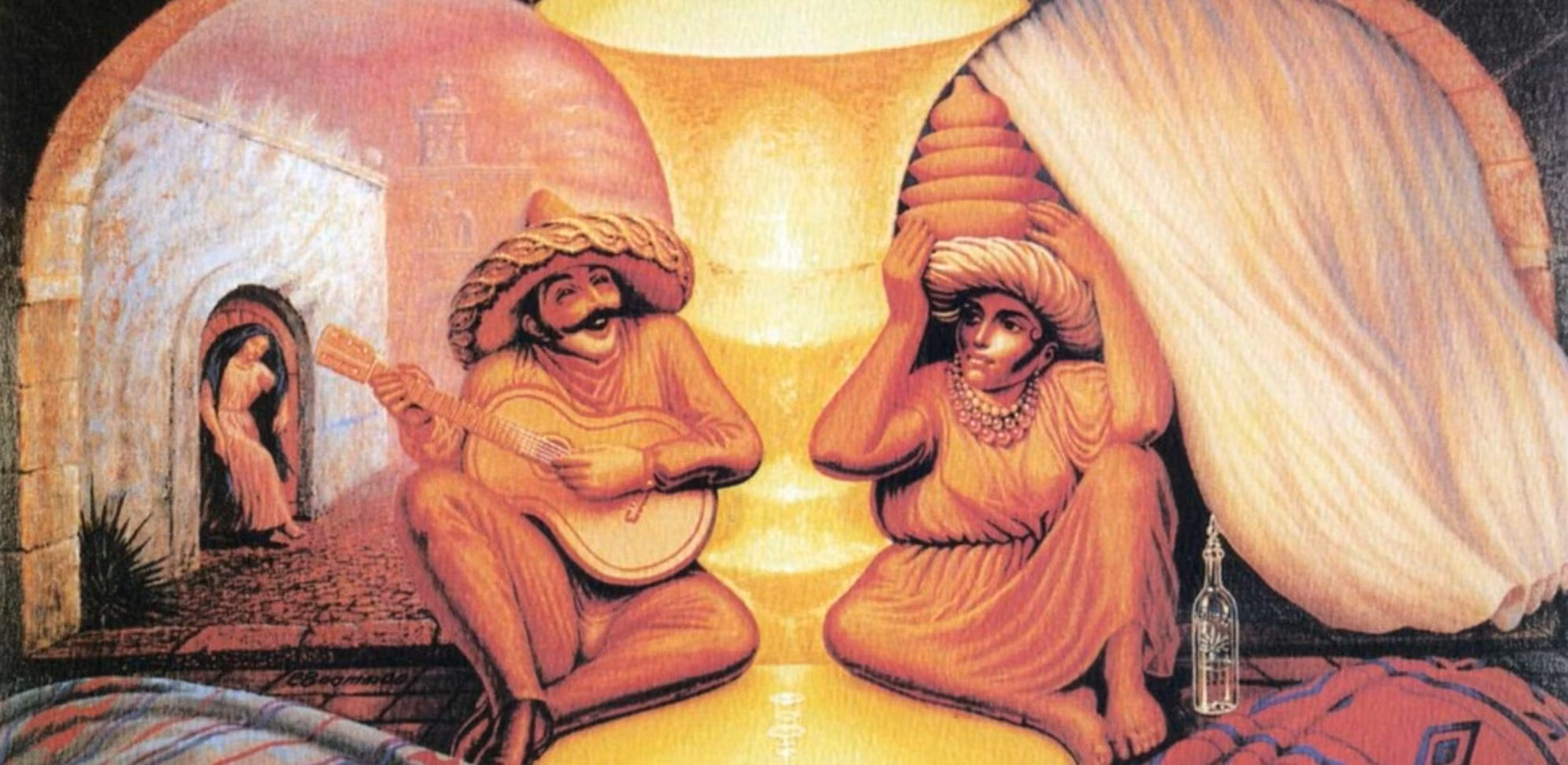
Some possible interpretations:
Two fish swimming in the sea
A woman looking to the left
Some possible interpretations:
An elderly man and woman facing each other
A younger man and woman sitting in a landscape scene
A candlestick or chalice
Discussion Questions
What did you see in each image?
Do you see anything else in the image?
If you did not see something that someone else saw, can you adjust what you are looking at to find what they identified?
Why do you think you saw what you did in the images?
Lecture Notes
Perspective-taking is the process by which we try on a different perspective to gain greater information about the world around us.
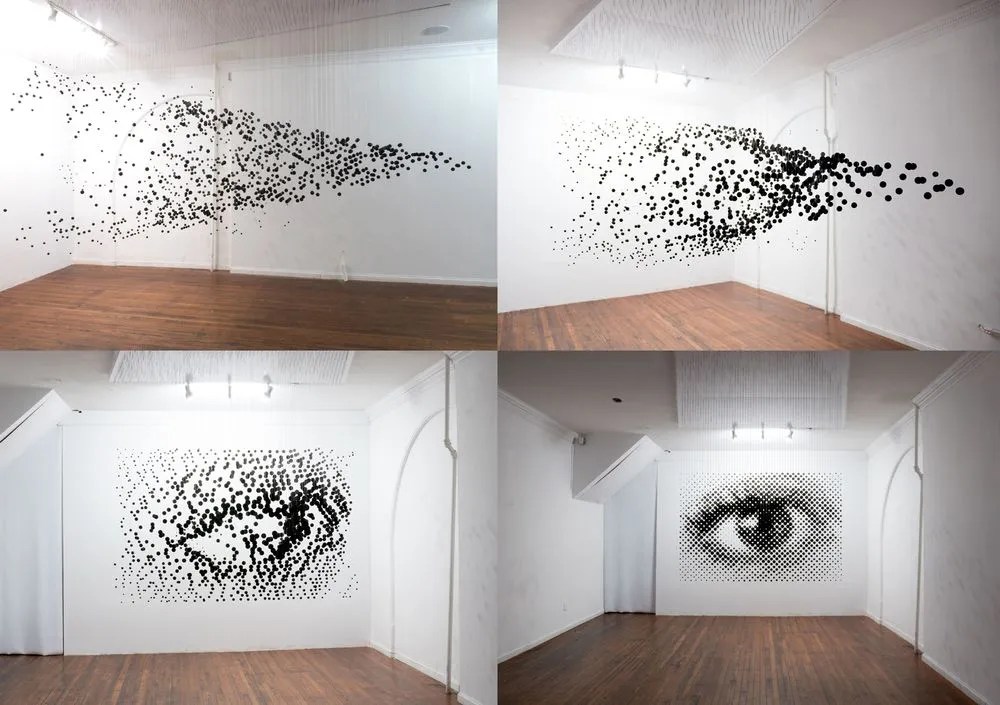
A common way we engage in perspective-taking is visually, wherein our position in the world determines how we interpret what is there. For example, take a look at this image:
This sculpture by the artist Michael Murphy is made from a series of floating balls. From one angle, all we can see is the cone of balls. However, by standing at the right place in the room, the balls resolve into the image of an eye.
In addition to its visual dimension, perspective-taking also has a conceptual component, where we ascribe ideas, meaning, and motivation to objects and actions. For example, take a look at this sculpture, also created by Michael Murphy:
Reflection Questions
Ask the participants to reflect on the following questions quietly to themselves:
What do you see in this image?
What does this image mean to you?
What do you think the artist was trying to portray in this image?
Is there another way this image could be interpreted?
Finishing up Phase 1
By taking on a different perspective, we can gain new information about a situation or expand our understanding of possible interpretations.
Visually, this can help us make sense of scenes and images.
Conceptually, it can allow us to better interpret and understand the actions, motivations, and intentions.
In the next phase, we will explore our own interpretations of a series of scenarios, then reflect on those interpretations.
The second phase of this activity explores participants’ responses to three different scenarios. In this phase, the participants are focused on reflecting on their responses, which will be revisited in the third phase as they imagine differences in their own perspectives.
Process
Distribute a set of sticky notes and writing utensils to each participant.
Prepare a whiteboard space with the scenario and provide space to allow participants to place their sticky notes on each section.
For each of the following scenarios, have the participants write their answers to the questions on sticky notes, then place them in the appropriate section.
After the participants have finished with the scenario, use the subsequent Guided Conversation sections to reflect on the answers.
Scenario
James is caught stealing from Steve’s store. Steve calls the police, but not before physically assaulting James. When the police arrive, they arrest James and send him to jail.
Have the participants use three sticky notes, writing the name of each actor in the scenario at the top (Emile, Steve, the police). Then, have them answer the following questions for each actor:
Was what they did morally right? What influenced this conclusion?
Why do you think the actor engaged in their particular action?
What do you think was the most important factor influencing the actor’s actions?
Guided Conversation
Take five minutes to allow the participants to reflect on everyone’s responses. Then, open the discussion with the following questions:
Was there anything surprising about the responses?
Was there anything you anticipated in the responses?
Were there any responses you did not understand?
Were there any responses you disagreed with, and why?
As you progress through the reflection questions, highlight in the discussion different elements of perspectives that may come up, such as the dimensions found on the handouts found on the following pages:
Lecture and Additional Resources
When the reflection questions have been answered or time constraints require moving on, distribute the handouts to each participant and discuss how each dimension plays a part in affecting perspective-taking. The third phase will allow participants to generate their own interpretations of these handouts, with broader meaning generated in the reflection portion of the exercise. However, here are some additional resources to provide additional information on the subject:
Gehlbach, H. (2004). A New Perspective on Perspective Taking: A Multidimensional Approach to Conceptualizing an Aptitude. Educational Psychology Review, 16(3), 207–234. https://doi.org/10.1023/B:EDPR.0000034021.12899.11
Sessa, V. I. (1996). Using perspective taking to manage conflict and affect in teams. The Journal of Applied Behavioral Science, 32(1), 101. https://doi.org/10.1177/0021886396321007
Galinsky, A., & Moskowitz, G. (2000). Perspective-taking: Decreasing stereotype expression, stereotype accessibility, and in-group favoritism. Journal of Personality and Social Psychology, 78, 708–724. https://doi.org/10.1037//0022-3514.78.4.708
Phase 3: Playing with Perspective
This final phase revisits the scenario in Phase 2, having participants imagine slight alterations to the situation to explore each of the dimensions listed in the first handout.
Process
Like Phase 2, a whiteboard is used alongside sticky notes to collect participants’ answers in this phase. Have participants write their answers and post them to the whiteboard for each of the four alternative scenarios. After the scenarios are explored, there is a second reflective conversation.
Scenarios
For each scenario, have the participants use three sticky notes, writing the name of each actor in the scenario at the top. Then, have them answer the following questions for each actor:
Was what they did morally right? What influenced this conclusion?
Did the change in the scenario change your previous answer? How and why?
What do you think is the most important factor affecting perspective in this new scenario?
Scenario 1
Emily is caught stealing from Steve’s store. Steve calls the police, but not before physically assaulting Emily. When the police arrive, they arrest Emily and send her to jail.
Scenario 2
In this scenario, imagine that you are a law enforcement officer responding to the situation. James is caught stealing from Steve’s store. Steve calls the police, but not before physically assaulting James. When the police arrive, they arrest James and send him to jail.
Scenario 3
James is caught stealing from Steve’s store. This is the fifth time Steve has caught James stealing this month. Steve calls the police, but not before physically assaulting James. When the police arrive, they arrest James and send him to jail.
Scenario 4
James, desperate to feed his family, is caught stealing food from Steve’s grocery store. Steve calls the police, but not before physically assaulting James. When the police arrive, they arrest James and send him to jail.
Reflection and Guided Conversation
After the participants have completed the scenarios and posted their sticky notes, give them five minutes to review the responses. Then, have them reflect on the following questions in a group discussion:
How did the answers change in each scenario? Did you notice anything surprising?
What dimension of perspective-taking might apply to each scenario?
Did you notice any stereotyping, caricature, or preferential treatment in the answers?
How might perspective-taking affect how you look at incidents or events in the world?
How might perspective-taking benefit you when dealing with conflict?
Are there any risks or drawbacks to engaging in perspective-taking?
Social-emotional intelligence is central to group dynamics and conflict. Yet, the exploration of emotional intelligence has historically been neglected in conflict resolution and peacebuilding conversations. The absence of emotional intelligence in conflicts can hinder the ability of group members to navigate conflict, empathize with others, and manage relationships (Schwarz, 2002). When emotional intelligence is considered at the educational, community, or organizational level, group members can learn to harness emotion as a community and relationship-building tool.
This activity explores emotional intelligence in the context of peace education. This resource draws inspiration from psychology surrounding basic emotions, emotional wheels, and the origin of emotion, as well as conflict resolution and peacebuilding research on emotions and conflict. This activity will support groups in building emotional intelligence on the individual and social levels. This activity is best suited for groups with a common goal, such as classrooms, community organizations, and the workplace.
Context
This activity is best suited for high school students, college-age students, and adults. The formality of this activity can be adapted to various education settings but is neutral in its current form. The activity consists of two phases and will take approximately 30 minutes per phase. The length of this activity may vary based on the depth of conversation and volume of participation.
The recommended group size for this activity is 4-10 people. Increased group size will increase duration, allowing for productive discussion among group members. This activity would be best supported by materials such as sticky notes, note cards, and a whiteboard. However, this exercise can be completed via discussion if these resources are unavailable.
Implementation
Phase 1: (30-45 minutes)
Introduction (2-3 minutes):
Check-in on how everyone feels and provide context for the activity. The purpose of this introduction is to reveal that the activity will encourage participants to explore and feel daily emotions and tensions. The facilitator should consider establishing a controlled environment where participants can explore emotions safely. An introductory example is below:
“We are going to discuss emotional intelligence today. We will create a respective space where real emotions will be felt. We will go through a simulation designed to stimulate emotions in scenarios we feel and experience in our daily lives. If you feel the need to leave the space and take a moment for yourself at any time, please do so.”
Describe the importance of emotional intelligence when managing conflict.
Description of the simulation (2-3 minutes):
Provide a scenario, context, and discussion topic for the audience to navigate. For example, a dinner party discussing travel destinations will generate conversation and allow participants a neutral space to explore group dynamics.Assign behavioral traits to participants randomly: Each participant will be assigned a behavioral trait designed to generate tension, such as disruptive talking, withdrawn behavior, and overconfidence.
Remind the audience of the difference between behavior and emotions, acknowledging that the two might contrast during the activity.
Open conversation for any questions before beginning.
Simulation (5-10 minutes)
During the simulation, the participants will navigate conversation based on the context and behavioral traits provided. The group may find conversation challenging to navigate. The goal of the activity is to stimulate emotions based on the role assigned, the conversations at hand, or the simulation process itself.
Reflection: (5 minutes)
Take a moment to check in with participants. Ask the audience to write down the emotions 1. They experienced during the role play, and 2. Behaviors that might indicate others’ emotions during the role play.
After listing these observations on a notecard or sticky note, ask participants to hold on to their observations for later conversation (allowing for further engagement).
Define emotional intelligence and explore this definition with the group. This is an excellent opportunity to explore the meaning behind emotional intelligence and clarify any questions regarding emotional intelligence with the group.
After defining emotional intelligence, ask group members to share the emotions they experienced during the activity with the group. Ask the participants to refrain from group observations until later.
Explore the dynamic of emotions as they arise:
Did members experience multiple emotions? Were those emotions in harmony with one another? Did emotions contrast with each other?
Clarifying emotions (5-10 minutes):
Explore the six types of basic emotions with the group: happiness, sadness, fear, disgust, anger, and surprise. Then, explore emotions surrounding each category and how they can be clarified. For example: if a group member said they felt anxious during the activity, that emotion is rooted in fear. If a group member said they felt confused during the activity, that emotion is rooted in surprise. Provide examples for the group, then encourage them to clarify their shared emotions.
Many people, especially adults, will provide cognitive responses instead of emotions when asked how they feel. When asked what emotions they experienced during the activity, a cognitive response might sound like, “conversations about travel destinations made me want to explore the world more.” Encourage using the emotional wheel to assist participants in shifting from cognitive responses to emotional responses. Ask the participant which emotion is closest to their shared responses and explore the differences between emotion and cognition.
Phase 2: (20-30 minutes)
Social-emotional intelligence (5-10 minutes)
Ask the participants to return to their group observational notes from the simulation. Consider what cues clued participants in on how others might have been feeling.Provide an example of clarifying social emotions for the group:
“I noticed that you were quiet after being interrupted. Did you feel sad after that interaction?” Remind the group to use core emotion vocabulary (i.e., happiness, sadness, fear, disgust, anger, surprise).
Allow group members to share their observations.
Open a conversation to ask how accurate their observations were.
Why were my observations accurate/inaccurate? How can I better observe the emotions in groups moving forward?
Further discussion: (15-20 minutes)
Allow the group to discuss their experience with the activity in depth. Some guiding questions might include the following:
How aware were you in the moment of your emotions? Others?
Did you feel that other people’s emotions influenced yours? How?
What were your reactions to emotions in the space? How/did you respond?
How might you manage your reactions to emotions in the future?
How difficult was it to clarify your emotions?
Ways to further curate this resource:
Pedagogies that may strengthen this resource involve increased participant freedom and involvement. The facilitator of this exercise might increase participant freedom by:
Encouraging group members to create their own activities to stimulate everyday emotions.
Allowing group members to redefine emotional intelligence for themselves based on shared interests.
Involving artistic approaches to exploring emotions such as paintings, photographs, and music. This might involve emotional responses to the creation of artwork or the observation of artwork.
Goal
This activity focuses on individual and social-emotional intelligence. As an introduction to emotional intelligence, this activity seeks to help group members identify their emotions and clarify the origin of their emotions. At the group level, this activity seeks to increase awareness of group dynamics through observations and clarification of emotion. This activity aims to foster empathy and connection within a group by discussing the relationship between individual and social emotions.
After this activity, participants should be able to:
Understand the meaning and importance of emotional intelligence.
Clarify everyday emotions into the six core emotions.
Have increased awareness of the connection between individual and social emotions.
Resources
Further reading on emotions and insight into social-emotional intelligence:
Schwarz, R. (2002). Ch 12: Dealing With Emotions. In The skilled facilitator: A comprehensive resource for consultants, facilitators, managers, trainers, and coaches. essay, Jossey-Bass.