What Can You Learn by Asking?

A Lesson/Facilitation Plan for Practicing Open-Ended Questions

This lesson/facilitation plan is an adaptation of “Open Questions – Role Play,” an exercise by William Chadwick that is available for free via https://www.sessionlab.com/methods/open-questions-role-play.

Learning Objectives

  • Learn about open-ended questions and the difference between open-ended questions and close-ended/leading questions
  • Develop confidence with asking open-ended questions
  • Practice listening to understand and respond
  • Consider the value of open-ended questions in conflict resolution facilitation

Context

This lesson/facilitation plan is appropriate for formal and informal settings, from middle- and high-school peer mediation workshops/clubs/classes to college and graduate courses to adult workplaces or community groups. It may be useful in any group setting in which instructors/facilitators are seeking to help participants learn to ask better questions, listen more closely to others, and/or prepare to serve as facilitators or mediators of some kind. As described below, this activity will work best when there are at least two instructors/facilitators. A single instructor/facilitator may modify the activity if needed, and there are suggestions below for that modification.

Materials

  • Paper/notecard and writing utensil for each participant
  • Timer
  • Optional:
    • Slides, poster, and/or handout with information about open-ended questions
    • Slides, poster, and/or handout with a list of potential fun facts for participants to choose from and instructions for the activity
    • Slides, poster, and/or handout with a written example of the activity (such as the one supplied below)

Time

Expect to spend at least 30 to 45 minutes on this activity, depending on the size of the group.

Room Set-Up

Place (or ask the participants to help place) 6 to 12 chairs (with or without desks/tables) in a semicircle, all facing towards the inside. Place one chair (with or without a desk/table) in front of the opening of the semicircle and make sure that it is facing the semicircle. If the class/group is too large to fit in the semicircle, have other chairs outside of the semicircle and explain that everyone will get a turn in the semicircle.

Background and Preparation

Invite the participants (or the first group of participants) to sit in the semicircle.

If there are people who do not fit in the semicircle, explain that those who are not in the semicircle are responsible for observing the action in the semicircle.

Tell the group that they will be practicing the facilitation tool of asking open-ended questions, which is a really important skill when you are trying to understand someone else’s experiences and perspective.

Explain that open-ended questions are questions that do not have yes-or-no answers and that are not leading or loaded. They often begin with “who,” “what,” “when,” “where,” “why,” or “how.” Using “why” can be tricky because the other person may see the question as judgmental, but “why” questions can also be valuable, when asked in the right situation and with the right tone.

Share examples of open-ended questions and close-ended/leading questions and discuss the difference and the value of open-ended questions. One example pair of questions is “How did that make you feel?” (open-ended) vs. “Were you scared?” (close-ended/leading).

Ask the group for their thoughts on the value of open-ended questions.

The Activity

The following lesson/facilitation plan refers to the co-teacher/assistant/co-facilitator as “Ms. Terry.” The name “Ms. Terry” is just a placeholder for personalization and ease of reference in this lesson/facilitation plan. If you have a co-teacher/assistant/co-facilitator, replace “Ms. Terry” and her pronouns with your co-teacher/assistant/co-facilitator’s name and pronouns throughout the instructions. If you are leading this activity without a co-teacher/assistant/co-facilitator, replace “Ms. Terry” and her pronouns with “a/the volunteer” (or something similar) and explain that the volunteer will change with each round.

The following script explains the activity. Feel free to personalize it and modify it as you see fit.

Ms. Terry will leave the room shortly and, while Ms. Terry is outside, the class/group will collectively decide on one fact that they would like to know about her.

I will provide you with a list of fun fact questions to choose from, and I hope to achieve a quick consensus or do a little vote (if needed). Remember that there will be multiple rounds, so there will be a chance to use several different questions.

  • Note to the instructor/facilitator: See the next section for some fun fact question ideas.

Once the class has decided on a fun fact, Ms. Terry will return and sit in the chair in front of the semicircle. She will start off the activity by making a random statement. She might share something she did earlier in the day, something she recently saw, or some other observation.

Next, the first person in the semicircle will ask Ms. Terry an open-ended question based on her initial statement.

Ms. Terry will answer the question, and then the next person will ask a new open-ended question based on Ms. Terry’s answer to the previous question.

This question-and-answer session will continue until the group is able to steer the conversation to the point at which someone is able to ask the original question of interest or the round reaches the 10-minute mark, whichever comes first. If the round reaches the 10-minute mark without getting to the question of interest, the group will share the question they were trying to get to, and the class/group will start a new round.

There will be no random participation in the semicircle. You will have a turn to ask a question based on the order in which you are sitting. If we make it all the way around the semicircle, we’ll go back to the first person in the semicircle.

If one of you asks Ms. Terry a closed or leading question, I will speak up and ask you to reframe your question so that it is open-ended. I will also step in if someone asks a question that is not based on Ms. Terry’s last statement.

Ms. Terry will leave the room again at the end of each round to give the group the chance to decide on another fun fact question, and then we’ll start a new round.

Notes for the Instructor/Facilitator

If there are observers, you can keep them engaged and provide them with another way to learn by tasking them with raising their hand if they notice that someone in the semicircle has asked a close-ended or leading question or if someone has asked a question that does not relate to the answer Ms. Terry provided for the previous question.

For the list of fun facts, favorites are often popular and can be appropriate for all ages, but you are not limited to posing questions related to favorites. Other questions are also appropriate and interesting. Example questions include the following:

  • What is your favorite animal?
  • What is your favorite candy/food?
  • What is your favorite holiday?
  • What is your favorite color?
  • What is your favorite TV show/book/movie?
  • What is a place you really want to visit?
  • If you could go back in time, which historical era would you choose to visit?
  • What is your biggest (non-serious) fear/superstition/pet peeve?
  • What is the first job you ever wanted/dreamed of as a little kid?
  • Who is a famous person you admire?

If you are leading this activity without a co-teacher/assistant/co-facilitator, you may choose not to provide the group with a list of fun fact questions (instead just having the class/group come up with options themselves) so that the potential volunteers to serve in the Ms. Terry role, who should change with every round, will not see the list of options.

Set a timer for 10 minutes at the beginning of each round and intervene as necessary (as described above) throughout the round.

Once Ms. Terry answers the participants’ original question or a round reaches the 10-minute mark, congratulate all involved and pass out paper and writing utensils so that participants can take a moment to record their thoughts and feelings.

If the class/group was too large to fit into the semicircle, have the participants who asked at least one question in the previous round swap places with observers and start a new round, sending Ms. Terry out of the room again while the participants decide on a new fun fact to learn about her.

If you are leading this activity without a co-teacher/assistant/co-facilitator, you may ask for a new volunteer to take the place of the previous round’s volunteer at this time.

In each round, start from a different place in the semicircle.

It may be helpful to provide the participants with an example, whether by reading aloud and/or by passing around a handout with a written example. One potential example is below. If you share the example below with the participants, it may be helpful to note that a real round may be longer or shorter than this example. Additionally, if you share the example below, feel free to replace Ms. Terry with the name of the person who will take on that role in your activity, or you can use the generic “Volunteer.”

Example

While Ms. Terry is outside the room, the participants decide that they would like to learn Ms. Terry’s favorite holiday. Now, Ms. Terry has returned and the question-and-answer activity begins.

Ms. Terry: Over the weekend, I played in a basketball tournament.

Participant 1: Where did the tournament take place?

Ms. Terry: It was in a community center in Somewhere, about a 30-minute drive away.

Participant 2: How did you get there?

Ms. Terry: My teammate picked me up, and then we picked up another teammate, so there were three of us in the car.

Participant 3: What did the three of you do in the car during the drive?

Ms. Terry: We talked to each other about our weeks, our jobs, our families, and the news. We had a nice time chatting and laughing.

Participant 4: What makes you laugh?

Ms. Terry: Oh, we’ve known each other for several years and we tease each other and joke about different things in our lives and in the news. I think it’s important to be able to laugh at yourself and with your friends.

Participant 5: Who do you like to laugh with the most?

Ms. Terry: I probably like to laugh the most with my family and my best friends. We’re all so comfortable with each other and we know how to really make each other laugh and how to laugh with and at each other and ourselves.

Participant 6: Who is in your family?

Ms. Terry: My family consists of my parents, my brother, my sister, my brother-in-law, my niece, my nephew, and a bunch of cousins and aunts and uncles.

Participant 7: Besides joking and laughing, what do you like to do with your family?

Ms. Terry: We like to cook and play games.

Participant 8: When do you like to cook and play games with your family?

Ms. Terry: We cook and play games pretty much anytime we are together at someone’s home.

Participant 1: When do you gather at someone’s home?

Ms. Terry: My closest family gathers together relatively frequently because we’re pretty close. More people join in for birthdays and holidays and other special occasions.

Participant 2: What is your favorite holiday?

Ms. Terry: My favorite holiday is Thanksgiving. I love how everyone comes and we talk about what we’re grateful for, plus there is a lot of time for cooking and playing games together.

Participant Debrief

After completing at least three rounds, shift to the debrief. Although appropriate debrief questions will vary depending on the age of the participants and the purpose of the activity, there are a few questions, identified below, that will likely be useful to all groups.

Was this easier or harder than you thought it would be?

To break up the activity, it may be helpful to ask participants to place themselves along a spectrum for this question, indicating that participants who thought that the activity was much easier than expected should go to one side of the room, those who thought that it was much harder than expected should go to another, and those who felt that it was about what they expected or somewhere else in the middle should place themselves in the room according to their experience. Then, you may choose to ask some people to explain why they chose to stand in the particular spot they picked.

After completing the activity and participating in the debrief up to this point, what do you think is the value of using open-ended questions when conflicts arise? How might you use open-ended questions to deal with rumors? How might you use open-ended questions when a group of people is trying to work together for the first time?

When you asked your questions, you were trying to steer Ms. Terry in a certain direction. Do you think this sort of questioning is okay in a real facilitation situation? If so, when and how would you decide to do this?

Additional Resources

For more information about open-ended questions, take a look at any of the following articles (presented in alphabetical order, not in order of preference).

Perspective-Taking

Introduction for Educators

An old and well-known parable tells the story of a group of blind men and an elephant. Originating in the Indian subcontinent, many versions have evolved over time, but each telling carries the same core element:

A group of blind men encounters an unfamiliar animal – something they are told is called an elephant. Curious about the creature but unable to see its form, they resolve to learn what it is by touch. Reaching out, each man felt a different part of the animal. The first man’s hand fell on the trunk – he proclaimed that the animal must be like a thick snake. The second man’s hand reached out toward a leg, arguing instead that the elephant must be like a pillar – a tree. Another, feeling the wing-like shape of the ear, quibbled that the elephant must be like a bat, to the disagreement of the man touching the tail, who stated the elephant was rope-like. So on and so forth, each man stepped forward, felt another part of the animal, and declared its nature. Lacking knowledge of the whole picture, however, none truly knew the elephant.

The moral of the story is to problematize the truth each man arrives at with their limited perception. While their subjective experiences may be real for them, that does not constitute an objective truth of the elephant itself. To bring the story into focus with the concept of perspective-taking, in some versions, the blind men gather together to share their experiences to create a greater picture of the elephant as a whole, arriving at a shared truth. By understanding what the other participants were doing and their rationale behind it allowed them to incorporate a broader and more creative understanding of the elephant.Perspective-taking, the “active cognitive process of imagining the world from another’s vantage point or imagining oneself in another’s shoes to understand their visual viewpoint, thoughts, motivations, intentions, and/or emotions,” is a process by which we can “try on” another’s perspective. It has important implications for cognitive development, and can broadly benefit social interactions and conflict, yet it also has elements that can be problematic in groups and organizations.[1] This activity, designed for educators working with high school or college students and organizational facilitators, seeks to teach what perspective-taking is and is not, its potential benefits, and its challenges and pitfalls


[1] Ku, G., Wang, C. S., & Galinsky, A. D. (2015). The promise and perversity of perspective-taking in organizations. Research in Organizational Behavior, 35, 79–102. https://doi.org/10.1016/j.riob.2015.07.003

Overview

Learning Goals

The goal of this workshop is to help participants:

  • Practice visual and conceptual perspective-taking to understand how to apply it in their everyday lives.
  • Understand how it can generate shared understanding and creative solutions to problems.
  • Understand some of the pitfalls of perspective-taking, including stereotyping, caricature, and preferential treatment.

Importance in Peace Education

Perspective-taking is an important element in peace education as it can help us to better understand the motivations of others as well as their worldviews on values such as justice, mercy, and equity. At its best, perspective-taking can reduce stereotyping and prejudice, improve the potential for creative solutions to conflict, and evoke empathy between adversaries in conflict. Conversely, in certain contexts, perspective-taking can increase prejudices and stereotyping, lead to preferential treatment, and deepen conflicts. Understanding how perspective-taking works, as well as the elements contributing to its positive and negative outcomes, can help individuals, leaders, and organizations navigate conflict constructively.

Target Audience

This workshop is designed for high-school-aged students and above. Aside from its use as a conceptual skill, perspective-taking is a developmental skill that children learn as they grow into adulthood. Drawing from Piaget’s theory of cognitive development, perspective-taking as a developmental skill takes shape from ages seven to twelve but improves as time goes on. Accordingly, this workshop assumes that the basic skillset of perspective-taking is already present, with the activity exploring that skill and its complexities.

Accessibility Note

Current research notes that some people with attention deficit hyperactivity disorder, comorbid with conduct disorders, or autism, may have difficulty engaging in perspective-taking[1]. While there is new research exploring teaching perspective-taking these populations[2], those approaches are beyond the scope of this workshop. As such, this exercise may not be suitable for groups with these individuals.


[1] See: Marton, I., Wiener, J., Rogers, M., Moore, C., & Tannock, R. (2009). Empathy and Social Perspective Taking in Children with Attention-Deficit/Hyperactivity Disorder. Journal of Abnormal Child Psychology, 37(1), 107–118. https://doi.org/10.1007/s10802-008-9262-4 or Reed, T., & Peterson, C. (1990). A comparative study of autistic subjects’ performance at two levels of visual and cognitive perspective taking. Journal of Autism and Developmental Disorders, 20(4), 555–567. https://doi.org/10.1007/BF02216060

[2] Pearson, A., Ropar, D., & Hamilton, A. (2013). A review of visual perspective taking in autism spectrum disorder. Frontiers in Human Neuroscience, 7. https://www.frontiersin.org/articles/10.3389/fnhum.2013.00652

Timing and Phases

This workshop consists of three phases, totaling about 60-90 minutes:

  • Phase 1 (10-15 Minutes): Introduces perspective-taking as an idea through visual perspective-taking, using optical illusions and an image of a dove to bridge the visual and conceptual.
  • Phase 2 (20-30 Minutes): Engages participants in exploring their own responses to a scenario, followed by a discussion on different elements informing their perspectives.
  • Phase 3 (30-45 Minutes): Participants revisit the scenario, role-playing slight modifications to their perspectives. This is followed by discussion questions and reflection.

Recommended Group Size

This exercise can accommodate various group sizes, with more participants requiring more time for each phase. However, a minimum of 4 to 5 participants is recommended to allow for a diversity of answers.

Materials Needed

The optical illusions for the first phase are provided here, though similar interpretive illusions can be utilized for the same effect. For the second and third phases, a whiteboard and sticky notes or a virtual platform with whiteboard and sticky note capacity is ideal so that participants can see responses. However, reading the scenarios aloud and having participants write their answers themselves is also feasible. Additionally, there are two handouts found in this document that are meant to be used in Phase 2 onward.

Potential Modifications

  • Different optical illusions can be employed to give participants increased experience in visual perspective-taking. Additionally, in face-to-face settings, having students engage with a complex physical object in a circle is another way to explore visual perspective-taking.
  • In large groups, Phases 2 and 3 can be done in small groups of 5 or more people.
  • A fourth phase, exploring real-life or historical scenarios and conflicts, can be implemented using the ideas discussed in the prior phases. This can allow educators to incorporate this exercise into existing curriculum.

Additional Resources


Phase 1: Visual Perspective-Taking

The first phase of this activity seeks to ground the process of perspective-taking using a visual approach, which can provide a foundation for what the participants will engage in later in subsequent phases. Visual perspective-taking is thought to emerge before conceptual perspective-taking[1], so its process may be more familiar to participants than its conceptual counterpart.


[1] Gabbe, A., & Marquis, C. (1996). The Emergence of Visual and Conceptual Perspective-Taking Abilities in Three and Four-Year-Old Children. https://doi.org/10.1184/R1/6712607.v1

Process

Have students look at the following images, responding with what they see in each image.

Some possible interpretations:

  • Two fish swimming in the sea
  • A woman looking to the left

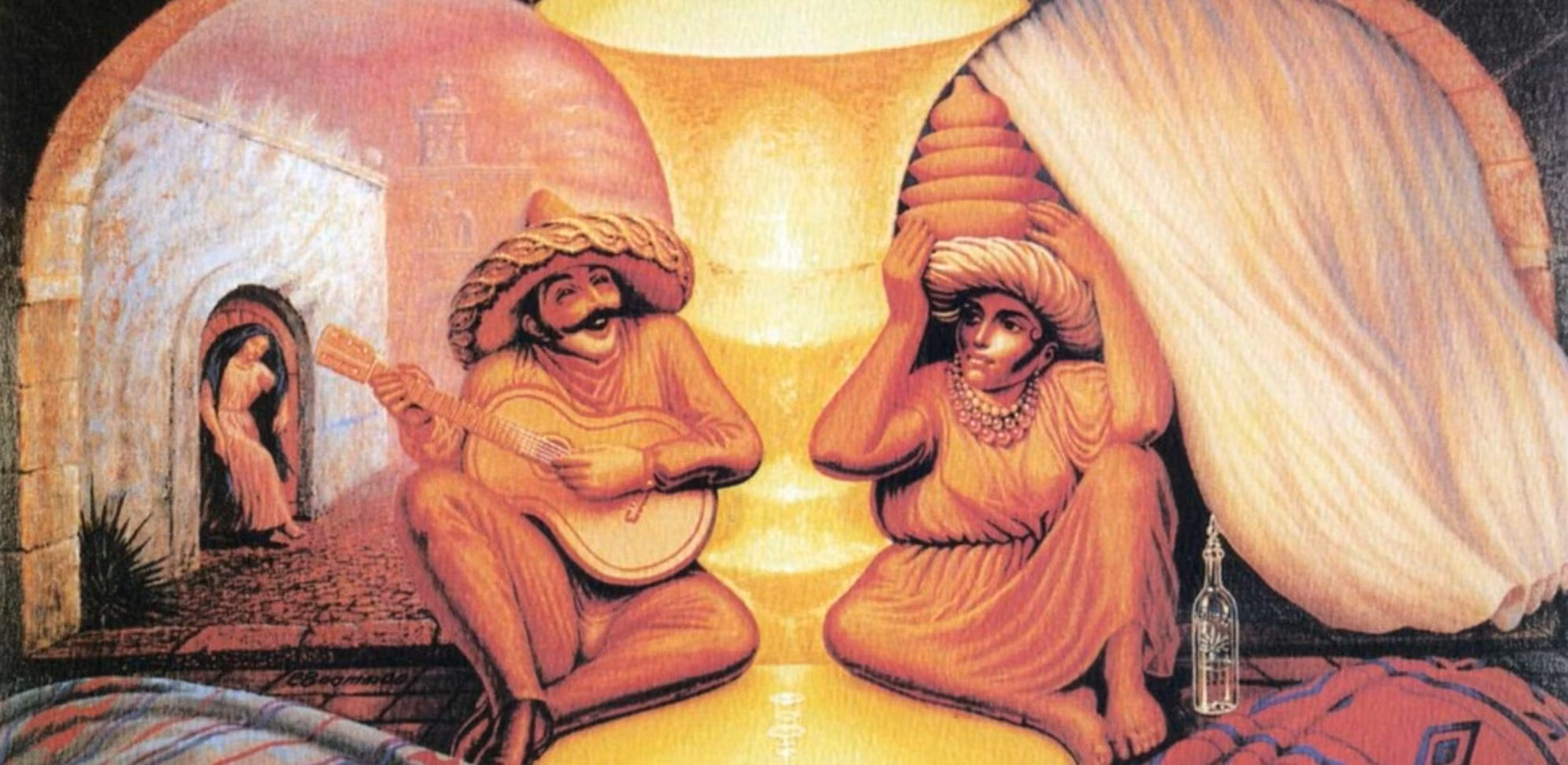
Some possible interpretations:

  • An elderly man and woman facing each other
  • A younger man and woman sitting in a landscape scene
  • A candlestick or chalice

Discussion Questions

  • What did you see in each image?
  • Do you see anything else in the image?
  • If you did not see something that someone else saw, can you adjust what you are looking at to find what they identified?
  • Why do you think you saw what you did in the images?

Lecture Notes

  • Perspective-taking is the process by which we try on a different perspective to gain greater information about the world around us.

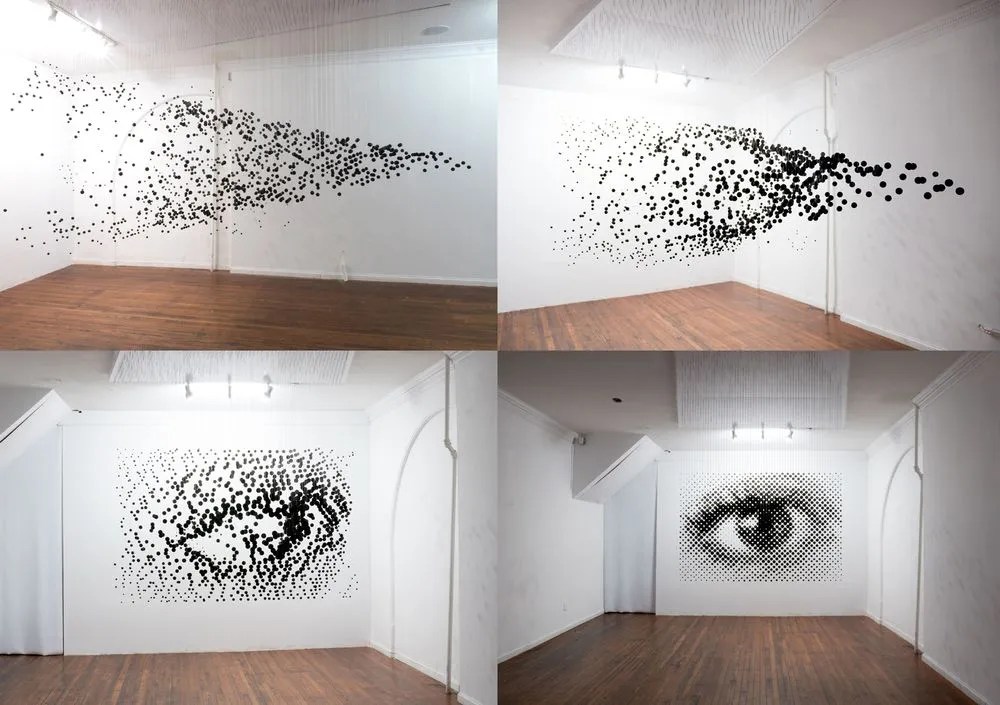
A common way we engage in perspective-taking is visually, wherein our position in the world determines how we interpret what is there. For example, take a look at this image:

This sculpture by the artist Michael Murphy is made from a series of floating balls. From one angle, all we can see is the cone of balls. However, by standing at the right place in the room, the balls resolve into the image of an eye.

In addition to its visual dimension, perspective-taking also has a conceptual component, where we ascribe ideas, meaning, and motivation to objects and actions. For example, take a look at this sculpture, also created by Michael Murphy:

Reflection Questions

Ask the participants to reflect on the following questions quietly to themselves:

  • What do you see in this image?
  • What does this image mean to you?
  • What do you think the artist was trying to portray in this image?
  • Is there another way this image could be interpreted?

Finishing up Phase 1

  • By taking on a different perspective, we can gain new information about a situation or expand our understanding of possible interpretations.
  • Visually, this can help us make sense of scenes and images.
  • Conceptually, it can allow us to better interpret and understand the actions, motivations, and intentions.
  • In the next phase, we will explore our own interpretations of a series of scenarios, then reflect on those interpretations.

Additional Resource:

Visual Perspective Taking” An article and YouTube video discussing different elements of visual perspective-taking.


Phase 2: Interpreting Conceptual Perspectives

The second phase of this activity explores participants’ responses to three different scenarios. In this phase, the participants are focused on reflecting on their responses, which will be revisited in the third phase as they imagine differences in their own perspectives.

Process

  • Distribute a set of sticky notes and writing utensils to each participant.
  • Prepare a whiteboard space with the scenario and provide space to allow participants to place their sticky notes on each section.
  • For each of the following scenarios, have the participants write their answers to the questions on sticky notes, then place them in the appropriate section.
  • After the participants have finished with the scenario, use the subsequent Guided Conversation sections to reflect on the answers.

Scenario

James is caught stealing from Steve’s store. Steve calls the police, but not before physically assaulting James. When the police arrive, they arrest James and send him to jail.

Have the participants use three sticky notes, writing the name of each actor in the scenario at the top (Emile, Steve, the police). Then, have them answer the following questions for each actor:

  1. Was what they did morally right? What influenced this conclusion?
  2. Why do you think the actor engaged in their particular action?
  3. What do you think was the most important factor influencing the actor’s actions?

Guided Conversation

Take five minutes to allow the participants to reflect on everyone’s responses. Then, open the discussion with the following questions:

  • Was there anything surprising about the responses?
  • Was there anything you anticipated in the responses?
  • Were there any responses you did not understand?
  • Were there any responses you disagreed with, and why?

As you progress through the reflection questions, highlight in the discussion different elements of perspectives that may come up, such as the dimensions found on the handouts found on the following pages:

Lecture and Additional Resources

When the reflection questions have been answered or time constraints require moving on, distribute the handouts to each participant and discuss how each dimension plays a part in affecting perspective-taking. The third phase will allow participants to generate their own interpretations of these handouts, with broader meaning generated in the reflection portion of the exercise. However, here are some additional resources to provide additional information on the subject:


Phase 3: Playing with Perspective

This final phase revisits the scenario in Phase 2, having participants imagine slight alterations to the situation to explore each of the dimensions listed in the first handout.

Process

Like Phase 2, a whiteboard is used alongside sticky notes to collect participants’ answers in this phase. Have participants write their answers and post them to the whiteboard for each of the four alternative scenarios. After the scenarios are explored, there is a second reflective conversation.

Scenarios

For each scenario, have the participants use three sticky notes, writing the name of each actor in the scenario at the top. Then, have them answer the following questions for each actor:

  • Was what they did morally right? What influenced this conclusion?
  • Did the change in the scenario change your previous answer? How and why?
  • What do you think is the most important factor affecting perspective in this new scenario?

Scenario 1

Emily is caught stealing from Steve’s store. Steve calls the police, but not before physically assaulting Emily. When the police arrive, they arrest Emily and send her to jail.

Scenario 2

In this scenario, imagine that you are a law enforcement officer responding to the situation. James is caught stealing from Steve’s store. Steve calls the police, but not before physically assaulting James. When the police arrive, they arrest James and send him to jail.

Scenario 3

James is caught stealing from Steve’s store. This is the fifth time Steve has caught James stealing this month. Steve calls the police, but not before physically assaulting James. When the police arrive, they arrest James and send him to jail.

Scenario 4

James, desperate to feed his family, is caught stealing food from Steve’s grocery store. Steve calls the police, but not before physically assaulting James. When the police arrive, they arrest James and send him to jail.

Reflection and Guided Conversation

After the participants have completed the scenarios and posted their sticky notes, give them five minutes to review the responses. Then, have them reflect on the following questions in a group discussion:

  • How did the answers change in each scenario? Did you notice anything surprising?
  • What dimension of perspective-taking might apply to each scenario?
  • Did you notice any stereotyping, caricature, or preferential treatment in the answers?
  • How might perspective-taking affect how you look at incidents or events in the world?
  • How might perspective-taking benefit you when dealing with conflict?
  • Are there any risks or drawbacks to engaging in perspective-taking?

Materials

Emotional Intelligence and Social Change: A Conflict skills and Peacemaking Activity

Designed by Haley Nelson

Background Information/Content

Social-emotional intelligence is central to group dynamics and conflict. Yet, the exploration of emotional intelligence has historically been neglected in conflict resolution and peacebuilding conversations. The absence of emotional intelligence in conflicts can hinder the ability of group members to navigate conflict, empathize with others, and manage relationships (Schwarz, 2002). When emotional intelligence is considered at the educational, community, or organizational level, group members can learn to harness emotion as a community and relationship-building tool. 

This activity explores emotional intelligence in the context of peace education. This resource draws inspiration from psychology surrounding basic emotions, emotional wheels, and the origin of emotion, as well as conflict resolution and peacebuilding research on emotions and conflict. This activity will support groups in building emotional intelligence on the individual and social levels. This activity is best suited for groups with a common goal, such as classrooms, community organizations, and the workplace. 

Context

This activity is best suited for high school students, college-age students, and adults. The formality of this activity can be adapted to various education settings but is neutral in its current form. The activity consists of two phases and will take approximately 30 minutes per phase. The length of this activity may vary based on the depth of conversation and volume of participation.

The recommended group size for this activity is 4-10 people. Increased group size will increase duration, allowing for productive discussion among group members. This activity would be best supported by materials such as sticky notes, note cards, and a whiteboard. However, this exercise can be completed via discussion if these resources are unavailable.  

Implementation

Phase 1: (30-45 minutes)

  • Introduction (2-3 minutes):
    • Check-in on how everyone feels and provide context for the activity. The purpose of this introduction is to reveal that the activity will encourage participants to explore and feel daily emotions and tensions. The facilitator should consider establishing a controlled environment where participants can explore emotions safely. An introductory example is below:
      • “We are going to discuss emotional intelligence today. We will create a respective space where real emotions will be felt. We will go through a simulation designed to stimulate emotions in scenarios we feel and experience in our daily lives. If you feel the need to leave the space and take a moment for yourself at any time, please do so.”
    • Describe the importance of emotional intelligence when managing conflict.
  • Description of the simulation (2-3 minutes):
    • Provide a scenario, context, and discussion topic for the audience to navigate. For example, a dinner party discussing travel destinations will generate conversation and allow participants a neutral space to explore group dynamics.Assign behavioral traits to participants randomly: Each participant will be assigned a behavioral trait designed to generate tension, such as disruptive talking, withdrawn behavior, and overconfidence.
      • Remind the audience of the difference between behavior and emotions, acknowledging that the two might contrast during the activity.
    • Open conversation for any questions before beginning.
  • Simulation (5-10 minutes)
    • During the simulation, the participants will navigate conversation based on the context and behavioral traits provided. The group may find conversation challenging to navigate. The goal of the activity is to stimulate emotions based on the role assigned, the conversations at hand, or the simulation process itself.
  • Reflection: (5 minutes)
    • Take a moment to check in with participants. Ask the audience to write down the emotions 1. They experienced during the role play, and 2. Behaviors that might indicate others’ emotions during the role play.
    • After listing these observations on a notecard or sticky note, ask participants to hold on to their observations for later conversation (allowing for further engagement).
  • Individual level emotional intelligence? (10 minutes)
    • Define emotional intelligence and explore this definition with the group. This is an excellent opportunity to explore the meaning behind emotional intelligence and clarify any questions regarding emotional intelligence with the group.
    • After defining emotional intelligence, ask group members to share the emotions they experienced during the activity with the group. Ask the participants to refrain from group observations until later.
      • Explore the dynamic of emotions as they arise:
        • Did members experience multiple emotions? Were those emotions in harmony with one another? Did emotions contrast with each other?
  • Clarifying emotions (5-10 minutes):
    • Explore the six types of basic emotions with the group: happiness, sadness, fear, disgust, anger, and surprise. Then, explore emotions surrounding each category and how they can be clarified. For example: if a group member said they felt anxious during the activity, that emotion is rooted in fear. If a group member said they felt confused during the activity, that emotion is rooted in surprise. Provide examples for the group, then encourage them to clarify their shared emotions.
    • Many people, especially adults, will provide cognitive responses instead of emotions when asked how they feel. When asked what emotions they experienced during the activity, a cognitive response might sound like, “conversations about travel destinations made me want to explore the world more.” Encourage using the emotional wheel to assist participants in shifting from cognitive responses to emotional responses. Ask the participant which emotion is closest to their shared responses and explore the differences between emotion and cognition.

Phase 2: (20-30 minutes)

  • Social-emotional intelligence (5-10 minutes)
    • Ask the participants to return to their group observational notes from the simulation. Consider what cues clued participants in on how others might have been feeling.Provide an example of clarifying social emotions for the group:
      • “I noticed that you were quiet after being interrupted. Did you feel sad after that interaction?” Remind the group to use core emotion vocabulary (i.e., happiness, sadness, fear, disgust, anger, surprise). 
      Allow group members to share their observations. 
    • Open a conversation to ask how accurate their observations were.
      • Why were my observations accurate/inaccurate? How can I better observe the emotions in groups moving forward? 
  • Further discussion: (15-20 minutes)
    • Allow the group to discuss their experience with the activity in depth. Some guiding questions might include the following:
      • How aware were you in the moment of your emotions? Others? 
      • Did you feel that other people’s emotions influenced yours? How? 
      • What were your reactions to emotions in the space? How/did you respond?
      • How might you manage your reactions to emotions in the future?
      • How difficult was it to clarify your emotions? 

Ways to further curate this resource:

  • Pedagogies that may strengthen this resource involve increased participant freedom and involvement. The facilitator of this exercise might increase participant freedom by:
    • Encouraging group members to create their own activities to stimulate everyday emotions.
    • Allowing group members to redefine emotional intelligence for themselves based on shared interests.
    • Involving artistic approaches to exploring emotions such as paintings, photographs, and music. This might involve emotional responses to the creation of artwork or the observation of artwork.

Goal

This activity focuses on individual and social-emotional intelligence. As an introduction to emotional intelligence, this activity seeks to help group members identify their emotions and clarify the origin of their emotions. At the group level, this activity seeks to increase awareness of group dynamics through observations and clarification of emotion. This activity aims to foster empathy and connection within a group by discussing the relationship between individual and social emotions. 

After this activity, participants should be able to:

  • Understand the meaning and importance of emotional intelligence.
  • Clarify everyday emotions into the six core emotions.
  • Have increased awareness of the connection between individual and social emotions. 

Resources

Further reading on emotions and insight into social-emotional intelligence:

Cherry, K. (2022, December). The 6 types of basic emotions and their effect on human behavior. Verywell Mind. Retrieved 2022, from https://www.verywellmind.com/an-overview-of-the-types-of-emotions-4163976 

The Junto Emotion Wheel. The Junto Institute. (2022). Retrieved 2022, from https://www.thejuntoinstitute.com/emotion-wheels/ 

Schwarz, R. (2002). Ch 12: Dealing With Emotions. In The skilled facilitator: A comprehensive resource for consultants, facilitators, managers, trainers, and coaches. essay, Jossey-Bass. 

“Dancing in the Dissonance” – A Conflict Resolution Skills Activity

Designed by Audrey Williams

I. Introduction

The goal of the “Dancing in the Dissonance” activity is to introduce the concept of “dissonance” as a tool to build curiosity and respect for difference in shared meaning-making spaces. The activity draws on narrative and musical tools for conflict resolution to build a better understanding of how people make meaning both individually and as part of a group. By the end of the activity, participants should have a better appreciation for how curiosity, complexity, and difference relate to healthy experiences of conflict.

By working with a pre-selected song to make and share meaning around sonic representations of conflict, participants will have the chance to ponder how meaning making happens on multiple levels, including:

  • on the level of the individual;
  • on the level of the group; and
  • on the level of the message between artist and audience.

This activity can be carried out in settings where participants already know each other as well as in settings where participants are just meeting each other for the first time. This activity involves a pre-class work expectation, and so it should be used in contexts where the facilitator has enough advance connection with participants to send pre-class materials to them.

At each stage, the activity is designed to help participants build greater appreciation for the flexibility and adaptability of meaning while also exercising their curiosity about how people can have different experiences of the same phenomena. Participants will learn how to see dissonance as an invitation to curiosity, and will walk away with an understanding of how to use curiosity to navigate difference in a generative, rather than destructive, way.


Continue reading

Conflict System Mapping

Background: In researching for my conflict resolution skills session assignment, I stumbled across a book, Making Peace Last, that takes the concept of systems thinking – one I originally grappled with during my master’s program in city and regional planning – and meshes it with peacebuilding. In the book, author Robert Ricigliano explains the paradox of macro-micro conflict, which is best summed up in this quotation he highlights:

All the good peace work being done should be adding up to more than it is. The potential of all these efforts is not being realized.” – Mary Anderson and Lara Olson

Continue reading

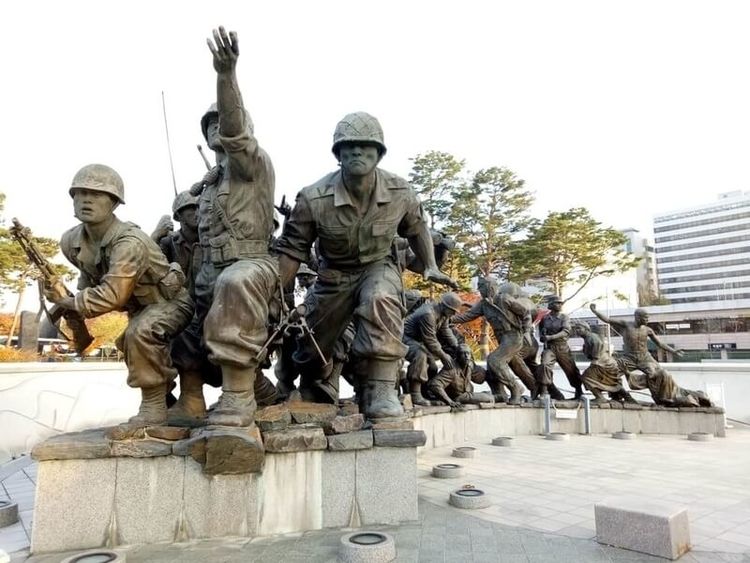
The War Memorial of Korea: war memories and reconciliation

Oct 1, 2019 – Kanghyun Kwon

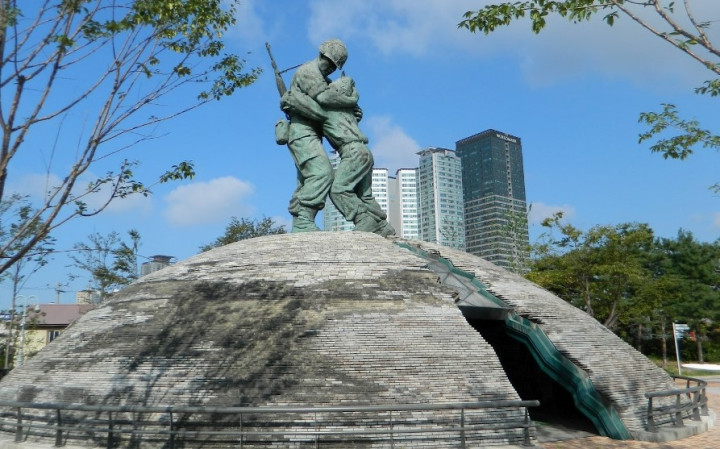
Statue of Brothers symbolizes the reconciliation, love, and forgiveness

Regardless of its scale, duration, actors, and implications, war is always saturated with tragedy. The Statue of Brothers created by Korean architect Choi Young-jeep symbolizes the desire for reunification of Korea by showing two brothers meeting in battle during the Korean War: the elder as from South Korea, and the younger from North Korea.

Having this sculpture at the external exhibition area underscores the significance of the War Memorial of Korea not only as the commemorative place for soldiers, but also as the informative museum of tragic memories for future reconciliation in the Korean Peninsula.

The War Memorial of Korea

Located in Seoul, the War Memorial of Korea is designed to be a place for commemoration of soldiers sacrificed in the Korean War of 1950, and peaceful reunification of North and South Korea.

After almost 7 decades since the war had scorched the Korean Peninsula, national scars from the war still remain unhealed and thus extremely sensitive to modern Korean society. The country is still divided into North and South, albeit with several attempts of alleviation of tension between two for peace settlement. The War Memorial of Korea is built to remind the modern society of human insecurity that its predecessors had to endure, and value of security that the current system guarantees, so that there would not be any reoccurrence of similar violent conflict in the future.

Divided into outdoor and indoor exhibition areas, the War Memorial of Korea presents remnants of Korean War in two different categories; one can find sources of military confrontation such as military equipment from the outdoor exhibition area. Indoor exhibition area shows visual information of progression of Korean War from civilian’s perspectives. It tells that everyone, not just soldiers, was involved in this 3 years of tragic event.

Defending the Fatherland show soldiers’ spirit to protect their fatherland

Importance of commemoration

The War Memorial of Korea is often visited by field trip of young generations who wish to study the history of peacebuilding in the Korean Peninsula, and of war veterans and their relatives who fought for democracy of South Korea during the Korean War.

For teenagers and young adults, who have not experienced war and thus feel detached from the terror of war, this place will teach them the tragic background the country had to go through at the beginning of its history, so that they could value the sense of peace they often take for granted in modern society.

For war veterans, the War Memorial of Korea will be the concrete evidence that their service was valuable in the sense that the country which they had protected from the invasion successfully achieved prosperity and did not forget their devotion.

This museum is, in short, a respect for transgenerational humanitarianism. It symbolizes the continuity of virtues which the past generation had protected from threat, and the present and future generations must inherit to their society. As long as this bond between generations stay connected, there will be always the path for peace.

Educating the next generation

The ideal way to incorporate the War Memorial of Korea into educational context is through field trip, because it is a unique place of commemorative spirit. For domestic educational institutions, planning a visit to this place for instructive purpose is an easy task. For those outside of Korea, it would require longer time and more sophisticated planning for visit.

Students from middle school to university who are interested in Korean War would benefit from visiting the War Memorial of Korea. Although high school students or younger might not be able to plan an actual visit to the place abroad, they could apply for commemorative programs for Korean War inside the US, and obtain precious memories from war veterans and representatives from South Korea. University students go even further and visit the place to incorporate the primary resources into their knowledge.

Meanwhile, scholars who explore the early period of Cold War would be interested in visiting this place after reading this post because it is a large database consisting of symbolic remnants as well as records of primary source regarding the early confrontation of the US and Soviet Union.

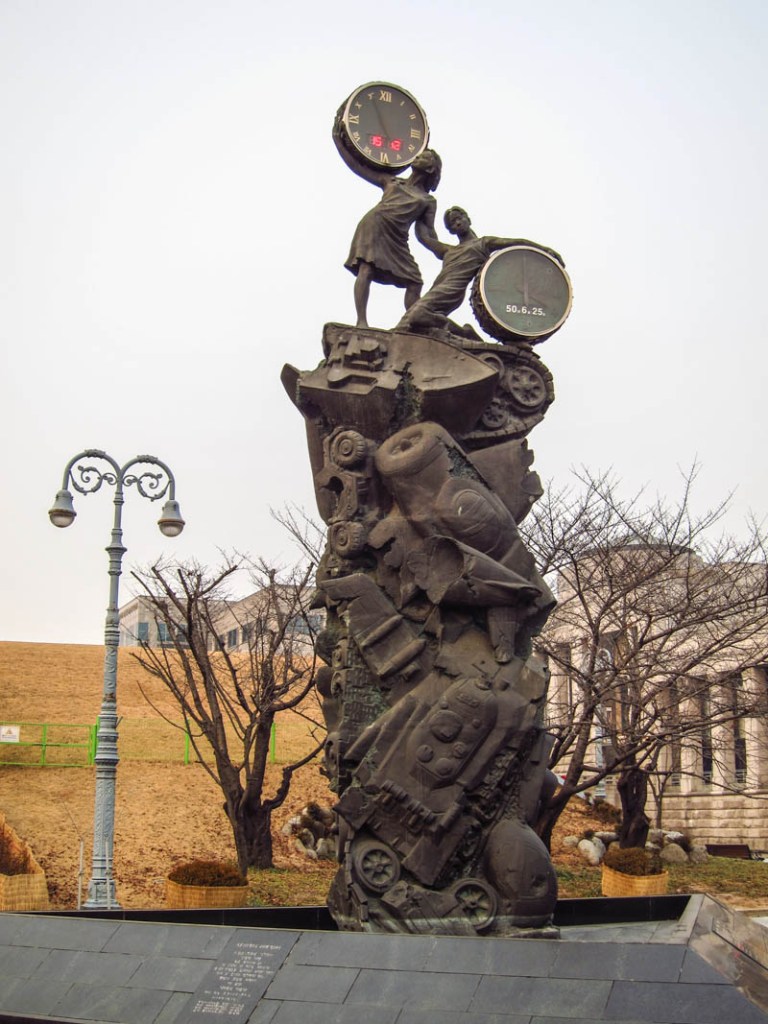
Clock Tower of Peace

Messages from the war museum

The War Memorial of Korea teaches its visitors the value of peace they often take for granted. South Korea enjoys economic prosperity and democratic peace today, but one must not forget that its foundation was saturated with bloodshed and subsequent devastation. As demand for reunification grows, radical opinions often propose a possibility of war with North Korea to physically overthrow its government and achieve reunification through military means.

As simple as it sounds, it is both politically and morally unreasonable. As a former victim of war, South Korea should not become the starter of war to inflict the same pain it experienced in the past to other countries. Especially if that country is the victim of same war. Moreover, one should not forget that while it is extremely easy to end the existing peace, it is extremely hard to restore the lost peace from the devastation of war.

The War Memorial of Korea opposes the return to Korean War. Any violent means used for conflict resolution in the Korean Peninsula would defy the humanitarian values represented by this place. It is a lighthouse for peaceful reconciliation which navigates the government and civil society actors by asking them the following questions:

> Is it possible to prevent the reoccurrence of Korean War? How can it be avoided?

> Is military means ever going to promote human security? Why is human security important?

> What can the government and society do to arrive at reconciliation?


Kanghyun Kwon is a junior in Global Affairs, B.A., George Mason University.

Images are taken from Prepare Travel Plans (https://preparetravelplans.com/war-memorial-of-korea-guide/), The Seoul Guide (https://www.theseoulguide.com/sights/museums/war-memorial-of-korea/), and Espionart (https://espionart.com/2014/06/27/the-divided-brothers-of-the-korean-war/).

For further information, please visit the official website (https://www.warmemo.or.kr/LNG/main.do?lan=en).

Narrative Praxis, Externalization, and Circular Questions

This series of videos introduces narrative praxis and then describes two common techniques used by narrative practitioners to look at information in different ways.

Introduction to Narrative Praxis

Externalization and Narrative

Externalization: The Apple in the Bowl

Circular Questions


Privilege Walk Lesson Plan

Privilege Walk Lesson Plan

Introduction:

Many educators and activists use privilege walks as an experiential activity to highlight how people benefit or are marginalized by systems in our society. There are many iterations of such walks with several focusing on a single issue, such as race, gender, or sexuality. This particular walk is designed with questions spanning many different areas of marginalization, because the goal of this walk is to understand intersectionality. People of one shared demographic might move together for one question but end up separating due to other questions as some move forward and others move back. This iteration of the privilege walk is especially recommended for a high school classroom in which the students have had time to bond with each other, but have never taken the time in a slightly more formal setting, i.e., led by a facilitator, to explore this theme. It is a good tool for classes learning about privilege or social justice and could also be used to discuss intersectionality in classes that have the danger of singling out a single aspect of social injustice. It is important that the students or group members are already acquainted and are not doing this activity as strangers, since an immense amount of trust in the people and the environment are needed to help people feel comfortable with acknowledging that certain statements apply to them.

Many people with certain privileges never notice them, because they are so woven into the mainstream that those who have them cannot see them. For youth, understanding and acknowledging privileges is key to understanding why and how they react and perceive their surroundings. The capacity for youth to objectively reflect on their interactions with the world will be invaluable. The focus on intersectionality in this practice will allow practitioners and students alike to understand that having one privilege does not make up for another marginalization and that every privilege or marginalization exists on a different but intersecting plane from another. This focus will help to avoid having positive developments being derailed by debates over who is more oppressed. It also helps youth understand ideas of intersectionality and be aware of marginalized groups within the marginalized group. Privilege walks have previously been criticized for being most beneficial to straight, white, able-bodied men, since it is supposed that they learn the most and that more marginalized students are made to feel vulnerable. The particular walk posted on this page works to avoid falling into these issues and has given detailed reasoning for recommended debrief questions, since the nature of the debrief discussion can either exacerbate or alleviate some of these issues. Even though it is not a perfect exercise, the privilege walk is a less confrontational way to discuss privilege and promote reflection. It helps people to open up, literally, in steps instead of difficult to articulate words and relate to each other in a different way.

Goal:

To discuss the complicated intersections of privileges and marginalizations in a less confrontational and more reflective way.

Time:

15~20 minutes for the Privilege Walk

45~60 minutes for the debrief

Materials:

  • A wide open space, e.g., a classroom with all chairs and tables pushed back, an auditorium, or a gymnasium
  • Chairs to form a circle for the debrief
  • Painter’s tape to make an initial line for participants
  • Optional: tape or other materials to draw lines to indicate where to step back or forth

Procedures:

  • Have participants line up in a straight line across the middle of the room with plenty of space to move forward and backward as the exercise proceeds.
  • Have participants hold hands or place one hand on the shoulder of the person to their left or right depending on space constraints. Important: Make sure to ask participants if they are comfortable touching and being touched by others. If some are not, do not make them and do not make a big deal out of it.
  • You may give an explanation about the activity, how it is intended to educate about privilege, and what exactly is privilege, or you can send students into the activity with no such background.
  • Read the following to participants:
  • I will read statements aloud. Please move if a statement applies to you. If you do not feel comfortable acknowledging a statement that applies to you, simply do not move when it is read. No one else will know whether it applies to you.
  • Begin reading statements aloud in a clear voice, pausing slightly after each one. The pause can be as long or as short as desired as appropriate.
  • When you have finished the statements, ask participants to take note of where they are in the room in relation to others.
  • Have everyone gather into a circle for debriefing and discussion.

Privilege Walk Statements:

  1. If you are right-handed, take one step forward.
  2. If English is your first language, take one step forward.
  3. If one or both of your parents have a college degree, take one step forward.
  4. If you can find Band-Aids at mainstream stores designed to blend in with or match your skin tone, take one step forward.
  5. If you rely, or have relied, primarily on public transportation, take one step back.
  6. If you have attended previous schools with people you felt were like yourself, take one step forward
  7. If you constantly feel unsafe walking alone at night, take one step back.
  8. If your household employs help as servants, gardeners, etc., take one step forward.
  9. If you are able to move through the world without fear of sexual assault, take one step forward.
  10. If you studied the culture of your ancestors in elementary school, take one step forward.
  11. If you often feel that your parents are too busy to spend time with you, take one step back.
  12. If you were ever made fun of or bullied for something you could not change or was beyond your control, take one step back.
  13. If your family has ever left your homeland or entered another country not of your own free will, take one step back.
  14. If you would never think twice about calling the police when trouble occurs, take one step forward.
  15. If your family owns a computer, take one step forward.
  16. If you have ever been able to play a significant role in a project or activity because of a talent you gained previously, take one step forward.
  17. If you can show affection for your romantic partner in public without fear of ridicule or violence, take one step forward.
  18. If you ever had to skip a meal or were hungry because there was not enough money to buy food, take one step back.
  19. If you feel respected for your academic performance, take one step forward.
  20. If you have a physically visible disability, take one step back.
  21. If you have an invisible illness or disability, take one step back.
  22. If you were ever discouraged from an activity because of race, class, ethnicity, gender, disability, or sexual orientation, take one step back.
  23. If you ever tried to change your appearance, mannerisms, or behavior to fit in more, take one step back.
  24. If you have ever been profiled by someone else using stereotypes, take one step back.
  25. If you feel good about how your identities are portrayed by the media, take one step forward.
  26. If you were ever accepted for something you applied to because of your association with a friend or family member, take one step forward.
  27. If your family has health insurance take one step forward.
  28. If you have ever been spoken over because you could not articulate your thoughts fast enough, take one step back.
  29. If someone has ever spoken for you when you did not want them to do so, take one step back.
  30. If there was ever substance abuse in your household, take one step back.
  31. If you come from a single-parent household, take one step back.
  32. If you live in an area with crime and drug activity, take one step back.
  33. If someone in your household suffered or suffers from mental illness, take one step back.
  34. If you have been a victim of sexual harassment, take one step back.
  35. If you were ever uncomfortable about a joke related to your race, religion, ethnicity, gender, disability, or sexual orientation but felt unsafe to confront the situation, take one step back.
  36. If you are never asked to speak on behalf of a group of people who share an identity with you, take one step forward.
  37. If you can make mistakes and not have people attribute your behavior to flaws in your racial or gender group, take one step forward.
  38. If you have always assumed you’ll go to college, take one step forward.
  39. If you have more than fifty books in your household, take one step forward.
  40. If your parents have told you that you can be anything you want to be, take one step forward.

Debrief Questions:

During and after the Privilege Walk, participants might experience an array of intense feelings no matter their position in the front or the back. While the point of the Privilege Walk is indeed to promote understanding and acknowledgment of privileges and marginalization, it would be detrimental to end the activity with potentially traumatic or destructive emotions. The point of the debrief session is twofold. First, through the reflection provoking questions, help participants realize what exactly they were feeling and muster the courage to articulate it to each participant’s acceptable level. This process will relieve possible negative emotions, preventing possible damage. Second, as negative emotions are relieved, the debrief will help participants realize that either privileges or marginalizations are integral to the person’s being. Instead of casting off either privilege or marginalization, participants can learn how to reconcile with themselves, and through the utilization of newfound knowledge of the self, have a better relationship with themselves and others around them.

  1. What did you feel like being in the front of the group? In the back? In the middle?

At the end of the exercise, students were asked to observe where they were in the room. This is a common question to use to lead into the discussion and allows people to reflect on what happened before starting to work with those idea in possibly more abstract ways. It keeps the activity very experience-near and in the moment.

  1. What were some factors that you have never thought of before?

This asks students to reflect in a broader sense about the experiences they might not think about in the way they were presented in this activity. It opens up a space to begin to discuss their perceptions of aspects of themselves and others that they might have never discussed before.

  1. If you broke contact with the person beside you, how did you feel in that moment?

This question focuses on the concrete experience of separation that can happen during the activity. For some students, a physical aspect like this can be quite powerful. There are many iterations of the privilege walk that do not involve physical contact, but this extra piece can add another layer of experience and be an opening for very rich student responses.

  1. What question made you think most? If you could add a question, what would it be?

The first part of this question asks students to reflect more on the activity and the thoughts behind it. The second part of this question is very important for creating knowledge. Students might suggest a question about which instructors had not thought. Asking students how they would change the activity and then working to incorporate those changes is an important part of collaborative learning.

  1. What do you wish people knew about one of the identities, situations, or disadvantages that caused you to take a step back?

This question invites people who would like to share about the ways they experience marginalization. It is a good question to ensure that this part of the conversation is had. That being said, it is also important to not expect or push certain students to speak, since that would be further marginalizing them and could cause them to feel unsafe. It is not a marginalized person’s job to educate others on their marginality. If they would like to do so, listen. If they would not like to do so, respect their wishes.

  1. How can your understanding of your privileges or marginalizations improve your existing relationships with yourself and others?

This question is based on the idea that people can always use knowledge and awareness of the self to improve how one lives with oneself and those existing within one’s life. It also invites students to think about ways that this understanding can create positive change. This is not only for the most privileged students but also for marginalized students to understand those in their group who may experience other marginalizations. This can bring the discussion form the first question, which asks about how they are standing apart to this last question, which can ask how can they work to stand together.

This activity was developed by Rebecca Layne and Ryan Chiu for Dr. Arthur Romano’s Conflict Resolution Pedagogy class at George Mason’s School for Conflict Analysis and Resolution. Some walk activity questions are commonly seen on other privilege walks while others were written by these students for this specific walk. Procedures were written from experiences participating in other walks. Debrief questions, excepting question one, were written by these students with the goal of this walk in mind. Question one is fairly universal for this activity.

An Example of the Critiques that Influenced Us

Another Privilege Walk Example from Buzzfeed

Roots Of Empathy – The Education of the Heart

Ken Robinson in a very charismatic talk at the Dalai Lama center for Peace+Education in 2011 claims education should be not just the education of the mind, but the education of the heart and I wholeheartedly agree. Particularly in relation to Peace Education and nurturing a civil society of responsible and caring citizens, the education of the heart and how to “feel” is just as important. We focus a lot of our educational energy on lecturing on the outside world and I believe Peace Education is the necessary inverse – it invites students to turn their gaze and perspective inward. They key to this inverse is the connection between humans and the power of empathy. In conflict we shut empathy off but empathy holds the power to solve conflict! There are numerous scientific studies that show the student’s early environment plays a large role in who they become as they grow, so this has become common knowledge. Empathy and nurturing emotional intelligence is one of the seven pillars of Peace Education and can be cultivated and groomed at different levels in the classroom. This was absent and not seen as important in my early childhood education, but it was in the household and this can vary from student to student. It is the role and duty of Peace Educators to foster a sense of empathy or increased emotional intelligence in our students and be part of the solution.

Sir Ken Robinson – Educating the Heart and Mind

https://www.youtube.com/watch?v=I1A4OGiVK30 (more specifically the last 10 mintues or so)

“Roots of Empathy” is a unique and award winning yearlong charitable program that is actively part of the solution in a desensitized and emotionally out of touch society. It takes place in a Elementary through Middle schools and has programs available globally. It has been researched and has been proven to create significant change in participating schools. The program pillars are specific and include Emotional Literacy, Neuroscience, Temperament, Male Nurturance, Inclusion, Infant Safety, Perspective Taking, Prevention of Teen Pregnancy, Attachment/Attunement, Participatory Democracy, Infant Development, and Violence Prevention. Instead of targeting violence, bullying, and aggressive behavior directly the program takes a holistic approach and engages all the students in the classroom.“Roots of Empathy” focuses on the relationship between parent and child and gives students the opportunity to observe an infant and its development. This program is at its core a reflective practice, because the students are actively identifying problems with their child and solving them, which effects the way they solve their own problems and manage their own relationships. The program is very personal and children very quickly learn through this program their own temperament traits and the situations that may spike or increase the chances for conflict.

Roots Of Empathy

– A more in depth video

There is a healthy amount of useful information and great resources on the site as well as contact information if you or a school around you is interested in running the program. Many of the activities like asking the students to depict creatively episodes when they felt afraid or helpless and using the community to help create an atmosphere of social responsibility are activities that can be incorporated in any classroom at any level.

Home

Humans uniquely possess the ability to empathize with others, including non-humans. We must embrace this distinct trait and connect students with themselves and their feelings, so they can go on and empathize with friends, family, and people on the opposite side of the globe. If we are to create a future culture of peace, we must start with the future, the children and the power of empathy can go a long way.

Who Will Take the Heat?

POSTED ON BEHALF OF ANNSLEIGH CARTER

For this blog, I wanted to look for an activity that addressed some of the things we talked about during our last class about environmental education. As a class, we discussed the degree to which we should include environmental education in schools, which led to an interesting conversation about priority of values and if teaching about climate change is pushing a political agenda in the classroom. To address that concern, I found an experiential learning lesson plan from PBS about environmental political negotiation called “Who will take the heat?” Here’s the link: http://www.pbs.org/wgbh/nova/worldbalance/roleplay/heat.html.

This is a policy negotiation role-play activity, and the players are the US, China, environmental movement, and international business. This activity requires the reading/discussion skills of high school or college students. For the first part of the activity, students are broken into groups and given readings for one of these four roles. Students should understand that this is a role-play, not a debate, and the lesson defines negotiation as “a process in which two or more parties seek to understand one another’s interests and create options that will reduce or remove a conflict between them.” In teams, students have to figure out what is most important to their group, what they could compromise on, and propose solutions. Before the negotiation, they go over the following terms:

  • Interests: What a group wants and its reasons for wanting them.
  • Beliefs: There are two types of beliefs—values and truths. Values are the group’s belief that it has a “right” to something or a belief in the way the world “should” be. Truth is its understanding of how and why things happen and how the world “is.”
  • Identities: These are the words a group uses to name itself and encompasses its history, culture, qualities, and characteristics.
  • Emotions: This is how a group feels about something.

Then, the teams come together in order to create a solution that fits the necessities of all of the groups. As it says in this lesson plan, this part might extend over more than one class period.

After the negotiation, the class should debrief by talking about what went well and what could have been better in the negotiation, as well as a discussion of some of the major points that were brought up. There is also a closing evaluation, and the site gives a few different options for that. Personally, I would like to close this activity by having the students pick a solution that they agreed with from the negotiation and write about their role in real life would be in the commitment. This would require them to reflect on their level of engagement with climate change, and this might create a sort of negotiation with the self about what we are and are not willing to do.

I appreciate that the activity implies that something must be done to limit our harm to the environment, but it lets students come to their own decision about what must be done about it. It does not really push a political agenda, but forces students to take on a role in a real world issue. Through discussion and negotiation, students realize how environmental policy works. The negotiation skills they will learn from this activity will be useful for them as well.

I think this class fits well into our class themes of environmental sustainability and conflict resolution. It forces students to look at environmental sustainability on a global scale, then with the closing activity that I chose, makes them apply what they learned to their own lives. At the heart of the activity is peaceful negotiation and mediation of conflicting ideals. Students have to learn how to compromise to get what they want and to listen to others.